
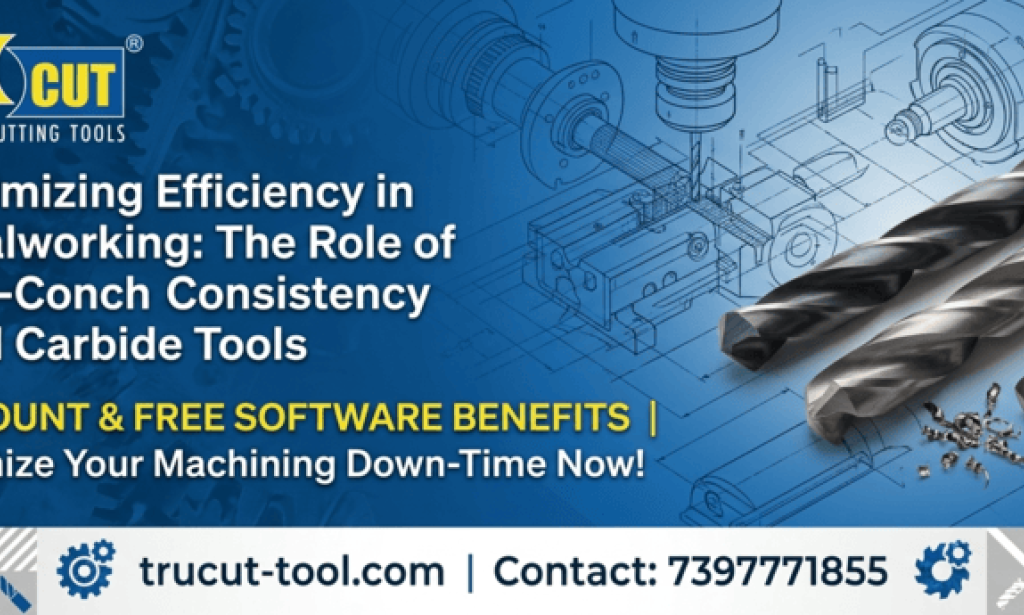
The pursuit of absolute optimization in high-precision metalworking requires an uncompromising commitment to tooling integrity. As manufacturing architectures evolve to demand tighter tolerances and accelerated cycle times, legacy tooling materials increasingly introduce vulnerability into the production line. To eliminate structural deflection, mitigate thermal stress, and sustain peak throughput, industrial machining must rely on advanced material science. High-consistency solid carbide tools represent the definitive benchmark for modern subtractive manufacturing, delivering the rigid structural baseline necessary to maximize machine uptime and yield flawless surface finishes.
The Core Physics of High-Consistency Solid Carbide Tools
Solid carbide is not a uniform commodity; it is a highly engineered composite material consisting of tungsten carbide grains bound together within a cobalt matrix. The performance consistency of these tools hinges entirely on microstructural uniformity. Premium solid carbide tools utilize sub-micron and ultra-fine grain configurations, which dramatically increase the density of the grain boundaries. This microstructural refinement prevents the propagation of micro-cracks under intense mechanical strain.
Standard tooling often suffers from macro-porosity or uneven cobalt distribution, leading to premature catastrophic failure during heavy roughing operations. High-consistency manufacturing ensures that the cobalt binder is perfectly dispersed, neutralizing localized stress concentration points. The resulting material profile exhibits exceptional hot hardness—the capacity to retain structural integrity at temperatures exceeding 900°C—allowing operators to push cutting parameters far beyond the limits of conventional high-speed steel (HSS).
Strategic Milling Architecture with the Carbide End Mill Cutter
Multi-axis milling operations demand tooling that can withstand severe cyclic loading while maintaining dimensional stability. The deployment of a premium Carbide End Mill Cutter is critical when executing complex trochoidal milling paths or high-efficiency milling (HEM) strategies. Because these cutters feature an exceptionally high modulus of elasticity, they resist the lateral deflection that typically compromises wall straightness in deep pocketing applications.
[Tool Material Comparison: Modulus of Elasticity & Hot Hardness]
Standard HSS: ████ 210 GPa | Retains hardness up to ~550°C
Premium Carbide: ██████████████ 600 GPa | Retains hardness up to ~950°C
To maximize metal removal rates (MRR), the geometry of the cutter must match the specific kinematics of the workpiece material. High-consistency end mills incorporate variable helix angles and unequal index spacing. This intentional asymmetry disrupts the harmonic frequencies generated during high-speed cutting, effectively dampening chatter. By eliminating harmonic resonance, the cutter maintains continuous, stable contact with the material, which drastically reduces micro-chipping along the peripheral cutting edges and extends predictable tool life.
Engineered Holemaking Excellence via Carbide Drills
Holemaking represents one of the most stressful phases of subtractive manufacturing due to the enclosed environment of the cutting zone. Evacuating chips from a deep cavity while managing heat accumulation requires highly specialized Carbide Drills. Unlike articulated or indexable drilling systems, solid carbide construction provides a continuous, rigid backbone from the shank to the point, eliminating the structural play that causes hole angularity errors.
Modern high-consistency drilling geometry utilizes advanced point designs, such as four-facet or pyramid points, which prevent the drill from walking upon initial contact with the workpiece. This eliminates the operational need for spot drilling, removing a cycle step and saving valuable production time. Furthermore, the integration of polished, flow-optimized internal coolant channels ensures that high-pressure cutting fluid is delivered directly to the cutting lips. This constant fluid delivery cools the primary shear zone instantly and forces chips up the flutes smoothly, preventing the catastrophic packing failures common in high-depth-to-diameter ratios.
Achieving Sub-Micron Accuracy with Precision Cutting Tools
In sectors like aerospace, medical device fabrication, and automotive engineering, component specifications leave zero margin for dimensional drift. Adhering to these strict quality thresholds requires the deployment of verified Precision Cutting Tools. The operational accuracy of a tool is determined by its total indicated runout (TIR) and its edge preparation.
High-consistency manufacturing keeps tool runout below three microns, ensuring that every cutting edge shares the structural load equally during rotation. If runout exceeds this threshold, a single flute bears the brunt of the impact force, accelerating wear and degrading surface quality. Additionally, precision edge conditioning—the microscopic rounding or chamfering of the cutting edge—strengthens the tool's geometry. This prevents the delicate edge from chipping under heavy loads, translating directly to mirror-like surface finishes and highly repeatable part dimensions over long production runs.
Tailored Machining Solutions from a Carbide Special Tool Manufacturer
Standard off-the-shelf tooling portfolios frequently fall short when dealing with highly complex component geometries, difficult-to-machine superalloys, or consolidated cycle configurations. Partnering with an expert Carbide Special Tool Manufacturer allows operations to transcend standard design constraints. Custom-engineered tooling consolidates multiple machining operations into a single specialized asset, such as a stepped drill-and-chamfer tool or a custom profile relief cutter.
Traditional Process: [Drill Process] ➔ [Tool Change] ➔ [Chamfer Process] (Higher Cycle Time)
Optimized Process: [Custom Step Tool: Drill & Chamfer Simultaneously] (Lower Cycle Time)
By consolidating operations, shops eliminate multiple tool changes and minimize the cumulative alignment errors that occur when shifting between different assets. A specialized manufacturer tailors the substrate grain size, cobalt content, and specific PVD (Physical Vapor Deposition) or CVD (Chemical Vapor Deposition) coatings to match the exact thermal and mechanical properties of the target material—whether it is abrasive carbon fiber laminates, gummy titanium alloys, or hardened tool steels.
Systemic Integration for Ultimate Shop Floor Efficiency
Transitioning to high-consistency solid carbide tooling requires a systemic approach across the entire machining ecosystem. To unlock the full performance potential of these advanced instruments, rigid machine setups and high-precision tool holding systems are mandatory. Using a premium carbide tool within a worn, standard collet chuck introduces mechanical runout that undermines the tool's inherent balance.
Operations should pair high-consistency carbide tools with hydraulic expansion chucks or shrink-fit holders. These holding technologies provide excellent gripping torque and near-zero runout, securing the tool firmly. When the tool is held rigidly, shops can safely implement aggressive cutting parameters—elevating surface footage and feed per tooth—to dramatically compress production schedules while keeping tool wear entirely predictable.
Advanced Troubleshooting and Failure Prevention
Even the highest quality carbide substrates will fail prematurely if subjected to improper operational parameters. Understanding the visual cues of tool wear allows production teams to adjust parameters before catastrophic failure damages the workpiece.
|
Wear Type |
Primary Root Cause |
Remedial Action |
|
Flank Wear |
Normal abrasive friction from prolonged use. |
Monitor tool life metrics; optimize coating selection. |
|
Crater Wear |
Extreme thermal exposure on the rake face. |
Increase coolant pressure; reduce cutting velocity ($V_c$). |
|
Thermal Cracking |
Severe thermal shock from interrupted coolant application. |
Switch to dry machining or ensure high-volume continuous flow. |
|
Chipping |
Mechanical overloading or excessive system harmonics/chatter. |
Reduce feed per tooth ($f_z$); verify setup rigidity. |
Frequently Asked Questions
What differentiates high-consistency solid carbide from standard high-speed steel (HSS)?
Solid carbide features a modulus of elasticity roughly three times higher than HSS, yielding immense structural rigidity. This allows carbide tools to resist deflection under heavy loads, maintain exceptional hardness at elevated operating temperatures, and run at cutting speeds up to four to five times faster than HSS counterparts.
How does variable helix geometry reduce harmonic chatter during milling?
Variable helix angles and unequal index spacing alter the timing of the cutting edges hitting the material. This variation disrupts the rhythmic cutting frequencies, stopping harmonic resonance before it can turn into chatter. The result is a much smoother cut and reduced stress on the machine spindle.
Why is tool runout (TIR) so critical when using micro-grain carbide tools?
Because solid carbide is highly rigid, it is less forgiving of uneven force distribution than more flexible materials. If a tool has poor runout, one flute will take a deeper cut than the others, leading to rapid, uneven wear, chipped edges, and poor surface finishes.
When should a machine shop consider custom tooling over standard catalog items?
Custom tooling from a specialized manufacturer makes sense when you need to combine multiple operations (like drilling, counterboring, and chamfering) into a single tool step, or when you are working with complex geometries that would otherwise require multiple tool changes and setups.
What coatings are best suited for high-temperature carbide machining?
For high-temperature applications, Titanium Aluminum Nitride (TiAlN) or Aluminum Titanium Nitride (AlTiN) coatings are excellent choices. These coatings form a protective aluminum oxide layer at high heat, which insulates the carbide substrate and protects it from thermal degradation.

You must be logged in to post a comment.