
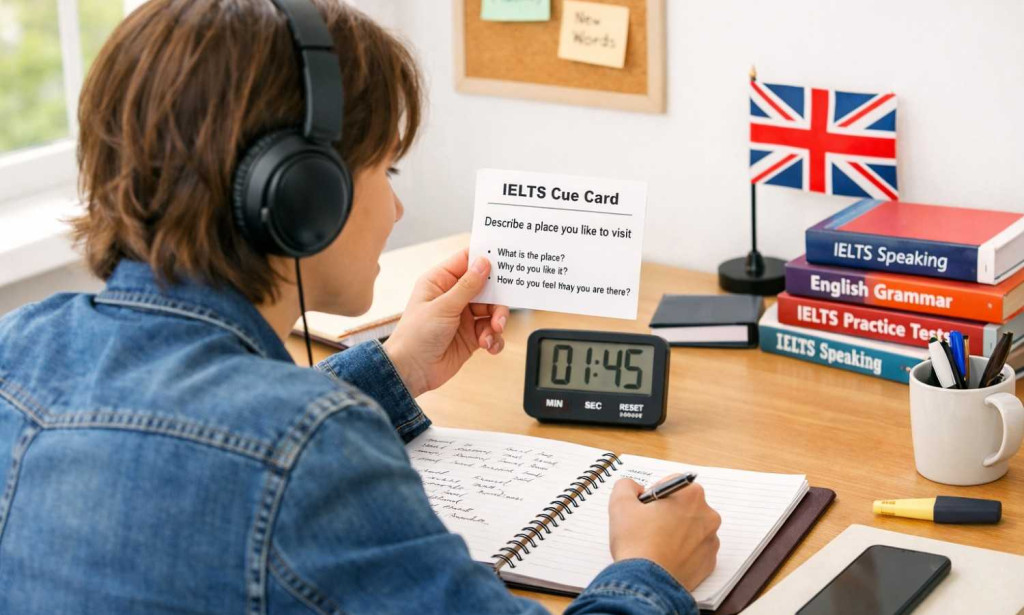
Writing clear answers in IELTS speaking cue cards can help improve speaking fluency and confidence. Many test takers know what they want to say, but they often struggle to arrange their ideas in the correct order. A well-organized answer sounds natural and easy to understand.
In the IELTS Speaking test, cue cards are part of Speaking Part 2. The examiner gives a topic card with a few points to discuss. You usually get one minute to prepare and about two minutes to speak. Good organization can help you continue speaking without long pauses.
One simple way to improve performance in IELTS speaking cue cards is by following a fixed answer structure. This helps you stay focused and avoid missing important points.
Understand the Cue Card Properly
Before speaking, read the cue card carefully. Most cue cards contain a topic and three or four bullet points. These points guide your answer.
For example, a cue card may ask you to describe a memorable journey. The bullet points may include:
- Where you went
- Who you traveled with
- What you did there
- Why it was memorable
These points already create a basic structure for your answer. Following them in order makes your response more organized.
Use a Simple Introduction
Start with a short introduction to the topic. This helps you begin speaking naturally.
For example:
“I would like to talk about a trip I took with my family last year.”
A simple opening sentence gives direction to the answer. In IELTS speaking cue cards, long introductions are not necessary. Short and clear openings work better.
Follow the Bullet Points Step by Step
The easiest way to organize answers is by following the bullet points one by one. This keeps your ideas connected and helps you speak continuously.
You can speak about:
- The place
- The people
- The activities
- Your feelings or opinion
This method is useful because the examiner can easily follow your response. It also reduces confusion during speaking.
Many students perform better in IELTS speaking cue cards when they avoid jumping between ideas.
Use Linking Words Naturally
Linking words help connect ideas smoothly. They make answers sound more fluent and organized.
Some easy linking words include:
- First
- After that
- Then
- Later
- Finally
- Because
- Also
For example:
“First, we visited the local market. After that, we went to a famous museum.”
Simple linking words improve the flow of answers in IELTS speaking cue cards without making the language complicated.
Add Small Details and Examples
Good answers are not only organized but also detailed. Small details make your answer more interesting.
Instead of saying:
“I visited a beach.”
You can say:
“I visited a quiet beach near Goa where we watched the sunset in the evening.”
Adding details helps increase speaking time naturally. It also shows better vocabulary and communication skills.
In IELTS speaking cue cards, examples and personal experiences make answers sound more real and natural.
Use the Past, Present, or Future Correctly
The cue card topic decides which tense you should use. If the topic is about a past event, use the past tense. If it is about future plans, use future forms.
For example:
- Past: “I visited Jaipur last summer.”
- Present: “I usually spend time reading books.”
- Future: “I plan to study abroad next year.”
Using the correct tense makes answers clearer and more accurate.
Make Short Notes During Preparation Time
You get one minute to prepare before speaking. Use this time wisely.
Do not write full sentences. Instead, note down keywords.
For example:
- Trip to Manali
- Friends
- Snowfall
- Local food
- Fun experience
These notes can help you remember ideas while speaking. Short notes are very helpful in IELTS speaking cue cards because they reduce nervousness and improve confidence.
Keep the Answer in a Logical Order
A logical answer is easier to understand. Try to speak in a natural sequence.
For example:
- Introduce the topic
- Explain the situation
- Add details
- Share feelings or results
This structure works for most IELTS speaking cue cards topics.
Random ideas can make answers confusing. Organized responses sound more fluent even when simple language is used.
Avoid Memorized Answers
Some students try to memorize full answers. This often sounds unnatural during the test.
Instead, focus on understanding common topics and practicing simple structures. Natural speaking is more effective than memorized lines.
Examiners usually notice when answers sound rehearsed. In IELTS speaking cue cards, clear communication is more important than difficult vocabulary.
Practice Speaking With a Timer
Practice can improve answer organization. Use a timer while practicing cue cards at home.
Try this method:
- 1 minute for preparation
- 2 minutes for speaking
This helps you manage time better during the real test.
Recording your answers can also help you notice mistakes and improve speaking flow.
Stay Calm and Continue Speaking
It is normal to forget a point while speaking. If this happens, continue talking calmly.
You can explain another detail, describe your feelings, or talk about related experiences. The goal is to keep speaking naturally.
Confidence and smooth communication are important in IELTS speaking cue cards.

You must be logged in to post a comment.