
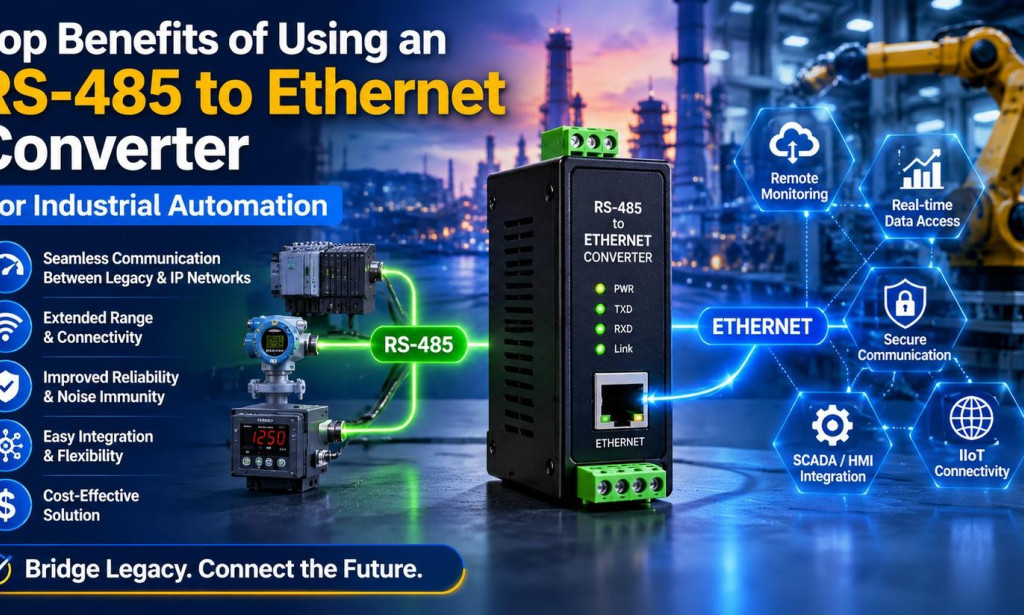
Industrial automation is rapidly evolving with the adoption of smart technologies, IoT devices, and advanced communication systems. Modern industries require reliable, fast, and long-distance communication between machines, sensors, PLCs, and monitoring systems. This is where an RS-485 to Ethernet Converter becomes an essential component in industrial networks.
An RS-485 to Ethernet Converter allows industries to connect traditional serial communication devices to modern Ethernet-based networks. It bridges the gap between legacy industrial equipment and advanced networking infrastructure, enabling seamless data transmission and remote monitoring.
In this blog, we will explore the top benefits of using an RS-485 to Ethernet Converter for industrial automation and why industries are increasingly adopting this technology.
What is an RS-485 to Ethernet Converter?
An RS-485 to Ethernet Converter is a networking device that converts RS-485 serial signals into Ethernet signals. It enables industrial devices using RS-485 communication protocols to communicate over LAN, WAN, or the internet through Ethernet networks.
These converters are commonly used in:
-
Industrial automation systems
-
Smart factories
-
Building automation
-
Energy management systems
-
SCADA systems
-
Remote monitoring applications
-
IoT and M2M communication
They help industries modernize their infrastructure without replacing existing RS-485 devices.
Top Benefits of Using an RS-485 to Ethernet Converter
1. Enables Long-Distance Communication
One of the biggest advantages of RS-485 communication is its ability to transmit data over long distances. When integrated with Ethernet networks, industries can achieve even greater communication flexibility.
Benefits include:
-
Reliable data transmission across large industrial facilities
-
Stable communication in noisy industrial environments
-
Reduced signal loss over long cable lengths
-
Improved communication between remote devices
This makes RS-485 to Ethernet Converters ideal for factories, warehouses, power plants, and oil & gas industries.
2. Supports Remote Monitoring and Control
Industrial automation relies heavily on real-time monitoring and remote access. An RS-485 to Ethernet Converter allows operators to monitor industrial devices remotely through Ethernet networks or cloud-based systems.
Advantages include:
-
Real-time equipment monitoring
-
Faster troubleshooting
-
Reduced downtime
-
Remote maintenance capabilities
-
Improved operational efficiency
Engineers and technicians can manage systems from centralized control rooms or even remote locations.
3. Cost-Effective Industrial Networking Solution
Replacing legacy RS-485 devices with modern Ethernet-enabled equipment can be expensive. An RS-485 to Ethernet Converter offers a highly affordable alternative.
Instead of replacing existing machines, industries can:
-
Upgrade communication infrastructure
-
Extend equipment lifespan
-
Reduce hardware replacement costs
-
Minimize installation expenses
This makes it a budget-friendly solution for small and large industries alike.
4. Easy Integration with Existing Systems
Many industrial environments still use RS-485-based devices such as PLCs, sensors, meters, and controllers. An RS-485 to Ethernet Converter allows these devices to integrate seamlessly into Ethernet networks without major modifications.
Key integration benefits include:
-
Compatibility with existing industrial equipment
-
Quick deployment
-
Minimal configuration requirements
-
Easy network expansion
This simplifies the transition toward Industry 4.0 and smart manufacturing.
5. Improves Data Transmission Reliability
Industrial environments often experience electrical noise, interference, and harsh operating conditions. RS-485 communication is known for its excellent noise immunity and reliable data transfer.
When combined with Ethernet technology, industries gain:
-
Stable communication performance
-
Reduced transmission errors
-
Better network reliability
-
Continuous industrial operations
This reliability is critical for mission-critical automation systems.
6. Supports Multiple Industrial Devices
RS-485 networks support multi-drop communication, allowing multiple devices to connect on the same communication line.
With an RS-485 to Ethernet Converter, industries can:
-
Connect multiple sensors and controllers
-
Simplify wiring infrastructure
-
Reduce cable clutter
-
Improve network scalability
This is especially useful in large-scale industrial automation projects.
7. Enhances Industrial IoT Connectivity
The Industrial Internet of Things (IIoT) is transforming manufacturing and automation. However, many industrial devices still operate on serial communication protocols.
An RS-485 to Ethernet Converter enables legacy devices to become part of modern IoT ecosystems by connecting them to Ethernet and cloud platforms.
Benefits for IIoT include:
-
Real-time data collection
-
Cloud integration
-
Smart analytics
-
Predictive maintenance
-
Improved decision-making
Industries can modernize operations without replacing older equipment.
8. High-Speed Data Communication
Ethernet networks provide faster data communication compared to traditional serial communication systems. By using an RS-485 to Ethernet Converter, industries can improve communication speed and efficiency.
This helps with:
-
Faster response times
-
Efficient process automation
-
Real-time industrial data transfer
-
Improved productivity
High-speed communication is essential for modern automation systems and smart factories.
9. Better Scalability for Future Expansion
Industrial operations continue to grow, and networking infrastructure must support future expansion. RS-485 to Ethernet Converters provide scalable communication solutions.
Industries can easily:
-
Add new devices
-
Expand automation systems
-
Integrate additional monitoring points
-
Upgrade networks over time
This flexibility supports long-term industrial growth.
10. Ideal for Harsh Industrial Environments
Industrial-grade RS-485 to Ethernet Converters are designed to operate in challenging conditions.
Features often include:
-
Wide operating temperature range
-
Metal housing
-
Surge protection
-
IP-rated protection
-
DIN-rail mounting support
These features ensure reliable operation in factories, power plants, transportation systems, and outdoor installations.
Common Applications of RS-485 to Ethernet Converters
RS-485 to Ethernet Converters are widely used in various industries, including:
Manufacturing Automation
Connect PLCs, HMIs, and industrial sensors for centralized monitoring.
Smart Energy Systems
Enable communication between smart meters and energy management systems.
Building Automation
Integrate HVAC systems, lighting controls, and security systems.
Water Treatment Plants
Monitor pumps, valves, and industrial controllers remotely.
Transportation Systems
Support communication in railway, traffic, and toll management systems.
Oil & Gas Industry
Enable remote monitoring of field equipment in harsh environments.
Key Features to Look for in an RS-485 to Ethernet Converter
When selecting an industrial-grade converter, consider the following features:
-
High-speed Ethernet connectivity
-
Dual serial ports
-
Surge and isolation protection
-
Industrial-grade metal enclosure
-
Wide voltage input range
-
DIN-rail mounting
-
TCP/IP protocol support
-
Remote configuration support
-
Wide temperature operation
Choosing the right converter ensures better reliability and long-term performance.
Conclusion
An RS-485 to Ethernet Converter plays a crucial role in modern industrial automation by bridging legacy serial communication systems with modern Ethernet networks. It provides cost-effective connectivity, reliable long-distance communication, remote monitoring capabilities, and seamless integration with industrial IoT systems.
As industries continue adopting smart manufacturing and Industry 4.0 technologies, the demand for high-performance and affordable RS-485 to Ethernet Converters will continue to grow.
Whether you operate a manufacturing plant, energy system, smart building, or automation project, investing in the right RS-485 to Ethernet Converter can significantly improve operational efficiency, scalability, and network reliability.

You must be logged in to post a comment.