
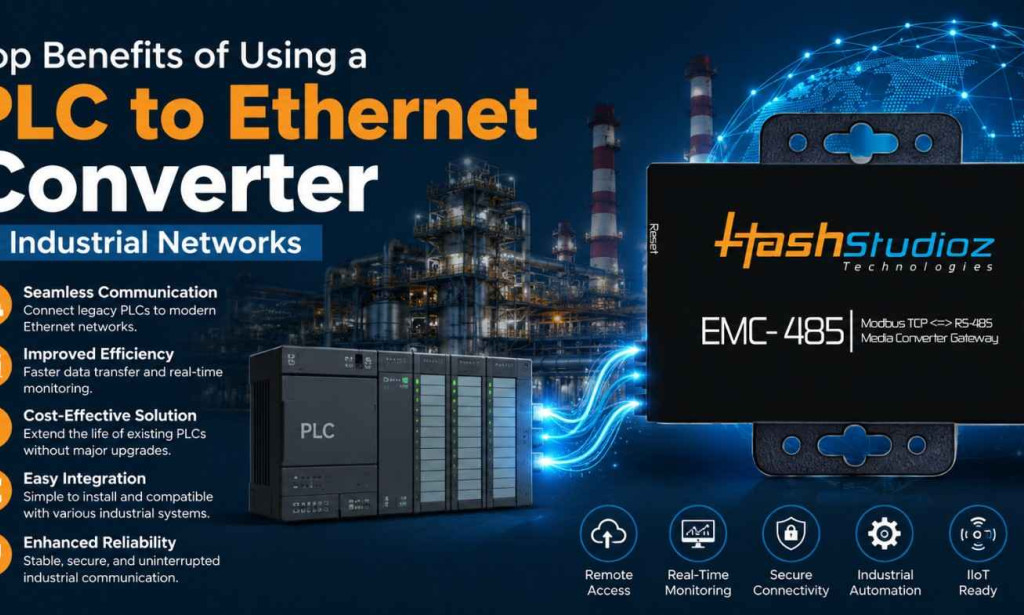
Industrial automation has evolved significantly over the last decade, with manufacturers increasingly adopting Industrial Internet of Things (IIoT), Industry 4.0, and smart factory technologies. However, many factories still rely on legacy Programmable Logic Controllers (PLCs) that communicate using serial interfaces such as RS-232 or RS-485. While these PLCs remain reliable, integrating them with modern Ethernet-based industrial networks can be challenging.
This is where a PLC to Ethernet Converter becomes an essential networking device. It bridges the gap between traditional PLC communication protocols and Ethernet networks, allowing older equipment to communicate seamlessly with SCADA systems, Human Machine Interfaces (HMIs), cloud platforms, and remote monitoring applications.
What is a PLC to Ethernet Converter?
A PLC to Ethernet Converter is an industrial communication device that converts serial data from a PLC into Ethernet packets. This enables PLCs that use RS-232 or RS-485 communication to connect to Ethernet-based LANs, WANs, or industrial IoT networks.
Instead of replacing existing PLC hardware, manufacturers can extend its capabilities by integrating it into modern Ethernet infrastructures.
Why Industries Need PLC to Ethernet Converters
Many manufacturing plants continue to operate legacy PLC systems because they are reliable, cost-effective, and designed for long operational lifespans. However, these systems often lack Ethernet connectivity, making integration with modern automation software difficult.
A PLC to Ethernet Converter helps organizations:
-
Connect legacy PLCs to Ethernet networks
-
Enable real-time monitoring
-
Support remote maintenance
-
Integrate with SCADA and HMI systems
-
Reduce equipment replacement costs
-
Prepare for Industry 4.0 initiatives
How Does a PLC to Ethernet Converter Work?
The converter acts as a communication bridge.
Step 1
The PLC sends data through its serial communication interface (RS-232 or RS-485).
Step 2
The converter receives the serial data.
Step 3
It converts the serial protocol into Ethernet packets.
Step 4
The Ethernet network transmits the data to:
-
SCADA software
-
Industrial PCs
-
HMIs
-
Cloud platforms
-
Remote monitoring applications
The reverse communication follows the same process, allowing two-way communication between Ethernet devices and PLCs.
Top Benefits of Using a PLC to Ethernet Converter in Industrial Networks
1. Connect Legacy PLCs to Modern Ethernet Networks
One of the biggest advantages is extending the life of existing PLCs.
Instead of replacing expensive controllers, industries can simply install a PLC to Ethernet Converter and immediately enable Ethernet communication.
This minimizes capital investment while modernizing factory communication.
2. Enables Remote Monitoring
Industrial engineers no longer need to remain physically present near the PLC.
With Ethernet connectivity, operators can monitor:
-
Machine status
-
Production data
-
Alarm conditions
-
Process variables
-
Equipment health
Remote monitoring improves operational efficiency and reduces response times.
3. Supports SCADA Integration
Modern manufacturing plants rely heavily on SCADA systems for centralized control.
A PLC to Ethernet Converter allows legacy PLCs to communicate with SCADA software, enabling:
-
Centralized monitoring
-
Historical data logging
-
Alarm management
-
Production reporting
-
Process optimization
4. Improves Industrial Network Flexibility
Serial communication is typically limited by cable length and point-to-point connections.
Ethernet offers:
-
Longer communication distances
-
Easier network expansion
-
Multi-device connectivity
-
High-speed communication
-
Simplified infrastructure
This flexibility allows factories to scale operations without replacing existing PLCs.
5. Reduces Installation Costs
Replacing an entire PLC system is expensive.
Costs may include:
-
New PLC hardware
-
Software upgrades
-
Installation
-
Programming
-
Employee training
-
Production downtime
Using a PLC to Ethernet Converter avoids these expenses by upgrading communication capabilities instead of replacing equipment.
6. Enables Industry 4.0 Implementation
Industry 4.0 depends on connected machines and intelligent data exchange.
A PLC to Ethernet Converter helps industries:
-
Connect legacy equipment
-
Collect real-time production data
-
Enable predictive maintenance
-
Support IoT platforms
-
Improve operational visibility
It acts as a bridge between traditional automation systems and smart manufacturing technologies.
7. High-Speed Data Communication
Traditional serial communication is significantly slower than Ethernet.
Ethernet offers:
-
Faster data transmission
-
Lower communication delays
-
Better network performance
-
Improved synchronization between devices
This results in quicker response times and more efficient production processes.
8. Supports Multiple Industrial Protocols
Many industrial Ethernet converters support widely used protocols such as:
-
Modbus TCP
-
Modbus RTU
-
Ethernet/IP
-
PROFINET
-
TCP/IP
-
UDP
This compatibility makes integration easier across different industrial automation systems.
9. Enhances Remote Maintenance
Maintenance teams can troubleshoot PLCs remotely using Ethernet connectivity.
Benefits include:
-
Faster fault diagnosis
-
Reduced travel costs
-
Lower machine downtime
-
Quick software updates
-
Improved maintenance efficiency
Remote access is especially valuable for factories operating multiple production sites.
10. Improves Production Efficiency
Real-time communication between PLCs and automation software improves decision-making.
Benefits include:
-
Faster process monitoring
-
Better machine utilization
-
Reduced downtime
-
Improved production planning
-
Higher operational efficiency
Factories gain greater visibility into production performance.
11. Simplifies Network Expansion
As manufacturing facilities grow, adding new equipment becomes easier with Ethernet.
Instead of installing additional serial communication infrastructure, organizations can simply connect new devices to the existing Ethernet network.
This simplifies future expansion.
12. Increases Equipment Lifespan
Legacy PLCs often continue operating reliably for decades.
A PLC to Ethernet Converter protects existing investments by extending the usefulness of older equipment without compromising compatibility with modern automation technologies.
13. Supports Cloud Connectivity
Cloud-based industrial platforms are becoming increasingly popular.
Ethernet-connected PLCs can transmit data to cloud applications for:
-
Data analytics
-
Predictive maintenance
-
Energy monitoring
-
Production reporting
-
AI-driven automation
This enables smarter business decisions through real-time industrial data.
14. Improves Industrial Cybersecurity
Modern industrial Ethernet converters often include advanced security features such as:
-
User authentication
-
Secure remote access
-
Firewall support
-
VPN compatibility
-
Access control
These features help protect industrial communication networks from unauthorized access and cyber threats.
15. Easy Installation and Configuration
Most PLC to Ethernet Converters are designed for quick deployment.
Common features include:
-
DIN rail mounting
-
Plug-and-play configuration
-
Web-based management interface
-
LED status indicators
-
Industrial-grade power inputs
This reduces installation time and minimizes production interruptions.
Applications of PLC to Ethernet Converters
PLC to Ethernet Converters are used across numerous industries, including:
-
Manufacturing plants
-
Oil and gas facilities
-
Water treatment plants
-
Food and beverage processing
-
Pharmaceutical manufacturing
-
Automotive production
-
Energy and utilities
-
Smart factories
-
Building automation
-
Warehouse automation
Key Features to Consider Before Buying
When selecting a PLC to Ethernet Converter, look for:
-
RS-232 and RS-485 compatibility
-
Industrial-grade design
-
Wide operating temperature range
-
Modbus TCP/RTU support
-
Ethernet 10/100 Mbps connectivity
-
DIN rail mounting
-
Surge and isolation protection
-
Secure remote access
-
Multiple serial ports
-
Low power consumption
Choosing the right features ensures reliable performance in demanding industrial environments.
Conclusion
A PLC to Ethernet Converter is an essential solution for industries looking to modernize their automation infrastructure without replacing existing PLC systems. By enabling seamless communication between legacy serial-based PLCs and modern Ethernet networks, these converters help improve operational efficiency, support remote monitoring, simplify SCADA integration, and prepare factories for Industry 4.0.
Whether you're upgrading an existing production line or building a smart factory, investing in a reliable PLC to Ethernet Converter can reduce costs, extend equipment lifespan, and enhance overall network performance.
As industrial automation continues to evolve, Ethernet connectivity is no longer a luxury—it's a necessity. A PLC to Ethernet Converter provides a practical and cost-effective path toward smarter, more connected industrial operations.

You must be logged in to post a comment.