

Albert Einstein: The Whole Package
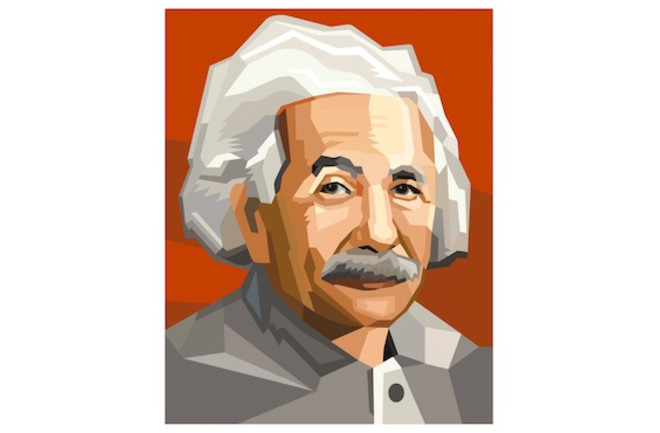
A crowd barged past dioramas, glass displays, and wide-eyed security guards in the American Museum of Natural History. Screams rang out as some runners fell and were trampled. Upon arriving at a lecture hall, the mob broke down the door. The date was Jan. 8, 1930, and the New York museum showed a film about Albert Einstein and his general theory of relativity. Einstein was not present, but 4,500 mostly ticketless people still showed up for the viewing. Museum officials told them “no ticket, no show,” setting the stage for, in the words of the Chicago Tribune, “the first science riot in history.”
Such was Einstein’s popularity. As a publicist might say, he was the whole package: distinctive look (untamed hair, rumpled sweater), witty personality (his quips, such as God not playing dice, would live on), and major scientific cred (his papers upended physics). Time magazine named him Person of the Century.
“Einstein remains the last, and perhaps only, physicist ever to become a household name,” says James Overduin, a theoretical physicist at Towson University in Maryland.
Born in Ulm, Germany, in 1879, Einstein was a precocious child. As a teenager, he wrote a paper on magnetic fields. (Einstein never actually failed math, contrary to popular lore.) He married twice, the second time to his first cousin, Elsa Löwenthal. The marriage lasted until she died in 1936.
As a scientist, Einstein’s watershed year was 1905, when he worked as a clerk in the Swiss Patent Office, failing to attain an academic position after earning his doctorate. That year he published his four most important papers. One of them described the relationship between matter and energy, neatly summarized.
E = mc2 formula.
Einstein expanded on relativity in 1916 with his theory of gravitation: general relativity. It holds that anything with mass distorts the fabric of space and time, just as a bowling ball placed on a bed causes the mattress to sag. During a solar eclipse in 1919, astronomers showed that the sun’s mass did indeed bend the path of starlight. (The temporary darkness around the sun enabled astronomers to chronicle the bending.) The validation made Einstein a superstar.
Two years later, Einstein won the Nobel Prize in Physics, not for general relativity, but for discovering the photoelectric effect. By this time, the 42-year-old physicist had made most of his major contributions to science.
In 1933, Einstein accepted a professorship at the Institute for Advanced Study in Princeton, N.J., where he tried (unsuccessfully) to unify the laws of physics for years. He became a U.S. citizen in 1940, and his fame grew as a public intellectual, civil rights supporter, and pacifist.
Marie Curie: She Went Her Way

When Curie and her three sisters finished regular schooling, they couldn’t pursue higher education like their brother. The local university didn’t let women enroll, and their families didn’t have the money to send them abroad. Their only options were to marry or become governesses. Curie and her sister Bronislawa found another way.
Eventually, the sisters hatched a plan to help them get the higher education they so desperately wanted. Curie would work as a governess and support Bronislawa’s medical school studies. Then, Bronislawa would return the favor once she was established. Curie endured years of misery as a governess, but the plan worked. In 1891, she packed her bags and headed to Paris and her bright future.
At the University of Paris, Curie was inspired by French physicist Henri Becquerel. In 1896, he discovered that uranium emitted something that looked an awful lot like — but not quite the same as — X-rays, which had been discovered only the year before. Intrigued, Curie decided to explore uranium and its mysterious rays as a Ph.D. thesis topic.
Around the same time, Curie met and married her French husband, Pierre, an accomplished physicist who abandoned his work and joined his wife’s research. The two started examining minerals containing uranium and pitchblende, a uranium-rich ore, and realized the latter was four times more radioactive than pure uranium. They reasoned some other element must be in the mix, sending those radioactive levels through the roof. And they were right: After processing literally tons of pitchblende, they discovered a new element and named it polonium, after Marie’s native Poland.
They published a paper in July 1898, revealing the find. And just five months later, they announced their discovery of yet another element, radium, found in trace amounts in uranium ore.
In 1903, Curie, her husband, and Becquerel won the Nobel Prize in Physics for their work on radioactivity, making Curie the first woman to win a Nobel.
Tragedy struck just three years later. Pierre, who had recently accepted a professorship at the University of Paris, died suddenly after a carriage accident. Curie was devastated by his death.
Curie racked up several other accomplishments, from founding the Radium Institute in Paris where she directed her lab (whose researchers won their Nobels) to head up France’s first military radiology center during World War I and thus becoming the first medical physicist.
Isaac Newton: The Man Who Defined Science on a Bet

Isaac Newton was born on Christmas Day, 1642. Never the humble sort, he would have found the date apt: The gift to humanity and science had arrived. A sickly infant, his mere survival was an achievement. Just 23 years later, with his alma mater Cambridge University and much of England closed due to the plague, Newton discovered the laws that now bear his name. (He had to invent a new kind of math along the way: calculus.) The introverted English scholar held off on publishing those findings for decades, though. It took the Herculean efforts of friend and comet discoverer Edmund Halley to get Newton to publish. The only reason Halley knew of Newton’s work? A bet the former had with other scientists on the nature of planetary orbits. When Halley mentioned the orbital problem to him, Newton shocked his friend by answering immediately, having long ago worked it out.
Halley persuaded Newton to publish his calculations, and the results were the Philosophiæ Naturalis Principia Mathematica, or just the Principia, in 1687. Not only did it describe for the first time how the planets moved through space and how projectiles on Earth traveled through the air, but the Principia also showed that the same fundamental force, gravity, governs both. Newton united the heavens and the Earth with his laws. Thanks to him, scientists believed they had a chance to unlock the universe’s secrets.
Charles Darwin: Delivering the Evolutionary Gospel

Charles Darwin would not have been anyone’s first guess for a revolutionary scientist.
As a young man, his main interests were collecting beetles and studying geology in the countryside, occasionally skipping out on his classes at the University of Edinburgh Medical School to do so. It was a chance invitation in 1831 to join a journey around the world that would make Darwin, who had once studied to become a country parson, the father of evolutionary biology.
Darwin’s observations pushed him to a disturbing realization — the Victorian-era theories of animal origins were all wrong. Most people in Darwin’s time still adhered to creationism, the idea that a divine being was responsible for the diversity of life we find on Earth.
Darwin’s observations implied a completely different process. He noticed small differences between members of the same species that seemed to depend upon where they lived. The finches of the Galapagos are the best-known example: From island to island, finches of the same species possessed differently shaped beaks, each adapted to the unique sources of food available on each island.
This suggested that species could change — already a divisive concept back then — and that the changes were driven purely by environmental factors instead of divine intervention. Today, we call this natural selection.
Darwin also married his first cousin, Emma Wedgwood, during this time. They had 10 children, and by all accounts, Darwin was an engaged and loving father, encouraging his children’s interests and taking time to play with them. This was a level of attention uncommon among fathers at that time — to say nothing of eminent scientists.
His observations and musings eventually coalesced into the tour de force that was On the Origin of Species, published in 1859 when Darwin was 50 years old. The 500-page book sold out immediately, and Darwin would go on to produce six editions, each time adding to and refining his arguments.
Nikola Tesla: Wizard of the Industrial Revolution

Nikola Tesla grips his hat in his hand. He points his cane toward Niagara Falls and beckons bystanders to turn their gaze to the future. This bronze Tesla — a statue on the Canadian side — stands atop an induction motor, the type of engine that drove the first hydroelectric power plant.
Tesla is perhaps best known for his eccentric genius. He once proposed a system of towers that he believed could pull energy from the environment and transmit signals and electricity around the world wirelessly. But his theories were unsound, and the project was never completed. He also claimed he had invented a “death ray.”
Finally, Thanks for reading.

You must be logged in to post a comment.