
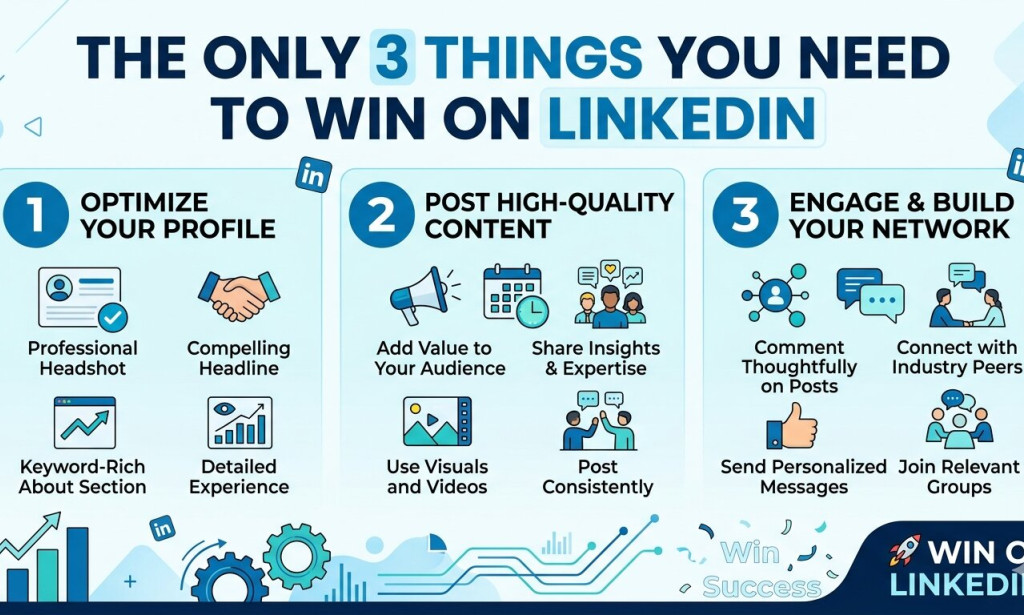
🚀 The Only 3 Things You Need to Win on LinkedIn
LinkedIn has become one of the most powerful platforms for professionals, entrepreneurs, freelancers and business owners. Yet most people approach it in the wrong way. They spend hours tweaking their profiles, chasing connections and posting random content, only to see little or no growth.
The truth is that LinkedIn success is far simpler than many so-called experts make it appear. While there are countless strategies, hacks and growth tactics circulating online, nearly all successful LinkedIn users share three common characteristics.
Whether you're trying to build a personal brand, attract clients, secure a new job, generate leads or establish yourself as an industry authority, you only need three things to consistently win on LinkedIn:
- Clarity
- Consistency
- Credibility
Master these three elements, and LinkedIn becomes less of a guessing game and more of a predictable growth engine.
1. Clarity: Know Exactly What You Want to Be Known For
One of the biggest mistakes people make on LinkedIn is trying to appeal to everyone.
They post about leadership one day, artificial intelligence the next, productivity tips the day after, and then throw in personal stories for good measure. While variety can be valuable, too much randomness creates confusion.
People follow experts, not generalists.
When someone visits your profile, they should immediately understand:
- Who you are
- What you do
- Who you help
- Why they should care
Clarity is the foundation of every successful LinkedIn strategy.
Ask yourself:
- What topic do I want to be associated with?
- What expertise can I genuinely demonstrate?
- What audience do I want to attract?
The most successful creators on LinkedIn become known for specific themes. Some focus on marketing. Others focus on leadership, entrepreneurship, sales, finance or technology.
Their audiences know exactly what to expect.
This doesn't mean you must only discuss one topic forever. It simply means your content should revolve around a clear central message.
When your positioning becomes obvious, your audience grows faster because people can easily understand the value you provide.
📸 
Clarity also extends to your LinkedIn profile itself.
Your headline should communicate your value proposition, not merely your job title.
For example:
Instead of:
"Marketing Manager"
Consider:
"Helping SaaS Companies Generate More Leads Through Content Marketing"
The second example instantly tells visitors what you do and whom you help.
Your profile should function like a landing page, guiding visitors towards understanding your expertise and encouraging them to connect with you.
Without clarity, every other LinkedIn strategy becomes significantly less effective.
2. Consistency: Show Up Even When Nobody Is Watching
Most LinkedIn users quit too soon.
They post for two weeks, receive minimal engagement, become discouraged and disappear.
Meanwhile, successful LinkedIn creators understand a simple truth:
Consistency compounds.
The majority of LinkedIn growth happens after months of persistent effort, not days.
Think about how trust develops in real life.
You rarely trust someone after a single interaction. Trust is built through repeated exposure and demonstrated reliability.
LinkedIn works exactly the same way.
Every post, comment and interaction contributes to your visibility.
Over time, people begin recognising your name, your ideas and your expertise.
Eventually, opportunities start appearing.
Potential clients reach out.
Recruiters send messages.
Partnerships emerge.
Speaking invitations arrive.
But none of these outcomes happen without consistency.
Successful LinkedIn users create systems that allow them to show up regularly.
They don't rely on motivation.
Instead, they rely on habits.
For example:
- Writing content every morning
- Scheduling posts in advance
- Commenting on industry discussions daily
- Engaging with their network consistently
The goal isn't perfection.
The goal is presence.
Many people underestimate the impact of simple consistency because results often appear delayed.
However, LinkedIn rewards persistence more than brilliance.
A good creator posting consistently often outperforms a brilliant creator posting occasionally.
📸 
Another important aspect of consistency is maintaining a recognisable voice.
Your audience should become familiar with your communication style.
Whether your tone is educational, inspirational, analytical or conversational, consistency helps build familiarity.
Familiarity leads to trust.
Trust leads to opportunities.
In many cases, LinkedIn success is simply the result of staying active long enough for the market to notice.
3. Credibility: Prove What You Know
Clarity attracts attention.
Consistency builds visibility.
Credibility converts attention into influence.
Without credibility, your audience has little reason to trust your opinions.
Many people focus on appearing knowledgeable instead of demonstrating knowledge.
The difference is significant.
Credibility comes from evidence.
You can build credibility by:
- Sharing real experiences
- Publishing case studies
- Presenting data
- Discussing lessons learned
- Offering practical insights
- Showcasing results
People trust proof.
For example, if you're a consultant, don't merely say you're excellent at helping clients.
Show specific outcomes.
Explain challenges.
Describe solutions.
Share measurable improvements.
Stories are particularly powerful credibility builders.
A story about overcoming a professional challenge often creates more trust than a list of achievements.
Why?
Because stories reveal authenticity.
They show that you've experienced real-world problems and developed practical solutions.
Credibility also involves honesty.
Not every post needs to portray perfection.
In fact, discussing failures, mistakes and lessons learned can make you more relatable.
Audiences increasingly value transparency.
They prefer genuine expertise over polished self-promotion.
📸 
Another overlooked source of credibility is engagement.
Many people treat LinkedIn as a broadcasting platform.
The best performers treat it as a conversation platform.
Responding thoughtfully to comments demonstrates expertise in real time.
Participating in discussions allows others to experience your knowledge directly.
Over time, these interactions strengthen your reputation.
Credibility compounds just like consistency.
Each valuable contribution increases the likelihood that others will view you as a trusted authority.
Why Most LinkedIn Strategies Fail
Many LinkedIn strategies fail because they focus on tactics before fundamentals.
People obsess over:
- Best posting times
- Hashtag counts
- Algorithm changes
- Content formats
- Engagement tricks
While these factors may influence performance slightly, they rarely determine long-term success.
The fundamentals matter far more.
A person with:
- Clear positioning
- Consistent activity
- Strong credibility
Will almost always outperform someone relying solely on tactical shortcuts.
Think of LinkedIn as a reputation-building platform.
Reputations are not built through hacks.
They are built through repeated demonstrations of value.
That's why the three principles discussed here remain effective regardless of how the platform evolves.
Algorithms change.
Human psychology does not.
People will always pay attention to individuals who:
- Know what they stand for
- Show up consistently
- Demonstrate genuine expertise
Putting the Three Principles Together
The real magic happens when clarity, consistency and credibility work together.
Imagine a professional who:
Has a clear niche.
Posts consistently every week.
Shares practical insights backed by real experience.
Their audience immediately understands their expertise.
Their regular presence keeps them visible.
Their evidence-based content builds trust.
This combination creates momentum.
Followers grow.
Opportunities increase.
Influence expands.
Eventually, LinkedIn becomes a powerful business and career asset rather than just another social network.
📸 
Final Thoughts
Winning on LinkedIn does not require complicated systems, expensive courses or endless productivity hacks.
It requires mastering three timeless principles.
First, develop clarity so people instantly understand who you are and what value you provide.
Second, maintain consistency so your audience repeatedly encounters your ideas and expertise.
Third, build credibility by demonstrating knowledge, sharing experiences and proving results.
Everything else is secondary.
When these three elements work together, LinkedIn becomes a platform that attracts opportunities rather than one that constantly demands effort.
In a world where attention is increasingly difficult to earn, the professionals who thrive are not necessarily the loudest or the most active.
They are the ones who are clear, consistent and credible.
Master these three things, and you'll possess everything needed to win on LinkedIn for years to come.

You must be logged in to post a comment.