
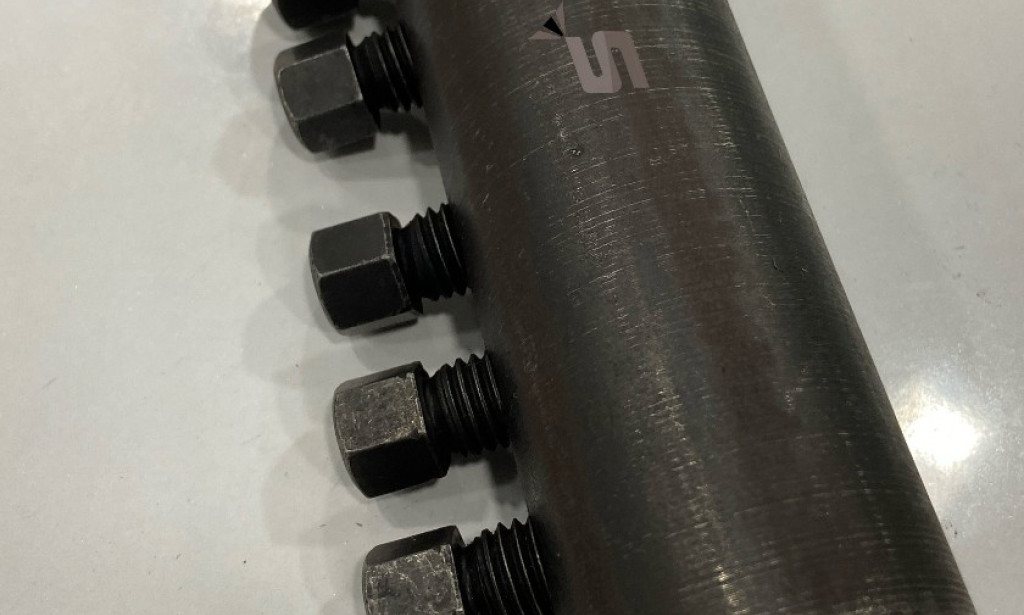
What is an MBT Coupler?
An MBT Coupler (Mechanical Bolted Coupler) is a mechanical splicing device used to join two reinforcing steel bars (rebar) end‑to‑end. Unlike traditional threaded couplers, the MBT Coupler requires neither bar end preparation (threading) nor bar rotation to effect installation.
The MBT Coupler works by clamping the rebar ends using a series of lockshear bolts that embed themselves into the bar as they are tightened. The bars are supported within the coupler by two serrated saddles, creating a tension‑ and compression‑resistant connection without any pre‑treatment of the bars – no thread cutting, no crimping, no swaging, and no welding
Why are MBT Couplers Used?
The primary reason for using MBT couplers is their ability to provide a secure connection in scenarios where traditional methods are impossible or impractical. They are the go-to solution for:
-
Fixed Bars: When bars are already cast in concrete and cannot be rotated.
-
Restricted Space: Ideal for congested reinforcement zones where threading machines cannot reach.
-
Repair and Retrofitting: Essential for connecting old reinforcement to new sections in restoration projects.
Industrial Applications
MBT couplers are utilized in critical infrastructure projects across India, including:
-
Metro Rail & Bridges: Used for pile-to-pile cap connections and viaduct segments.
-
High-Rise Buildings: Perfect for column splicing and shear walls in residential and commercial towers.
-
Energy Projects: Deployed in the construction of dams, power plants, and industrial foundations.
Technical Specifications & Information
-
Sizes: Standard range available for 12mm to 40mm diameter bars.
-
Material: Bodies are typically crafted from high-strength EN8D steel or Chromium-Molybdenum (Cr-Mo) alloy for fatigue resistance.
-
Finish: Available in plain, black, or hot-dipped galvanized finishes for corrosion protection.
-
Performance: Meets or exceeds ACI 318 and IS 16172 Type 1 and Type 2 splice requirements.
| Rebar Diameter (mm) | External Diameter (mm) | Coupler Length (mm) | Approx. Number of Bolts |
| 12 | 33.4 - 34.0 | 100 - 140 | 4 - 6 |
| 16 | 39.0 - 42.2 | 150 - 160 | 6 - 8 |
| 20 | 44.0 - 48.3 | 200 - 204 | 8 - 10 |
| 25 | 51.5 - 54.0 | 200 - 258 | 10 - 12 |
| 32 | 63.5 - 71.0 | 250 - 312 | 12 - 14 |
| 40 | 73.5 - 81.0 | 300 - 484 | 14 - 16 |
.jpg)
Advantages of Using MBT Couplers
MBT Couplers offer distinct engineering and commercial benefits:
1. Zero Bar End Preparation – No threading, no crimping, no swaging, no welding. This dramatically reduces on‑site labour and eliminates the need for specialised threading machines.
2. No Bar Rotation Required – Unlike screw‑type couplers where one bar must be rotated, MBT Couplers work even when both bars are fixed in place – ideal for repair works and congested sites.
3. High Load‑Bearing Capacity – Connections achieve failure loads exceeding 115% of the parent rebar’s yield strength, meeting and often surpassing code requirements.
4. Space‑Saving Design – Eliminates lap overlaps, reducing reinforcement congestion at joints and edges. The connection is independent of local concrete strength.
5. Instant Visual Quality Check – The lockshear bolts are designed to shear off when the pre‑determined tightening torque is reached, providing an immediate visual confirmation of correct installation.
6. Versatility – Suitable for static and fatigue loading, and can join imperial, plain round, or deformed reinforcing bars of different diameters.
7. Reduced Steel Wastage – Eliminating lap overlaps significantly reduces overall steel consumption, directly lowering project costs.
8. Faster Construction Cycles – Simple, tool‑operated installation accelerates rebar placement, shortening overall project duration.
Installation Process – Step by Step
The MBT Coupler installation is remarkably simple and requires no special bar preparation:
Step 1 – Bar Cutting & Squaring
The rebar end must be clean and cut square. However, no threading or end forging is required – the MBT system accepts the bar exactly as it comes.
Step 2 – Positioning the Coupler
Place the MBT Coupler over the end of the first rebar to half the coupler length (±6 mm). Finger‑tighten the lockshear bolts onto the bar to hold it in place.
Step 3 – Inserting the Second Bar
Insert the second rebar from the opposite end until it contacts the internal centre stop inside the coupler.
Step 4 – Tightening the Bolts
Using a standard torque tool, ratchet wrench, or nut runner, tighten a series of lockshear bolts around the coupler body. As the bolts are tightened, they embed themselves into the bar, while the internal serrated saddles bite into both the bar and the coupler shell.
Step 5 – Visual Completion Confirmation
Tighten each bolt until the head shears off. The sheared head provides an instant visual indication that the correct pre‑determined torque has been reached and the installation is complete.
Installation Notes:
For couplers up to 20mm, a ratchet wrench is sufficient.
For larger couplers (25mm–40mm), a nut runner is recommended.
Impact tools (percussion tools) must NOT be used – they can damage the coupler.
Always use heavy‑duty sockets.
click here to know more : https://youtu.be/dRtAG1NtGBs?si=aWBR-_3CFW8Uhjmx
Bar Preparation for MBT Couplers
The defining advantage of the MBT system is that it requires NO bar end preparation beyond basic cleaning.
| Preparation Step | Requirement |
|---|---|
| Threading | ❌ Not required |
| Crimping | ❌ Not required |
| Swaging | ❌ Not required |
| Welding | ❌ Not required |
| End forging | ❌ Not required |
| Cleaning bar surface | ✅ Recommended (remove excess dirt/rust) |
| Square cut | ✅ Recommended (for full engagement) |
This zero‑preparation feature makes MBT Couplers ideal for repair works, retrofits, and congested construction sites where access is limited.

Essential Machines Required on Site
Because MBT Couplers require no threading or end forging, the equipment needed on site is minimal:
| Machine/Tool | Required for MBT Couplers | Notes |
|---|---|---|
| Rebar Cutting Saw | ✅ Yes | For cutting bars to required length; must produce clean, square ends |
| Threading Machine | ❌ Not required | MBT system completely eliminates threading |
| Cold Forging Machine | ❌ Not required | No bar end upsetting needed |
| Chamfering/Peeling Machine | ❌ Not required | MBT accepts bar as is |
| Torque Tool / Ratchet Wrench | ✅ Yes | For tightening lockshear bolts (up to 20mm bars) |
| Nut Runner | ✅ Recommended | For larger bars (25mm–40mm) |
| Heavy‑Duty Socket Set | ✅ Yes | For all bolt tightening operations |
| Calibration Device | Recommended | To periodically verify torque tools |
Latest Test Report: IS 16172:2023 Compliance
Under the revised IS 16172:2023 standard, MBT bolted couplers must undergo a rigorous suite of tests to ensure structural safety in India:
-
Static Tensile Test: The joint must achieve a "Bar Break" failure outside the coupler zone, reaching at least 1.25 times the yield strength of the rebar.
-
Slip Test: The relative movement (slip) between the bar and coupler must not exceed 0.10 mm under service loads.
-
Cyclic Loading: The assembly must withstand 100 cycles of stress variation without loss of capacity, which is essential for tall structures and seismic zones.
-
Fatigue Resistance: High-cycle fatigue tests (up to 2 million cycles) are mandatory for infrastructure like bridges and metro viaducts.
Locations in PAN-India Supplies:
To capture high-intent B2B leads, targeting these industrial and infrastructure hubs is essential :
-
West: Mumbai, Pune, Ahmedabad, Rajkot, Nashik.
-
North: New Delhi, Faridabad, Gurgaon, Noida, Chandigarh.
-
South: Bangalore (Peenya), Chennai, Hyderabad, Coimbatore.
-
East: Kolkata, Jamshedpur, Raipur, Bhubaneswar.
Conclusion
The MBT bolted coupler is more than just a connector; it is a strategic tool that addresses the most common construction challenges—congestion, misalignment, and speed. By adhering to the new IS 16172:2023 standards and leveraging high-grade materials, MBT manufacturers are providing the backbone for India's next generation of resilient infrastructure.

You must be logged in to post a comment.