
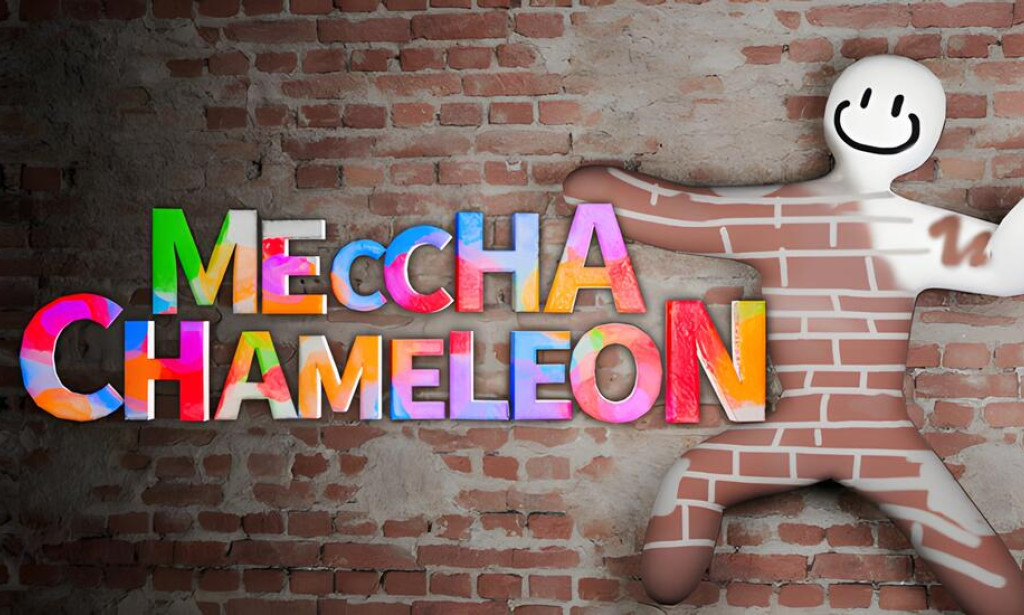
In Meccha Chameleon you start each round as a white figure on a map full of color, which matters immediately because Seekers are already memorizing the room while you are still deciding where to stand. The preparation phase is not generous. You have a limited window to travel to a position, open the paint tool, sample the surface correctly, adjust your roughness and metallic values, lock your pose, and become indistinguishable from whatever you have chosen to become. Players who treat that window casually are the first found in every round. Players who have internalized the full sequence — spot selection, eyedropper sampling, HSV adjustment, roughness calibration, pose commitment — are the ones who appear during the end-of-round reveal in positions that make the lobby collective make a noise of genuine disbelief.
The Mechanic That Separates Meccha Chameleon from Every Other Hide-and-Seek Game
Most hide-and-seek games give players a fixed map and ask them to find the cleverer corner. Meccha Chameleon replaces that with a painting system that makes your body the variable. Two players standing in the exact same position on Hide-and-Seek Mansion will produce completely different outcomes based on how well each one matched the surface. One player samples the wallpaper correctly, adjusts for the shadow across their left shoulder, matches the matte finish of the plaster, and locks a pose with their arms oriented to follow the wall's vertical lines. The other player eyeballs a similar color from across the room, ignores the roughness sliders, and stands upright. The first player survives the round. The second is tagged within thirty seconds of the hunt phase beginning. Same spot, opposite results, entirely because of the paint tool.
This is what makes the game legitimately skill-based rather than luck-dependent after the first few hours. Map knowledge matters, and there are verified positions — 11 confirmed on Hide-and-Seek Mansion, 6 on Indoor Country, 4 each on Sewer and Backrooms — that the community has established as reliably strong. But knowing a position exists does not produce a successful hide. Executing the paint process correctly on that surface does. Players who find Meccha Chameleon's ceiling more than the community average usually have a high-quality painting technique that they apply consistently across different maps, rather than a memorized list of hiding spots that they cycle through. The spots change as the lobby learns them. The paint technique transfers everywhere.
The Steam review that captures this most precisely, widely paraphrased across the community, describes the game as one where you are trying to convince another human being that you are a random piece of wallpaper. That framing is more accurate than it appears. Seekers are not running an algorithm. They are human pattern recognition systems that have learned what a room should look like and are scanning for deviations. Fooling that system requires understanding not just what color the wall is but how the human eye processes a scene at speed — which elements it skips over, which shapes it flags, which combinations of light and dark register as furniture versus person.
Developing as a Hider Across the Official Maps
Hide-and-Seek Mansion is the starting point the community agrees on, and the reason goes beyond beginner friendliness. The Mansion's density — library shelves, kitchen shelving, bathroom tiles, curtains, hallway paintings, upstairs routes — creates an environment where a player can make a different mistake every round for several sessions without repeating the same failure. The library is where many players first understand pose logic: crouch among the books, orient your body to follow the horizontal lines of the shelves, and Seekers scanning at standing height process you as an unbroken row. The kitchen shelves teach color sampling under furniture conditions where ambient light differs from direct light. The pillar ceiling attach in the main room teaches elevation as a tool for removing your shadow from the floor scan entirely.
Indoor Country follows as the natural second map because its hay bales, fence lanes, and barn wall textures make the relationship between pose and surface clearer than Mansion's more complex interior. A player who has not understood why their body needs to follow the lines of whatever they are mimicking will find Indoor Country's open sightlines and fewer forgiving props expose that gap in about four rounds. Hay bale hides work when the body's shape matches the bale's geometry. They fail when a player has sampled the color accurately but positioned themselves at an angle that produces a human silhouette against the bale's rectangular form. Once that distinction clicks — that shape discipline matters as much as color discipline — a player's survival rate changes noticeably.
The Sewer requires a shift in thinking that some players find frustrating and others find rewarding. Post-v1.1.0, the dark areas no longer grant automatic cover. The graffiti walls are the map's strongest hiding category because multi-color chaotic patterns create genuine visual noise, but they demand a specific approach: you are not blending into a flat surface, you are becoming part of a pattern, which requires sampling multiple colors or finding the dominant value that the seeker's eye will read from that graffiti section at scan speed. Oil barrel tops are a medium-risk option that works when a player lies flat across the curved surface and matches the barrel's specific metallic tone rather than approximating it. The pipe ceiling spot in the darkest section is the most reliable position for players whose paint quality is still developing, because the residual shadow at that elevation hides imprecision that would be obvious at ground level.
Meccha Chameleon's Seeker Side and Advanced Hunt Technique
Seeker technique is underdiscussed relative to hiding technique in most Meccha Chameleon community spaces, which creates an imbalance in what new players understand about the game. The majority of guides cover paint tool mechanics and hiding positions. Far fewer cover the specific visual discipline that Seeker players need to develop. The result is lobbies where Hider technique often outpaces Seeker technique in the early game, which produces the hide-heavy round outcomes that feel satisfying to new players but can frustrate experienced ones who are searching with more precision than the lobby gives them credit for.
Value scanning is the fundamental Seeker skill. Rather than checking whether a color matches its background — which well-painted Hiders do successfully — value scanning checks whether the relative brightness relationship between an element and its surrounding surfaces is consistent. A dark object against a surface where the light source should be producing something lighter at that position is a mismatch that registers as visual noise even when the color itself appears correct. Intermediate Seekers who have developed this habit catch hides that beginner Seekers walk past repeatedly. The transition from color scanning to value scanning is the single highest-impact skill shift available in the Seeker role.
Shadow checking is the technique that Meccha Chameleon's community treats with the most affection, perhaps because the failure mode is simultaneously embarrassing and funny. Player models cast dynamic shadows based on the map's actual light source angles. A Hider with a perfect paint job who positioned themselves in open floor space casts a shadow that falls at an angle different from nearby furniture shadows, which creates an inconsistency that the floor scan picks up even when the body itself is convincing. Veteran Seekers develop the habit of glancing at floor shadow patterns while sweeping a room, which catches a consistent percentage of advanced hiders who have handled every other element of their disguise correctly. The detail does not appear in any in-game tutorial, which is why it circulates through the community as a piece of earned knowledge rather than documented information.
Game Modes and When Each One Suits Different Players
Meccha Chameleon's Classic Hide and Seek mode is the baseline experience and the format where painting quality matters most. The preparation window is long enough to execute the full paint process carefully, the hunt phase rewards Hiders who have developed pose discipline, and the round length creates enough tension for the end-of-round reveal to feel genuinely satisfying. Players who want to improve their painting technique should spend most of their session time in Classic because the mode does not compress the preparation window in a way that forces shortcuts.
Infection mode changes the round dynamic significantly. Tagged Hiders join the Seeker team mid-round, which means the map becomes increasingly searched as the round progresses rather than having a fixed Seeker count throughout. For Hiders, this creates a different strategic calculus: a position that is easy to miss on the first Seeker sweep becomes much riskier once the second and third waves of Seekers arrive with accumulated round knowledge. Players who enjoy Infection tend to favor positions with strong physical concealment or elevation rather than flat-surface mimicry, because those positions maintain some effectiveness against multiple Seeker passes where a wall-blend that worked in the first sweep has been flagged as a checked area by the second.
Speed Hunt compresses the preparation time enough that painting quality inevitably drops. This is either a feature or a problem depending on who you ask. Players who find the full preparation sequence stressful often prefer Speed Hunt because the compressed window creates a legitimate excuse for imperfect disguises and shifts the game toward quick decision-making rather than technical execution. Players who have invested time in developing their paint technique find Speed Hunt frustrating precisely because it neutralizes the skill gap — a round where everyone is painting quickly looks more similar in quality than a round where experienced players have time to sample precisely. The mode works best in casual friend lobbies where the group wants shorter rounds and does not mind imperfect disguises.
Penguin Hotel and Sugarland and the Expanding Map Pool
Penguin Hotel introduced a map philosophy that differs from the original four in ways that took the community a few weeks to articulate clearly. The first four maps ask Hiders to become part of a surface. Penguin Hotel asks Hiders to become a specific object. The lobby furniture, decorative statues, themed props, ceiling fan elements, and bathroom objects are distinct enough from generic architecture that the most effective hides on this map involve committing to an object identity — this is an armchair, this is a decorative vase, this is something that belongs in a hotel lobby — rather than pressing against a wall and matching plaster. The community term for this approach is object theater, and it demands a kind of confident commitment to a character that flat-surface mimicry does not require.
The map's named theming works in Hiders' favor because Seekers' visual systems already expect odd objects in a space called Penguin Hotel. A Seeker sweeping the lobby at speed has already primed their pattern recognition to skip over themed props because the whole environment is themed. That priming is exactly what a well-executed object theater hide exploits. The ceiling fan positions and bathroom prop locations that have become community favorites are effective partly because they are optimal spots and partly because they produce the kind of reveal moment — the round ends, the Hider's white-figure outline appears inside a prop they were inhabiting — that generates the shared reactions that make the game spread through friend groups on voice chat.
Sugarland, the sixth official map added in v1.4.0 on June 17, 2026, is still accumulating the kind of community documentation that the original maps have. Initial session reports describe color palettes that differ from the darker official maps, which likely means the HSV value adjustments that work for Sewer hides will not transfer directly. Players whose technique was built on Mansion's varied interior surfaces are probably better positioned for Sugarland than Sewer specialists, though the community's documentation of specific verified positions is still developing.
What the Community Still Debates and What Remains Genuinely Divisive
The Sewer map and the v1.1.0 changes that removed dark-area shortcuts remain the most persistent discussion in Meccha Chameleon spaces. Players who built their Sewer approach on low-light cover view the post-update version as a more demanding map without equivalent reward for the added difficulty — fewer strong positions, higher paint quality requirement, less variety in approach. Players who view paint precision as the game's core skill consider the update an improvement that made Sewer genuinely test the mechanic rather than allowing darkness to substitute for it. Neither position has become dominant, which means the Sewer debate resurfaces regularly in community discussions about map balance.
The noclip and out-of-bounds question is less contested but still present. Every official map has confirmed positions where partial geometry clipping is possible, and the community treats use of those positions as unsportsmanlike in organized lobbies. The game's too-buried warning system flags Hiders who push too deep into geometry during preparation, which addresses some of the most extreme cases. The Backrooms wall-clip positions were specifically patched in v1.2.0 after the community flagged them. Remaining unpatched positions on other maps are treated as known issues rather than legitimate strategy by most of the active player base, though the topic reappears whenever new Workshop maps with geometry quirks enter circulation.
Whether Meccha Chameleon's skill ceiling is high enough to sustain long-term competitive interest is a question the community is still answering as the game's map pool expands and the Workshop adds custom stages. The core mechanic — paint your white body, lock your pose, fool a human brain — is elegant enough that it does not obviously exhaust itself. But hide-and-seek games live or die on whether the meta evolves fast enough to stay ahead of lobby knowledge, and the end-of-round reveal mechanic that makes positions visible to everyone after each round accelerates that knowledge spread. Whether the Workshop maps, new official additions like Sugarland, and mode variety keep that evolution moving at a pace that sustains the player base is what determines whether Meccha Chameleon is remembered as a viral moment or a game people play for years. The preparation window on Mansion still runs long enough that a player who has learned the eyedropper, matched the roughness, and found the pillar ceiling spot above the main room has room to believe it might be the latter.

You must be logged in to post a comment.