

Chronic pain in particular is a major problem, as it has major economic consequences for society and psycho social consequences for the individual.
In the past, BSH was limited to the group of middle-aged and elderly adults, but today the incidence of BSH between the ages of 20 and 30 is practically comparable to that after the age of 40. The frequency is also rising sharply among children and teenagers. The increase in the incidence of BSH in young people can be largely attributed to lifestyle changes.
BSH is also among the top frequencies among sports injuries. Kayla and co-workers conducted an extensive study on the incidence of sports injuries in football, hockey, volleyball, basketball, judo and karate. Of the 54,186 injuries, an average of 8 to 16 percent were back and pelvic injuries.
Similar to workloads, from a biomechanical point of view, the most exposed sports are sports that are characterized by sudden high compression and rotational loads, and sports that require prolonged back loads.
Injury can therefore be caused by a single load that exceeds the resistance of the tissue, and even more often the loads are (quasi-static or repetitive movements) but contribute to the cumulative (over) load. All types of loads become especially dangerous when they occur near the final range of motion.
When the position is maintained or repeated near the final range of motion for a long time, the passive stiffness of the spine is reduced, and the automatic reflex responses of the torso muscles change, which increases the risk of loss of stability. The resistance of the intervertebral disc to stress is also reduced, so after possible exposure to positions close to the final range lasting two minutes or more, it is advisable to avoid high loads for at least as long as the exposure lasts.
Numerous changes in torso neuromuscular control have also been observed in people with BSH, manifesting as altered patterns of muscle activation with expected and unexpected mechanical disturbances, poorer balance, and poorer sense of torso position. The question has long been raised in the literature whether such changes are the cause of BSH or only its consequence. Various studies suggest that both mechanisms are likely.
Of particular concern is the fact that adverse changes in neuromuscular control often do not return spontaneously, even after the cessation of acute pain. This is also often highlighted as one of the reasons for the frequent recurrence of BSH.
The portrayed changes in neuromuscular control can be successfully improved by uncommon exercise measures, which we have likewise displayed in our exploration bunch with a couple of studies. The practice has additionally shown to be the best long haul measure. Particularly in the intense period of torment, it is significant that the activity is customized to the individual and zeroed in on his particular issue.
Preventive/healing treatment in such cases starts with a nitty-gritty clinical assessment, which ought to include:
(1) taking a far-reaching history
(2) clinical evaluation of stance
(3) appraisal of the nature of fundamental development designs
(4) direction testing of solidarity, versatility, and soundness of individual body parts
(5) performing designated provocative clinical tests for the more extensive middle and lower appendages
(6) palpation.
In case we have the choice, direction testing of solidarity, perseverance, versatility, and programmed adjustment designs are better supplanted by true assessment, which permits us to all the more adequately immediate and guides practice measures. Regarding the competitor's customer, it is significant that a piece of the general appraisal is a definite investigation of sports preparing and attributes/highlights of development designs that happen in this game (and furthermore explicitly in this person) during the preparation rivalry process.
The procedure of performing engine errands is frequently the reason for BSH, which we should take out assuming we need enduring improvement.
In the accompanying, we will discuss the standards of preventive measures and exercise intercessions reasonable for everybody and sporting competitors who have infrequent agony or might want to stay away from it.
Proposals ought not to be mistaken for exercise to further develop brings about top competitors. While this activity should keep the majority of the rules given here, it requires loads in positions and with loads that are regularly extremely near the over-burden region. If you right now have intense or persistent agony, a counsel with an expert is needed before making any move.
A comprehensive exercise approach to preventing/eliminating BSH can be roughly divided into four sets that complement each other and/or complement each other. When performing, we adhere to the main principles of load escalation and the variability of the training stimulus. Exercise should not cause an increase in pain either during or after it.
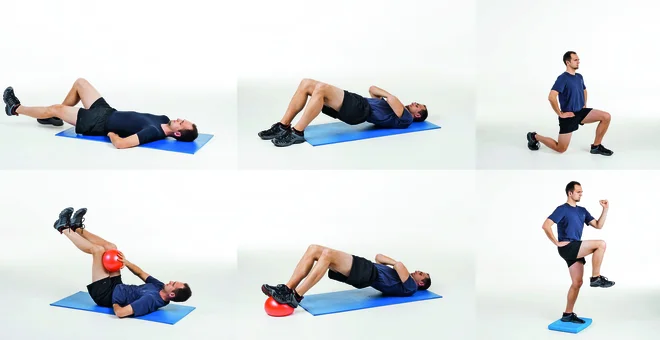
Lot 1: Learning position awareness and establishing/maintaining a neutral spine position
Suitably, the spine is curved in the lateral plane so that it bends forward in the neck and lumbar region, with the neck curvature being slightly more pronounced. If we place our back against the wall, it remains in the lumbar part of the space for about the thickness of the palm (it can be a kind of orientation measure), which is called the neutral position of the spine.
We try to master the neutral position in different positions, focusing on the lumbar-pelvic area and trying to be as aware of the position as possible. The latter contradicts the recommendations of some current exercise programs, which recommend pressing the lumbar spine against the ground. In contrast to pushing the back against the ground, in the neutral position, the ligaments around the spine are the least stressed, and the forces are evenly distributed over the entire surface of the intervertebral disc. The importance of learning a neutral position is strongly demonstrated in the transition to more complex exercises.
Figure 1: Awareness and acquisition of the neutral position of the spine in different positions.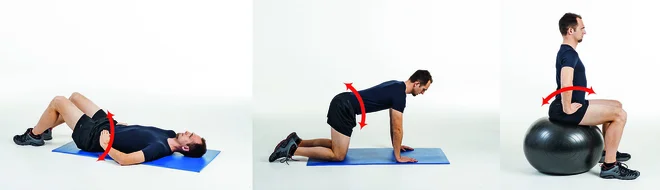
Lot 2: Improving torso muscle endurance
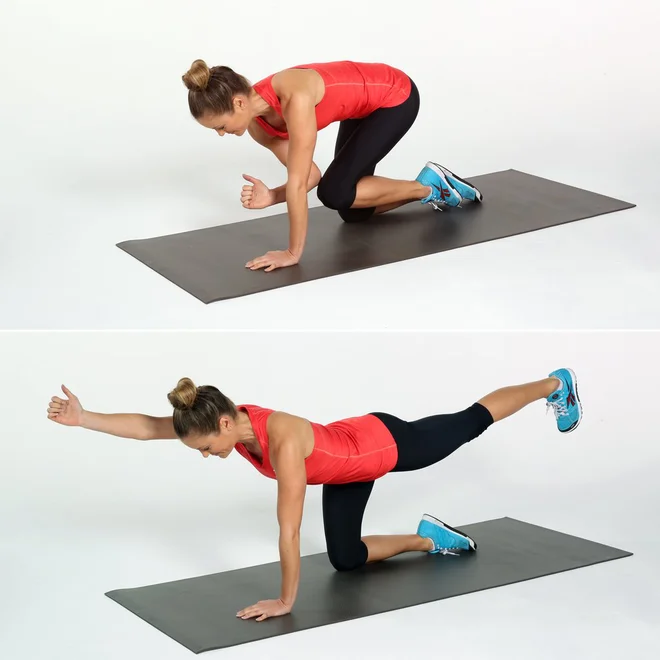
BSH is most commonly associated with poorer endurance of torso extensors, and some studies similarly point to a change in the relationship between the endurance of flexors and torso extensors. Once we become aware of and assimilate the neutral position, we begin to engage in limb movement while maintaining a neutral position. To maintain the position, it is now necessary to increase the stiffness of the torso, which is achieved by simultaneously activating the muscles of the abdominal wall and back.
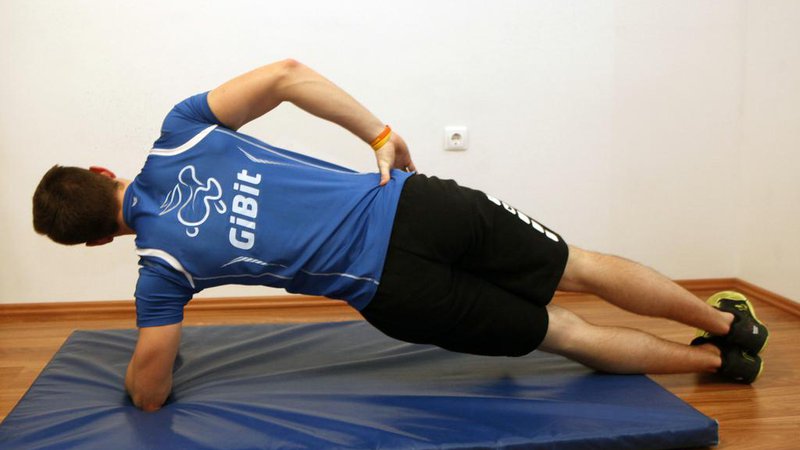
However, recent studies no longer recommend bending the abdomen (navel inside) to achieve isolated activation of the transverse abdominal muscle. In this set, we move from less stable positions to more demanding ones, thus increasing the need for neuromuscular control and coordinated muscle activation. We are also gradually moving into asymmetrical loads, such as mixed support on the arms and legs/knees, side supports, and one-legged positions. One-sided loads can also address any perceived asymmetries in muscle strength or endurance. In all positions, the goal is still to maintain a neutral lumbar curvature.
Figure 2: Example of escalation and transition from stable to less stable positions by keeping the back in a neutral position.
Lot 3: Providing mobility
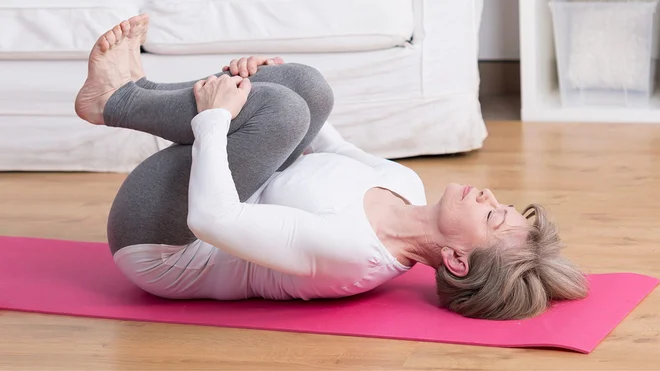
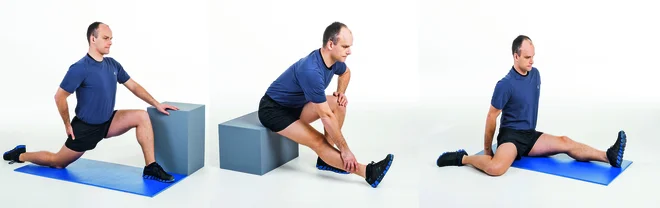
Increasing the mobility of the lumbar spine is rarely the goal of preventive action, except in some sports that require extensive torso movements. Conversely, excessive lumbar spine mobility may even be a risk factor for BSH. In this set, which overlaps with sets 2 and 4, we focus mainly on good hip mobility, which enables the functional execution of movements with smaller amplitudes of torso movements.
Poorly moving hips can also be an important factor in the load on the lumbar spine in recreational sports. A typical example is kayaked, in which an association between the range of motion in the direction of hip flexion and torso flexion during rowing has been shown. Similarly, poorly moving hips in the direction of extension can cause excessive pelvic movements during running and thus an increased cyclic load on the lumbar spine. To reduce the strain on the back, we stretch the hips with each leg separately.
Figure 3: It is also necessary to keep the back close to the neutral position while stretching the hips.
Lot 4: Transition to functional movements
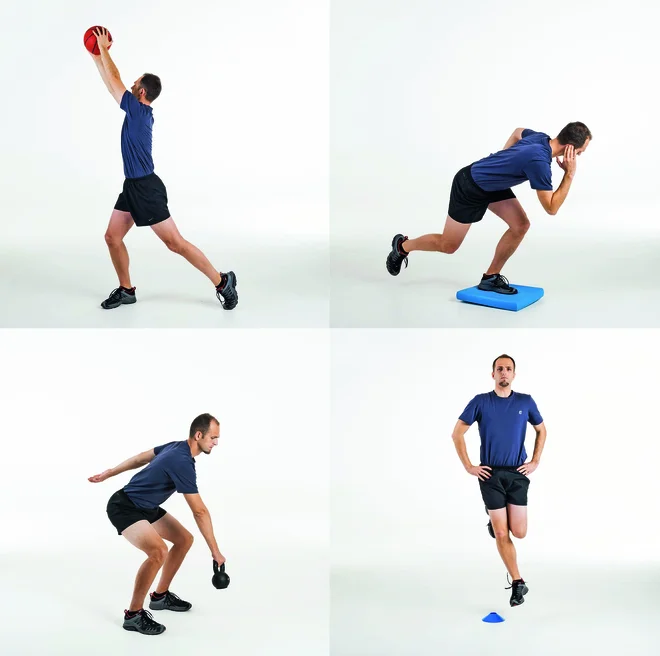
In this section, we deal with sports and/or work-specific movement patterns that require movement of the lumbar spine. This phase is very important, as we are only now allowing controlled movement of the spine. In this context, it is also necessary to include the newly acquired hip mobility in functional movements.
Studies have shown that people with BSH perform a greater proportion of lumbar movement during bending than people without BSH, although there is no difference in mobility between them. It is therefore necessary to address movement patterns while avoiding finite ranges of spinal movements. This will reduce the load on passive structures, while also reducing the likelihood of injury due to neuromuscular control errors.
Figure 4: Examples of complex functional movements with additional loads and in conditions of reduced stability, where the controlled movement of the spine is required during the performance.
To ensure the functional stability of the torso, the exercise of neuromuscular control is of key importance, the endurance of the muscles of the lumbar-pelvic region and the mobility of the hip-pelvic complex and the thoracic spine with the shoulder girdle also play an important role. Exercise requires adjustment of loads and training requirements to the abilities of the individual, to which the frequency of exercise is adjusted.
Whether exercise will be a poison or a cure for your back often depends on the little things in choosing or implementing movement content and on following some basic principles for a safer movement of the spine. You can read more about the issue in the book entitled Lower Back Pain - Structure, Function, Ergonomics and Movement Therapy, which was published last year and is available in many libraries.

You must be logged in to post a comment.