

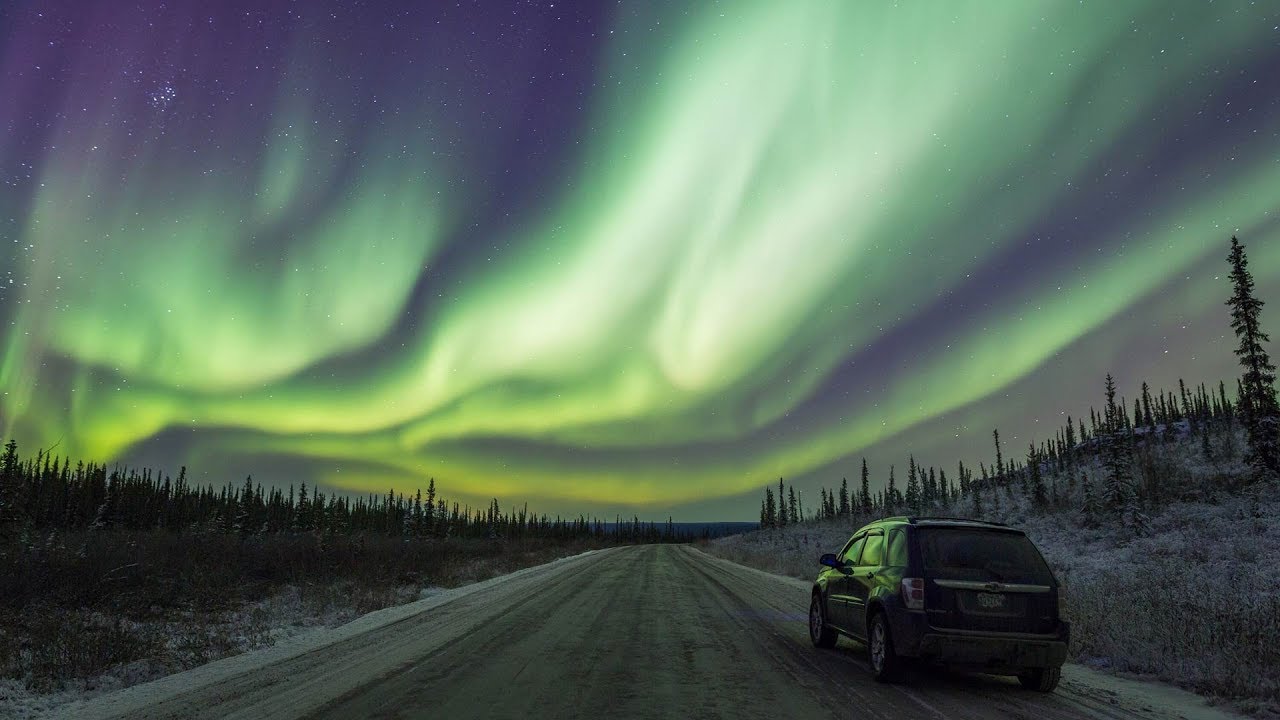
 Auroras are streamers of reddish or greenish light in the sky. They are also known as northern and southern lights. These natural dazzling lights appear in the Earth’s polar regions. The northern lights, or aurora borealis, can be seen from Canada and Iceland. They can also be spotted from Greenland and Norway. The southern lights, or aurora Australia, can be seen by sky watchers in New Zealand and Antarctica.
But how do auroras form?
The sun continually sheds a stream of charged particles, or plasma. That plasma, called the solar wind, largely flows around the Earth’s magnetic field. (Picture water flowing around a rock in a stream). But the magnetic field does capture some particles in the plasma gale. These particles travel along the magnetic field lines toward Earth’s poles. Here, the particles collide with oxygen and nitrogen atoms in the atmosphere. The collisions give the atoms a bit of extra energy. The atoms then release that energy in the form of light particles. These particles, or photons, form the auroras.
See all the entries from our Let’s Learn About series
The color of an aurora depends on the intensity of incoming charged particles. If you see a red aurora, that means the charged particles are low in energy. They make oxygen atoms give off low-frequency red light. You can see a green aurora when more energetic particles slam into oxygen. The high energy of the particles causes the oxygen atoms to exude higher-frequency green light. The highest energy particles cause nitrogen atoms to glow blue.
Auroras are often colorful, but this is not always the case. So-called black auroras appear as inky patches in the night sky. That makes them difficult to spot against the dark backdrop. This anti-aurora appears wherever charged particles are flowing up, rather than down, through the atmosphere.
In addition to their variety of colors, auroras come in many shapes and sizes. These features are defined by conditions in the atmosphere and Earth’s magnetic field. A common Aurora, form is a tall curtain of light. This shape arises from charged particles riding into the atmosphere on Alfvén waves. A rarer Aurora, formation is called the dunes. This series of green bands parallel to the ground can 'span' hundreds of kilometers (miles) in the sky.
The beauty of auroras is that they’re not just a natural wonder in our world, but beyond too. They occur on other planets with magnetic fields and atmosphere. Jupiter and Saturn are two such planets.
Want to know more? We’ve got some stories to get you started:
Meet STEVE, the northern lights in mauve Say hello to a new member of the colorful night sky, STEVE. Here’s how this unconventional sky glow was discovered, with its mauve ribbons in the night sky. Read to find out more about this new phenomenon. (4/10/2018) Readability: 7.4
Jupiter’s intense auroras heat up its atmosphere Scientists have often wondered why Jupiter’s atmosphere is hundreds of degrees warmer than expected. It could be because of its intense auroras. Here’s how. (10/8/2021) Readability: 8.1
Newfound ‘dunes’ is among the weirdest of northern lights Possibly arising from ripples of gas in the atmosphere, the dunes are stripes of Aurora, light that run parallel to the ground. (3/9/2020) Readability: 7.5
What are Northern Lights? The bright dancing lights of the aurora are actually collisions between electrically charged particles from the sun that enter the earth's atmosphere. The lights are seen above the magnetic poles of the northern and southern hemispheres

You must be logged in to post a comment.