

What is a Black Hole?
A black hole is formed when a massive star runs out of fuel and collapses under its own weight. This process creates a gravitational field so strong that not even light can escape. The boundary around a black hole where the gravitational pull is so strong that nothing can escape is called the event horizon. Anything that crosses the event horizon is trapped and is pulled towards the center of the black hole called the singularity.
Types of Black Holes come in different sizes and types.
The most common type is stellar black holes, which are formed from the collapse of a massive star. They have a mass ranging from a few to tens of times that of the sun. Another type of black hole is an intermediate-mass black hole, which is thought to be formed from the merging of smaller black holes or the collapse of a dense cluster of stars. Supermassive black holes are the largest type, with a mass ranging from millions to billions of times that of the sun. They are thought to be present at the center of most galaxies, including our own Milky Way.
Observing Black Holes are difficult to observe directly because they do not emit any light or radiation that can be detected by telescopes. However, scientists have been able to infer their existence and properties through indirect observations. For example, they have detected the effects of black holes on nearby stars and gas clouds, such as changes in their orbits or the emission of X-rays. They have also observed the behavior of matter falling toward a black hole, which emits radiation as it heats up and accelerates toward the event horizon.
Recent Discoveries in Black Hole Research In 2015, the Laser Interferometer Gravitational-Wave Observatory (LIGO) made the groundbreaking discovery of gravitational waves, ripples in space-time that are produced by the collision of two black holes. This observation provided the first direct evidence of the existence of black holes and confirmed predictions made by Albert Einstein’s theory of general relativity.
In 2019, the Event Horizon Telescope produced the first-ever image of a black hole. The image was of the supermassive black hole at the center of the Messier 87 galaxy, which has a mass of 6.5 billion times that of the sun. The image showed a bright ring of light surrounding a dark center, which is the shadow of the black hole’s event horizon.
Ongoing Search for Intermediate-Mass Black Holes Despite the recent discoveries in black hole research, there is still much that scientists do not know about these mysterious objects. One area of active research is the search for intermediate-mass black holes, which are thought to exist between stellar black holes and supermassive black holes.
Intermediate-mass black holes …
They are important because they may play a role in the formation of supermassive black holes. However, detecting them is challenging because they are expected to be rare and difficult to distinguish from other types of objects, such as dense star clusters.
Scientists are using a variety of techniques to search for intermediate-mass black holes, including analyzing the behavior of stars and gas clouds in the vicinity of suspected black holes
Some interesting facts about black holes…
- Black holes can actually spin. Just like stars and planets, black holes can also have a rotational motion. This spin can affect the behavior of matter around the black hole and even influence the shape of the event horizon.
- Black holes can also emit radiation. While black holes themselves do not emit any light or radiation, the matter falling towards a black hole can get so hot and compressed that it emits X-rays and gamma rays. This phenomenon is known as accretion disk radiation and can be used to study the properties of black holes.
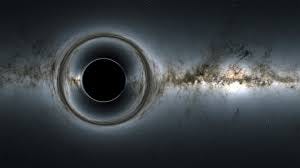
- Black holes can warp space and time. The strong gravitational pull of a black hole can distort the fabric of space and time, creating a phenomenon known as a gravitational lens. This effect can cause light from distant objects to bend around the black hole and create visual distortions in the images of those objects. A gravitational lens is also used as a tool for astronomers to study the properties of black holes and other objects in the universe.
In conclusion, black holes are fascinating objects that continue to intrigue and challenge scientists. While they are difficult to observe directly, recent discoveries such as the detection of gravitational waves and the first image of a black hole have provided new insights into their properties and behavior. The ongoing search for intermediate-mass black holes also promises to further expand our understanding of these mysterious objects. As we continue to explore the properties and behaviors of black holes, we may uncover new insights into the nature of the universe and our place within it.

You must be logged in to post a comment.