
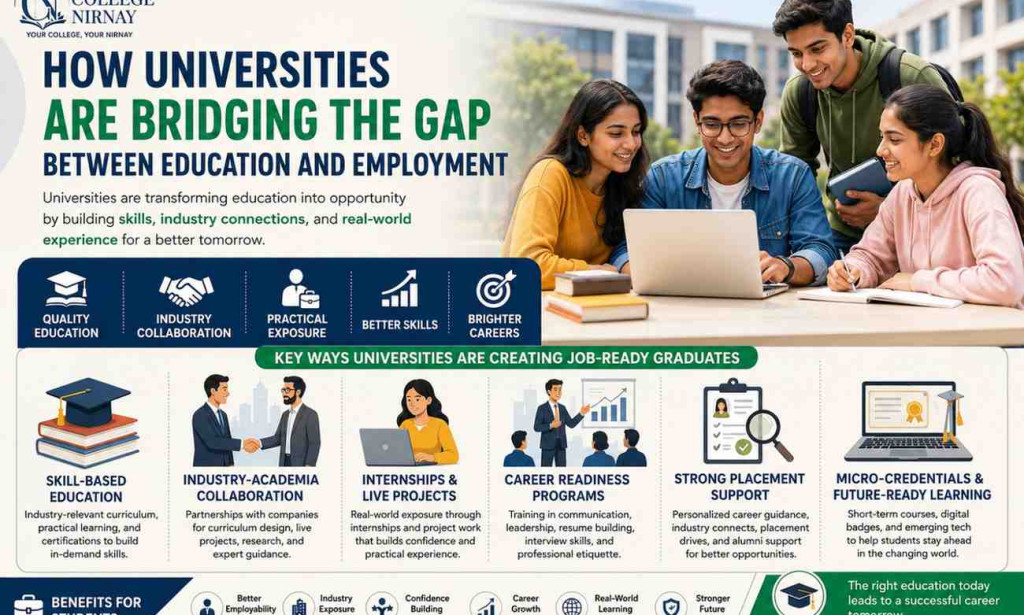
How Universities Are Bridging the Gap Between Education and Employment
Higher education is changing quickly. Earlier, a college degree was often seen as enough to start a career. Today, students need more than a degree. They need practical skills, communication ability, industry exposure, internships, projects, and career readiness.
This is why many universities are now focusing on bridging the gap between education and employment.
The education and employment gap means the difference between what students learn in college and what employers expect in the workplace. Many graduates complete their degrees but still struggle to find suitable jobs because they may not have enough practical experience, industry knowledge, or employability skills.
To solve this problem, universities are introducing new initiatives such as skill-based education, industry-academia collaboration, internship programs, career readiness training, placement support, and updated curriculum models.
Why the Education and Employment Gap Exists
The gap between education and employment does not exist because students are not capable. It usually exists because the education system and industry expectations do not always move at the same speed.
Many courses still focus heavily on theory. Students may learn concepts, definitions, and exam-based content, but they may not always get enough opportunities to apply that knowledge in real situations.
Employers, on the other hand, look for candidates who can solve problems, communicate clearly, work in teams, use modern tools, and adapt to workplace challenges.
Some common reasons for the gap include:
-
Outdated curriculum
-
Limited practical training
-
Lack of internships
-
Weak communication skills
-
Limited industry exposure
-
Less focus on projects and portfolios
-
Placement preparation starting too late
-
Low awareness of career trends
Universities that understand these challenges are now changing the way they prepare students.
1. Skill-Based Education
Skill-based education is one of the most important ways universities are improving employability.
Instead of focusing only on theory, universities are adding practical skills into the learning process. These skills may include communication, digital tools, data analysis, coding, financial literacy, presentation skills, research ability, problem-solving, teamwork, and industry-specific tools.
Skill-based education helps students become more confident and job-ready. It also allows students to show what they can do, not just what they have studied.
For example, a management student may work on business case studies. A computer science student may build software projects. A commerce student may learn Excel, accounting tools, or financial analysis. A media student may create content, videos, or campaign plans.
This practical learning makes the degree more useful in the real world.
2. Industry-Academia Collaboration
Many universities are now working directly with companies and industry experts. This is called industry-academia collaboration.
A strong collaboration can include:
-
Guest lectures by industry professionals
-
Live projects from companies
-
Industry visits
-
Updated curriculum suggestions
-
Practical workshops
-
Internship opportunities
-
Mentorship programs
-
Industry certification programs
When universities involve industry experts, students get a better idea of what the workplace actually expects. They also understand current tools, market trends, and job requirements.
However, students should check whether a university’s industry collaboration is genuine. Some institutions only show company names in brochures, while others actively involve companies in training, projects, internships, and placements.
3. Internship Opportunities
Internships are one of the strongest bridges between college and career.
An internship allows students to experience real work before getting a full-time job. It helps them understand office culture, deadlines, teamwork, reporting, communication, and problem-solving.
Good internships can help students:
-
Build practical experience
-
Understand their career interest
-
Improve resumes
-
Learn professional behaviour
-
Build industry contacts
-
Gain confidence
-
Improve interview performance
Universities that provide structured internship support can help students become more employable.
Students should try to complete at least one or two internships during college. Internships do not need to be in big companies only. Even internships with startups, local businesses, NGOs, online platforms, or small firms can teach valuable skills.
4. Career Readiness Programs
Career readiness programs are designed to prepare students for the job market.
These programs may include:
-
Resume writing
-
Interview preparation
-
Group discussion practice
-
LinkedIn profile building
-
Communication training
-
Aptitude preparation
-
Mock interviews
-
Career counselling
-
Professional etiquette
-
Portfolio development
Many students wait until final year to prepare for placements, but career readiness should start much earlier.
A good university helps students plan their careers from the first or second year itself. This gives students enough time to build skills, complete projects, gain internships, and prepare for interviews.
5. Updated Curriculum and Practical Projects
One major reason for the education and employment gap is curriculum delay. Industry tools and technologies change quickly, but university syllabuses often take time to update.
To solve this, many universities are adding practical modules, elective subjects, industry certifications, minor specialisations, and project-based assessments.
Practical projects are very useful because they help students apply classroom learning.
Projects can include:
-
Research reports
-
Business plans
-
Coding projects
-
Case studies
-
Marketing campaigns
-
Data analysis reports
-
Design portfolios
-
Social impact projects
-
Technical prototypes
When students work on projects, they learn how to plan, execute, solve problems, and present their work. These are valuable employability skills.
6. Placement Support and Employer Connect
University placement programs are also evolving.
Earlier, placements were mostly about inviting companies to campus in the final year. Now, better institutions are building employer relationships throughout the academic journey.
Strong placement support includes:
-
Company interaction sessions
-
Pre-placement training
-
Internship-to-job opportunities
-
Alumni networking
-
Skill assessment
-
Career counselling
-
Industry-specific training
-
Job role awareness
Students should not judge placements only by the highest package. They should also check the average package, median package, percentage of students placed, job roles offered, and companies visiting the campus.
A high placement banner does not always show the complete picture. Students should research carefully before choosing a university.
7. Micro-Credentials and Certifications
Another growing trend is the use of micro-credentials and short certifications.
These are short learning programs that help students gain specific skills in areas like artificial intelligence, digital marketing, cloud computing, data analytics, finance, communication, cybersecurity, design, and business tools.
Certifications can make a student’s profile stronger when combined with a proper degree, projects, and internships.
However, students should choose certifications carefully. A certificate is useful only when it teaches a relevant skill and adds value to the student’s career goal.
What Students Should Check Before Choosing a University
Students who want better career outcomes should ask important questions before taking admission.
They should check:
-
Does the university provide internships?
-
Are there industry projects?
-
Is the curriculum updated?
-
Are practical skills taught?
-
Does the college offer career readiness training?
-
What companies visit for placements?
-
What is the average placement package?
-
Are students building portfolios?
-
Are there active clubs and competitions?
-
Is there alumni support?
These questions can help students choose a university that supports both education and employability.
Why Students Must Also Take Responsibility
Universities can provide opportunities, but students must also take action.
Students should not depend only on classroom learning. They should use college years to build skills, complete projects, join clubs, attend workshops, create a LinkedIn profile, apply for internships, and improve communication.
A job-ready student is created through continuous effort, not only through a degree.
Students should focus on:
-
Learning practical skills
-
Building a strong resume
-
Completing internships
-
Creating a portfolio
-
Networking with professionals
-
Improving communication
-
Staying updated with industry trends
-
Participating in competitions and events
Final Thoughts
Universities are playing an important role in bridging the gap between education and employment. Through skill-based education, industry collaboration, internships, career readiness programs, updated curriculum, and placement support, institutions are helping students become more prepared for the job market.
However, students should choose universities carefully. They should look beyond advertisements and placement banners. The real value of a university lies in the learning environment, practical exposure, industry connection, internship support, and career guidance it provides.
The future belongs to students who combine academic knowledge with practical skills and real-world experience.
For students who want to explore colleges, courses, admission details, placements, and career guidance, CollegeNirnay can be a useful platform for making informed education decisions.
Read More: https://www.collegenirnay.com/blogs/how-universities-bridging-gap-between-education-employment

You must be logged in to post a comment.