RUBY LASER
A ruby laser is a solid-state laser that uses a synthetic ruby crystal as its gain medium.
The first working laser was a ruby laser made by Theodore H. Ted Maiman at Hughes Research Laboratories on May 16, 1960.
The pump source is the element of a ruby laser system that provides energy to the laser medium. In a ruby laser, population inversion is required to achieve laser emission. Population inversion is the process of achieving a greater population of a higher energy state than a lower energy state. In order to achieve population inversion, we need to supply energy to the laser medium (ruby).
In a ruby laser, we use the flash tube as the energy source or pump source. The flash tube supplies energy to the laser medium (ruby). When lower energy state electrons in the laser medium gain sufficient energy from the flash tube, they jump into the higher energy state or excited state.
Construction of Ruby Laser
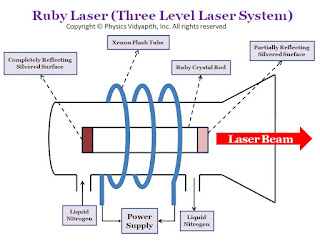
The ruby laser consists of a ruby rod. Which is made of chromium-doped ruby material. At the opposite ends of this rod, there are two silver polished mirrors. Whose one is fully polished, and the other is partially polished? A spring is attached to the rod with a fully polished end for adjustment of the wavelength of the laser light. Around the ruby rod, a flashlight is kept for the pump input. The whole assembly is kept in a glass tube. Around the neck of the glass tube, the R.F. source and switching control in order to switch on and off the flashlight at desired intervals.
Operation of Ruby Laser:
When we switch on the circuit, the R.F. operates. As a result, a flash of light is obtained around the ruby rod. This flash causes the electrons within the ruby rod to move from the lower energy band toward the higher energy band. The population inversion takes place at a high energy band and electrons start back to travel towards the lower energy band.
During this movement, the electron emits laser light. This emitted light travels between the two mirrors, where cross-reflection takes the place of this light. The stimulated laser light now escapes from the partially polished mirror in the shape of the laser beam.
The spring attached to the fully polished mirror is used to adjust the wavelength equal to /2 of laser light for the optimum laser beam. The switching control of the R.F. source is used to switch on and off the flashlight so that excessive heat should not be generated due to the very high frequency of the movement of the electron.
Energy Level Diagram for Ruby Laser
The above three-level energy diagram show that in ruby lasers the absorption occurs in a rather broad range in the green part of the spectrum. These make raises the electrons from the ground state in the band of level E3 higher than El. At E3 these excited levels are highly unstable and so the electrons decay rapidly to the level of E2. This transition occurs with energy difference (El - E2) given up as heat (radiation less transmission).

The level E2 is very important for the stimulated emission process and is known as Meta stable state. Electrons in this level have an average lifetime of about 5 m.s before they fall to the ground state. After this, the population inversion can be established between E2 and El. The population inversion is obtained by optical pumping of the ruby rod with a flashlamp. A common type of flashlamp is a glass tube wrapped around the ruby rod and filled with xenon gas. When the flashlamp intensity becomes large enough to create population inversion, then stimulated emission from the Meta stable level to the ground level occurs, which results in the laser output. Once the population inversion begins, the Meta stable level is depopulated very quickly. Thus, the laser output consists of an intense spike lasting from a few Na no sec to sec. after the stimulated emissions spike, solution inversion builds 1st and 2nd spike results. This process continues as long as the flashlamp intensity is enough to create the population inversion.
Advantages of Ruby Lasers
• From a cost point of view, the ruby lasers are
economical.
• Beam diameter of the ruby laser is comparatively less than C02 gas lasers.
• Output power of the Ruby laser is not as less as in He-Ne gas lasers.
• Since the ruby is in solid form, therefore there is no chance of wasting material of the active medium.
• Construction and function of the ruby laser is self-explanatory.
During this movement, the electron emits laser light. This emitted light travels between the two mirrors, where cross-reflection takes the place of this light. The stimulated laser light now escapes from the partially polished mirror in the shape of the laser beam.
The spring attached to the fully polished mirror is used to adjust the wavelength equal to /2 of laser light for the optimum laser beam. The switching control of the R.F. source is used to switch on and off the flashlight so that excessive heat should not be generated due to the very high frequency of the movement of the electron.
The pump source is the element of a ruby laser system that provides energy to the laser medium. In a ruby laser, population inversion is required to achieve laser emission. Population inversion is the process of achieving the greater population of higher energy state than the lower energy state. In order to achieve population inversion, we need to supply energy to the laser medium (ruby).
In a ruby laser, we use flashtube as the energy source or pump source. The flashtube supplies energy to the laser medium (ruby). When lower energy state electrons in the laser medium gain sufficient energy from the flashtube, they jump into the higher energy state or excited state.
Enjoyed this article? Stay informed by joining our newsletter!



You must be logged in to post a comment.