
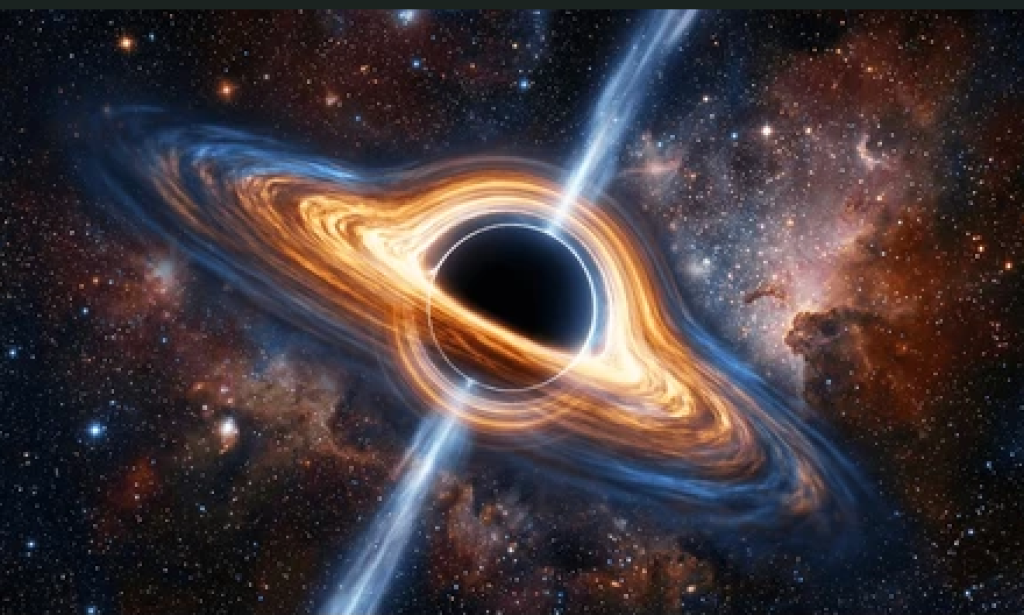
The universe is full of mysteries, but nothing captures our imagination quite like black holes. 🌌 These invisible cosmic monsters are fields of gravity so intense that not even light can escape them. For decades, scientists have been studying them to unlock the secrets of space and time. Learning how to understand black holes doesn't require an advanced physics degree. Here are 5 mind-blowing facts that make them easy to grasp. 🚀
1. 🕳️ Black Holes Are Not Empty Spaces
Contrary to their name, a black hole is not an empty hole in space. It is actually a massive amount of matter packed tightly into a tiny area. Imagine squeezing a star that is ten times larger than our sun into a sphere the size of a small city. This incredible density is what creates their powerful gravitational pull. 💥
2. 👁️ They Are Completely Invisible
You cannot actually "see" a black hole because they swallow all light. 🕶️ Astronomers find them by watching how they affect nearby stars and gas clouds. When a star gets too close, it gets pulled in and heats up, glowing brightly in X-rays before disappearing forever. This allows special space telescopes to map exactly where the black hole is hiding. 🛰️
3. ⏳ Time Inside a Black Hole Slows Down
According to Albert Einstein’s theories, intense gravity warps both space and time. ⏰ If you were to watch a spaceship fall into a black hole from a safe distance, the ship would appear to slow down and freeze in time. To the astronaut inside, however, time would feel normal as they are pulled into the center. This strange effect is known as time dilation. 🌀
4. 🪐 The Nearest One is Closer Than You Think
You don't have to look to the edge of the universe to find one. Scientists recently discovered a black hole called Gaia BH1, which is located just 1,560 light-years away from Earth. 🌍 While that sounds incredibly far, in cosmic terms, it is practically in our backyard! Don't worry though, it poses absolutely no danger to our solar system. 🛡️
5. 🌌 Supermassive Black Holes Live inside Galaxies
Almost every large galaxy, including our own Milky Way, has a "Supermassive" black hole sitting right at its center. 👑 Our local monster is named Sagittarius A*. It has a mass equal to about 4 million of our suns combined. These giant black holes act like cosmic anchors, helping to hold entire galaxies together. ⚓
Conclusion 💡
Black holes are not just terrifying destructive forces; they are essential pieces of the cosmic puzzle. 🌟 The more we learn about how they work, the closer we get to understanding the true nature of reality and the universe we call home. 👑

You must be logged in to post a comment.