
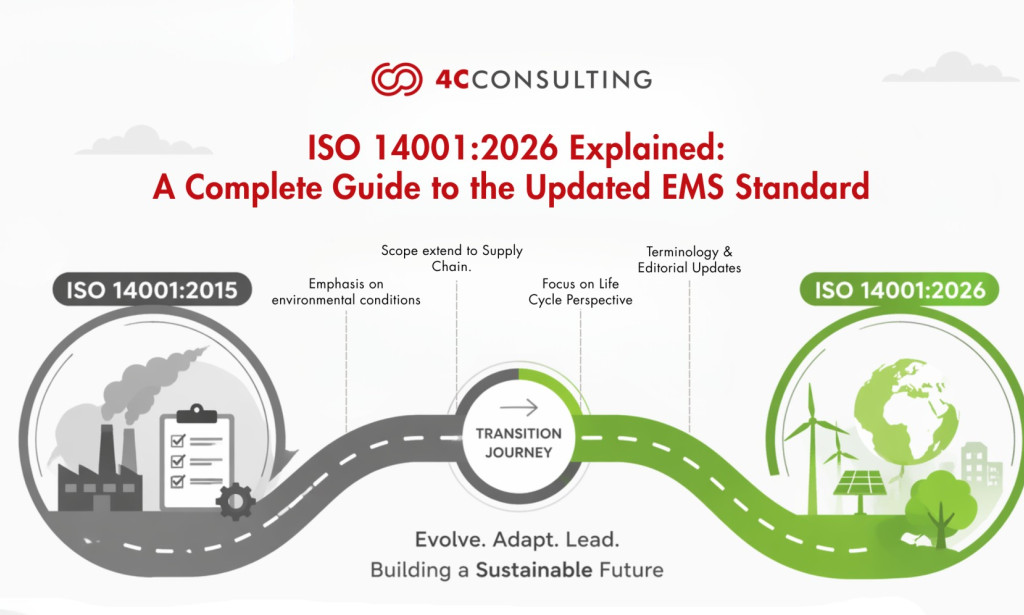
The ISO 14001 environmental management system has been adopted by organizations across the globe, and the official publication of ISO 14001:2026 marks a significant milestone. The revised standard places stronger emphasis on climate change adaptation, climate resilience, biodiversity protection, and sustainable resource use, making it more relevant than ever to today's environmental challenges.
This guide breaks down everything you need to know: what has changed, why it matters, and how to prepare your organization for a smooth transition.
What Is ISO 14001:2026?
An Environmental Management System (EMS) is a structured framework that helps an organization identify, manage, monitor, and improve its environmental impacts in a systematic way. It covers energy consumption, waste generation, emissions, water usage, resource efficiency, legal compliance, and sustainability goals. The purpose of an EMS is not only to control environmental risks but also to integrate environmental responsibility into daily business operations.
ISO 14001 is the internationally recognized standard for implementing an EMS. The 2026 revision strengthens this framework by refining clause structures, updating terminology, and providing clearer implementation guidance, all while continuing to follow the Annex SL structure used across ISO management system standards.
The updated standard emphasizes the following:
-
Measurable environmental performance
-
Risk-based thinking
-
A lifecycle perspective
-
Alignment with global sustainability expectations
Organizations are now expected to demonstrate real, data-driven environmental improvements and integrate sustainability into long-term business strategy.
💬 Need expert guidance? → Get a 1-hour Free Consultation
Transition Timeline
Organizations must transition from ISO 14001:2015 to ISO 14001:2026 by 2029. Planning should begin now to allow sufficient time for gap analysis, documentation updates, training, and internal audits before certification deadlines.
Key Focus Areas in ISO 14001:2026
-
Stronger emphasis on measurable environmental performance indicators
-
Clearer integration of climate change and sustainability considerations
-
Improved risk and opportunity assessment
-
Greater alignment with corporate strategy and ESG goals
-
Enhanced leadership accountability and stakeholder engagement
In simple terms, ISO 14001:2026 will not just help organizations "manage" environmental issues; it will guide them toward building a resilient, performance-driven, and sustainability-focused business model.
Key Changes by Clause
Clause 4: Context of the Organization
The revised standard strengthens the lifecycle perspective requirement when defining the EMS scope. Organizations must more clearly consider upstream and downstream environmental impacts, including those related to suppliers, outsourced activities, and product use stages.
Documentation updates needed:
-
Update context analysis
-
Revise stakeholder register
-
Include climate-related risks and expectations
Clause 5: Leadership
Top management involvement is expanded. Leadership must now support not only managerial roles but also all relevant roles within the organization, making environmental performance a shared responsibility rather than a delegated task.
Documentation updates needed:
-
Update Environmental Policy to reflect sustainability commitments
-
Revise the roles and responsibilities matrix if required
Clause 6: Planning
A new focus on "planning and managing changes" is introduced. Organizations must formally plan and control changes that may affect EMS outcomes. Emergency preparedness has also been expanded from "reasonably foreseeable" emergencies to identifying all potential emergency situations, strengthening climate resilience planning.
Documentation updates needed:
-
Update the environmental aspects register
-
Revise the risk and opportunity assessment format
-
Strengthen measurable environmental objectives
Clause 7: Support
Changes here focus on improving clarity and consistency in language, aligned with the latest harmonized structure across ISO management system standards.
Documentation updates needed:
-
Review document control procedures
-
Improve version control and traceability
-
Update communication and training records
Clause 8: Operation
Control of outsourced processes is now more clearly defined under the term "externally provided processes, products, or services." Emergencies are also linked directly to risks and opportunities, ensuring broader identification of possible environmental incidents.
Documentation updates needed:
-
Update operational procedures
-
Strengthen supplier evaluation records
-
Review emergency preparedness plans, including climate-related risks
Clause 9: Performance Evaluation
Greater emphasis is placed on measuring EMS effectiveness. Internal audits now require clearly defined objectives, and management review inputs are more specific and mandatory, strengthening transparency and performance monitoring. The use of "shall" language makes information requirements explicit and non-negotiable.
Documentation updates needed:
-
Update monitoring matrices
-
Strengthen management review inputs
Clause 10: Improvement
Changes are minor and mainly related to terminology clarification, but the overall direction reinforces continual improvement and measurable environmental performance outcomes.
Steps to Prepare Your Organization
Step 1: Conduct a Gap Analysis. Compare your existing ISO 14001:2015-aligned EMS against the updated ISO 14001:2026 requirements. Evaluate whether climate-related risks are formally identified, whether performance metrics are measurable, and whether environmental commitments are communicated effectively to stakeholders.
Step 2: Establish Competence and Awareness Conduct structured awareness training on updated requirements, particularly those related to climate risks and sustainability reporting. Clearly define updated roles and responsibilities. Ensure cross-functional participation; procurement, operations, HR, and compliance teams should all contribute to environmental objectives.
Step 3: Strengthen Environmental Risk Assessment. Re-evaluate environmental aspects and impacts to reflect current operational realities, including energy consumption, waste generation, water usage, and emissions. Reassess compliance obligations against updated environmental laws and identify emerging risks such as climate-related disruptions and carbon emission liabilities.
Step 4: Upgrade Documentation and Monitoring: Modernize EMS documentation and monitoring systems. Move toward structured digital systems that ensure real-time access. version control, and audit readiness. Strengthen KPI tracking and automate compliance alerts where possible to reduce the risk of missed obligations.
Step 5: Conduct Internal Audits and Management Review. Run internal audits aligned to ISO 14001:2026 to verify compliance, review documented information, and assess the effectiveness of risk controls. Top management should then conduct a formal management review and document corrective actions and strategic decisions to ensure certification readiness.
Key Benefits of ISO 14001:2026
1. Increased Strategic Responsibility: Environmental management is elevated from an operational function to a board-level priority. Leadership accountability becomes visible, with measurable environmental objectives aligned to corporate strategy.
2. Higher Compliance Credibility A robust EMS minimizes the risk of legal penalties and regulatory notices and boosts confidence during third-party surveillance and certification audits.
3. Stronger ESG Reporting Alignment ISO 14001:2026 encourages organizations to measure, monitor, and disclose environmental performance, supporting better sustainability reporting and stronger ESG ratings.
4. Competitive Market Advantage ISO 14001 certification signals environmental responsibility, building long-term trust and improving chances for sustainability-driven contracts, particularly in infrastructure, manufacturing, and export sectors.
5. Improved Operational Efficiency: By monitoring energy use, waste generation, and resource consumption, organizations can identify inefficiencies and make targeted improvements that reduce both environmental impact and operational costs.
Frequently Asked Questions
How should manufacturing organizations prepare for an ISO 14001:2026 audit?
Conduct a gap analysis, update environmental aspects and risk registers (including climate-related risks), review operational controls, strengthen supplier evaluation, and conduct internal audits before the certification audit.
What questions are typically asked during an ISO 14001 audit?
Auditors typically ask how environmental aspects and impacts were identified, how compliance obligations are evaluated, how risks and opportunities are managed, how environmental objectives are monitored, and how top management demonstrates commitment. They also review how nonconformities are handled and how continual improvement is ensured.
Can small businesses implement ISO 14001:2026?
Yes. Small businesses can adopt a practical and scalable approach: to identify environmental aspects, understand applicable legal requirements, develop a simple environmental policy, set measurable objectives, and maintain essential documented information. An EMS does not need to be complex; consistency, compliance, and continual improvement are what matter.
What are the steps to establish an effective EMS?
The key steps are: understand organizational context → develop environmental policy → identify environmental aspects and impacts → set objectives and targets → implement operational controls → monitor and measure performance → conduct internal audits → management review and improvement.
What are the core principles of an EMS?
Environmental protection, compliance obligations, risk-based thinking, leadership commitment, employee awareness and participation, and continuous improvement.
The transition from ISO 14001:2015 to ISO 14001:2026 represents more than a routine standard update; it reflects a global shift toward measurable, transparent, and performance-driven environmental responsibility. Organizations that approach this transition proactively will not only maintain their certification but also strengthen stakeholder confidence, improve operational efficiency, and align with evolving ESG expectations.
For the original article and additional resources, visit: https://www.4cpl.com/blog/iso-14001-2026-changes-transition-guide/

You must be logged in to post a comment.