
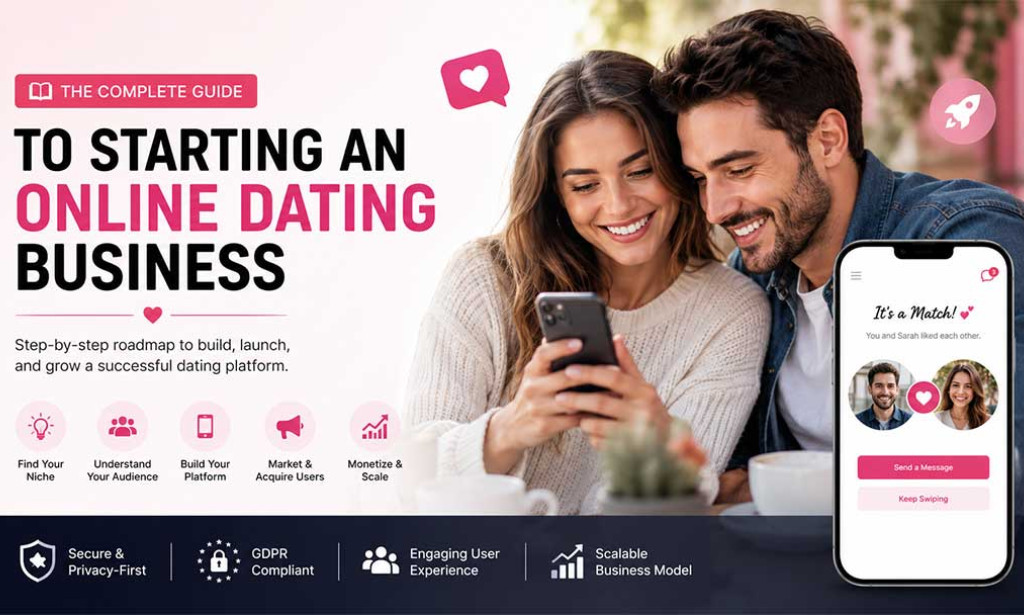
Tinder's user numbers are shrinking. Bumble's revenue dropped nearly 10% last year. Yet founders are still building profitable dating businesses in 2026, often faster than the giants. The difference comes down to strategy, not luck.
If you want to start an online dating business, the opportunity is real, but it no longer rewards copying what Tinder built a decade ago. It rewards founders who pick a clear audience, choose the right business model, and launch with a plan for revenue from day one. This guide walks through exactly how to do that.
Why the Dating Business Is Still a Smart Bet in 2026
The global online dating market is projected to generate more than 9 billion dollars in revenue this year, with steady growth expected through the next decade. That is not a shrinking industry. It is a maturing one, shifting away from mass-market apps toward smaller, more focused platforms.
The biggest players are consolidating and struggling to grow their user base. Meanwhile, niche and intent-based platforms are expanding fast, some reporting user growth rates several times higher than mainstream apps. For a new founder, that gap is the opening.
People are not leaving online dating. They are leaving generic, one-size-fits-all apps that feel crowded, impersonal, and full of fake profiles. A well-built platform for a specific audience can win their attention and their trust.
Choosing Your Niche Before Anything Else
Every successful dating startup guide will tell you the same thing: your niche decides everything else, from your business model to your marketing budget. Skip this step and you will spend money competing directly with Tinder and Hinge, a fight you cannot win.
Look at where demand is underserved. Faith-based communities, professionals in specific industries, adults over 50, and lifestyle-focused groups all show strong engagement on platforms built just for them. These users are not looking for the biggest app. They are looking for the right one.
A focused audience also makes your marketing cheaper and more effective. You are not trying to reach everyone. You are reaching a specific group who already gathers in identifiable online spaces, which makes early user acquisition far more achievable on a limited budget.
Picking a Dating App Business Model
Once you know your audience, your dating app business model should follow naturally. There is no single "best" model. There is only the model that fits how your users behave and what they are willing to pay for.
Freemium works well for broad, younger audiences who want free access to core matching, with paid boosts and visibility upgrades layered on top. This is the Tinder playbook, and it still works, but it needs volume to succeed.
A subscription or hard-gate model, where users pay to message at all, tends to fit serious or niche communities better. It filters out casual users and builds a more committed community, which is exactly what platforms serving faith-based or relationship-focused audiences need.
Credit-based systems, where users buy tokens to unlock messages or gifts, suit casual and international dating audiences who prefer paying per action instead of committing to a monthly fee. Many founders now combine two or three of these into a hybrid model instead of picking just one.
How to Start a Dating Website or App: Build vs. Buy
This is where most first-time founders get stuck. Building a dating app from scratch with a custom development team typically takes six to nine months and can cost well over 100,000 dollars before you have a single paying user.
That timeline works for well-funded teams. It rarely works for a founder trying to validate an idea before spending serious money. This is why so many successful dating platforms today start with a ready-made dating script or no-code builder instead of custom code.
Nikolas, a founder with no coding background, bought a dating script just to test an idea. It turned into a real, revenue-generating business, proof that a limited technical background does not have to block you from launching.
Choosing how to build a dating website or app is really a question of speed versus control. A ready-made platform gets you live in weeks, lets you test your niche with real users, and gives you room to customize as you grow. You can always invest in custom development once the business proves itself. For a deeper walkthrough of the full build process, this step-by-step dating website guide covers the technical and strategic decisions in more detail.
Monetization That Actually Works
Revenue in dating apps no longer comes from chasing new sign-ups at any cost. It comes from getting more value out of the users you already have. Match Group and Bumble are both proving this, growing revenue per paying user even as total user counts flatten.
Niche apps benefit the most from this shift. Specialized platforms often see average revenue per user land between 28 and 44 dollars, compared to 7 to 13 dollars on mass-market apps. Users who feel understood by a platform pay more to stay on it.
The strongest monetization strategies rarely rely on one revenue stream. A mix of subscriptions for predictable income, in-app purchases for impulse spending, and light advertising for free users tends to outperform any single approach. If you want a deeper breakdown of how these pieces fit together, this guide on dating business models for startups is worth reading before you finalize your pricing.
Advertising alone typically covers about a fifth of total revenue for dating platforms, which makes it a useful supplement rather than a standalone plan. Treat it as a way to monetize users who are not ready to pay, not your core strategy.
Common Mistakes First-Time Founders Make
The most common mistake is trying to be the next Tinder instead of the best option for one specific group of people. Broad platforms need enormous marketing budgets to reach critical mass. Niche platforms do not.
The second mistake is picking a monetization model that fights against your audience. A hard paywall on a casual, mass-market app will kill growth before it starts. A fully free model on a serious, relationship-focused platform will attract low-intent users and drive away the people you actually want.
The third mistake is underestimating trust and safety. Romance fraud and fake profiles are now one of the biggest threats facing the industry. Platforms that build in identity verification and reporting tools from the start earn user trust faster than those that add it later.
Getting Started
Starting an online dating business in 2026 is less about technology and more about clarity: a defined audience, a business model that matches how they behave, and a monetization plan built around real user value from the beginning.
You do not need a massive budget or a technical co-founder to get moving. Many founders now use ready-made platforms like Best Dating Scripts to launch quickly, test their niche with real users, and reinvest as the business grows.
The dating industry is not slowing down. It is getting more specific, more trust-focused, and more profitable for founders who understand their audience better than the giants ever will. That is where the real opportunity sits right now.

You must be logged in to post a comment.