

Step 5: Install helpful plugins for travel blogs
WordPress plugins help you add new functionality to your travel blog without requiring any technical knowledge on your part. They’re one of the things that makes WordPress so awesome. And pretty much every WordPress site makes good use of plugins.
- There are some must-have plugins for all sites, including travel blogs:
- SEO plugins
- Caching plugins
- Social share button plugins
- Security plugins
- Contact form plugins
- Gutenberg block plugins
Beyond those must-haves, you’ll also want some specific travel plugins. While this can vary depending on your focus area, here are some good ideas:
A good photo gallery plugin such as NextGEN Gallery to share your travel pictures in a gallery
Plugins to help integrate with Instagram and Facebook
Slider plugins such as Nivo Slider to display amazing full-width photos
A lightbox plugin such as Simple Lightbox to allow readers to view your photos in a customizable lightbox
A map plugin to plot places and routes is a must-have when you want to start a travel blog. It helps to keep your readers stay engaged with you as you move from one place to another. Intergeo Maps plugin is available for free (and as a premium plugin). Interactive World Maps plugin is another fine option
Plugins like TravelPayouts help you add a travel booking capability to your blog. It helps your visitors find deals on flights and hotels to different locations while you earn a commission
Step 6: Create and add content
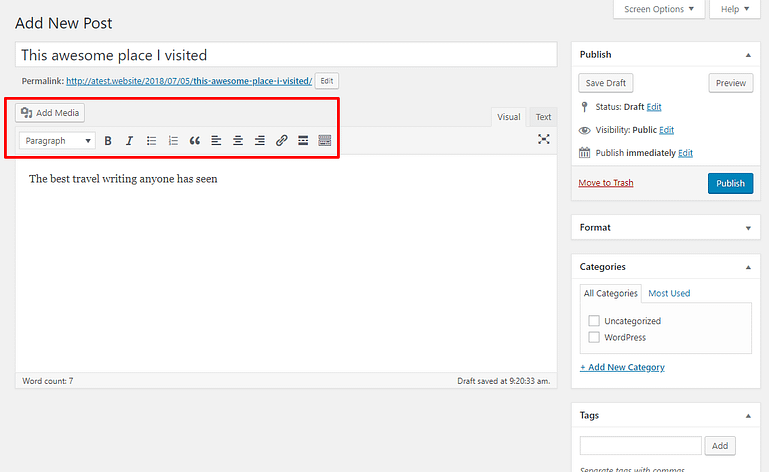
Once you’ve set up your travel blog’s foundation, you’re ready to start adding content. To write blog posts in WordPress, go to Posts –> Add New in your WordPress dashboard.
From there, you can use the Add Media button to insert images and the text editor to write and format your content:
Step 7: Build your blog’s audience
There are a few channels you can use to grow your blog’s traffic.
With millions of active users, social media can help your content reach the right audience. Adding Social media share buttons makes it easy for readers to share your content. Instagram and Pinterest are suitable platforms to promote your blog, and should form part of your social media strategy.
Beyond that, you should also learn about SEO and topics like keyword research.
Building an email list is another great way to grow a long-term audience.
Step 8: How to make money from your travel blog
Once your starts to get some traffic, here are some ways that you can make money from your blog:
- Affiliate marketing: You can have affiliates for almost everything – accommodation, insurance, travel gear, web hosting. Every time someone clicks on a link resulting in the purchase of an affiliate’s product, you earn a (small) commission.
- Google Adsense: Google generates ads relevant to travel on your blog. When visitors click on the offered ads, you earn revenue
- Premium content: You can sell digital guides for the places that you’ve visited to save other travelers time.
- Add a donation button: Obviously, this can work only when you’ve built up a dedicated readership
- Offer personalized advice: Offer travel related advice for payment of a fee, or offer personalized or guided tours of specific places, or curate travel plans
- Sponsored posts: Travel related businesses may pay you to write about them on your blog. Just make sure to be transparent.
- Sponsored trips: Tourism boards, private companies or brands can ask you to visit their places and write about it.
- Workshops: Accept offers to conduct travel-related workshops
Wrapping up
That wraps up our guide. If you made it this far, congratulations on creating your own travel blog!

You must be logged in to post a comment.