
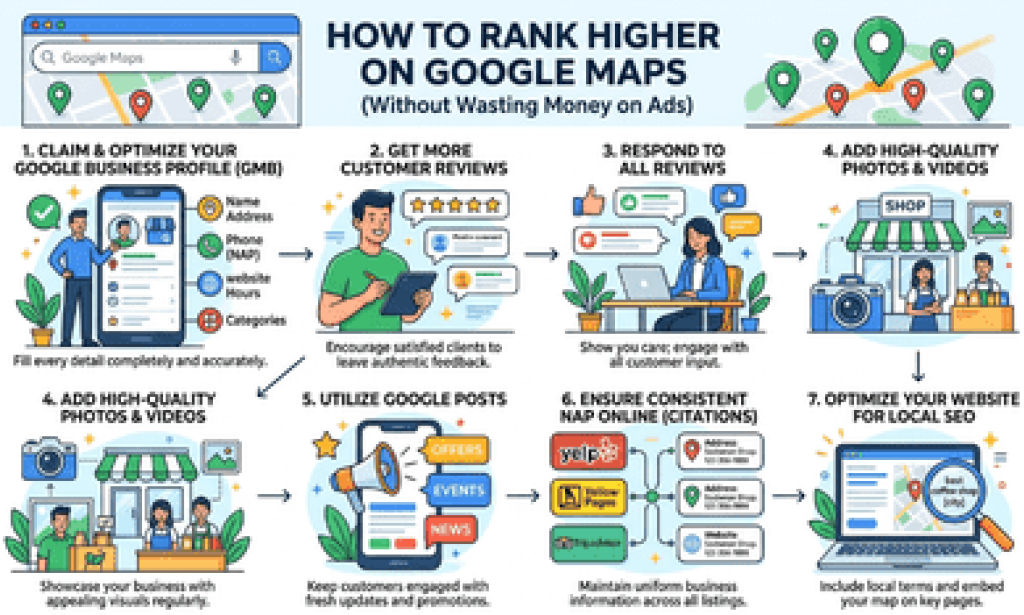
If your business isn't showing up in the Google Maps 3-pack when someone nearby searches for what you sell, you're losing customers to competitors who simply show up first. I've managed local listings for small businesses across different industries, and the pattern is always the same: the shops that rank higher aren't necessarily the best ones, they're just the ones doing local SEO right.
This guide walks you through exactly what moves the needle on Google Maps rankings in 2026, based on what I've actually seen work, not recycled theory. By the end, you'll know how to get more local customers through SEO without spending a single dollar on paid ads.
How Does Google Decide Who Ranks Higher on Maps?
Google ranks Maps listings using three main factors: relevance, distance, and prominence.
Relevance means how well your Business Profile matches what someone searched for. Distance is fairly self-explanatory: closer businesses usually get preference, though not always. Prominence is where most of the real opportunity lives. It's based on your reviews, your online mentions, your website authority, and how complete and active your listing is.
Here's the part most business owners miss: you can't control distance, but you have almost full control over relevance and prominence. That's where your energy should go.
Claim and Fully Optimize Your Google Business Profile
This is the foundation. Skip this step and nothing else matters.
Start by claiming your listing through Google Business Profile if you haven't already. Then fill out every single field, not just the basics. That means:
-
Accurate business name (no keyword stuffing like "Best Plumber Near Me 24/7")
-
Correct primary category, plus relevant secondary categories
-
Complete address that matches your website and other directories exactly
-
Business hours, including holiday hours
-
A clear, keyword-natural business description
-
Services or products listed individually, with short descriptions
I've seen businesses jump several positions in the map pack just from filling in fields they'd left blank for years. Google rewards completeness because it signals a real, active, trustworthy business.
Why Category Selection Matters More Than People Think
Your primary category tells Google exactly what kind of searches you should appear in. A bakery listed under "Restaurant" instead of "Bakery" will struggle to rank for bakery-specific searches, even with great reviews. Take ten minutes to research what categories your top-ranking competitors use, and match or refine accordingly.
Get Consistent NAP Citations Across the Web
NAP stands for Name, Address, Phone number. Google cross-checks this information across the web to verify your business is legitimate and stable.
If your business is listed as "123 Main St." on one directory and "123 Main Street, Suite 4" on another, that inconsistency quietly erodes trust signals. Go through major directories, Yelp, Bing Places, Facebook, industry-specific directories, and make sure every listing matches your Google Business Profile exactly.
This isn't glamorous work, but it's one of the most reliable ways to build prominence, especially for newer businesses trying to establish credibility.
Reviews Are Still One of the Biggest Ranking Levers
Review count and review quality directly influence both prominence and click-through rate. A business with 150 reviews at 4.7 stars will almost always outrank one with 12 reviews at 5 stars, all else being equal.
How do you get more reviews without sounding pushy? Ask at the right moment, right after a positive interaction, not weeks later. A simple text or email with a direct link works better than a generic request buried in a receipt.
Respond to every review, good or bad. A thoughtful reply to a negative review often does more for your credibility than another five-star rating, because it shows future customers how you actually handle problems.
Avoid review gating or offering incentives for reviews. Google has cracked down hard on this, and it can get your listing suspended entirely.
Post Regularly and Keep Your Listing Active
Google Business Profile lets you publish updates, offers, and photos directly to your listing. Businesses that use this consistently tend to hold their rankings better than ones that set up their profile once and never touch it again.
A simple weekly habit works well: one photo update, one short post about a service or seasonal offer, and a quick check that your hours are still accurate. It takes fifteen minutes and signals ongoing activity to Google's algorithm.
Photos matter more than people expect. Listings with more photos generally get more requests for directions and website clicks, simply because people trust what they can see.
Build Local Relevance Into Your Website
Your Google Business Profile doesn't work in isolation. It's connected to your website's authority and content. If your website has a dedicated page for each service and each location you serve, with genuinely useful content, that reinforces the relevance signals Google is already picking up from your Maps listing.
For example, a local HVAC company that only has one generic homepage will struggle to rank against a competitor with individual pages for "AC repair," "furnace installation," and "emergency HVAC service," each written with real, specific detail rather than templated filler.
This is also a good spot to link internally to a more detailed guide on local SEO fundamentals or on-page optimization, if you have one, since it helps both users and search engines understand the full picture of your local strategy.
Common Objections (and Honest Answers)
"I don't have time to manage all this:" Start with the highest-impact steps: complete your profile and ask for reviews consistently. Everything else can be layered in gradually.
"My competitors have way more reviews than me:" Focus on review velocity, not just total count. Steadily gaining new reviews often signals more current activity than a large but stagnant review count.
"I tried this before and nothing changed:" Local SEO results typically take four to twelve weeks to show up, depending on competition. If nothing changed in a week, that's expected, not a sign of failure.
Key Takeaways
Ranking higher on Google Maps isn't about tricks or shortcuts. It comes down to a fully optimized profile, consistent NAP information across the web, genuine and regularly earned reviews, active weekly engagement, and a website that backs up what your listing claims. Businesses that do these things consistently outrank ones that don't, regardless of size or budget.
If you've already got the basics covered and want to go deeper, a good next step is auditing your current listing against your top three local competitors to see exactly where the gaps are. And if local SEO still feels overwhelming, it's worth having a conversation with someone who does this daily, since sometimes an outside perspective catches what you can't see from the inside.

You must be logged in to post a comment.