

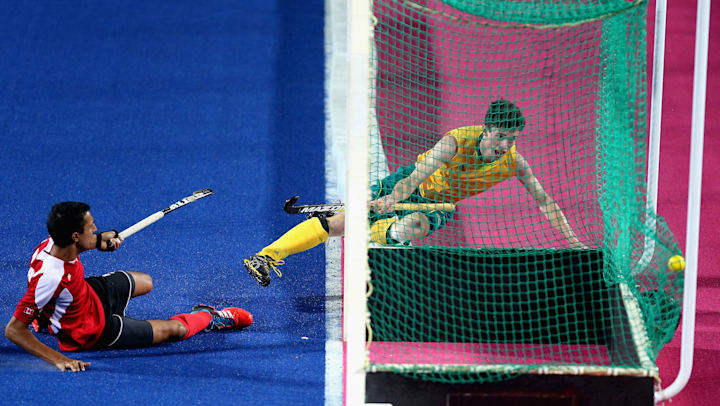
This game is a shorter and faster variant of the traditional sport of field hockey. It’s similar to what T20 is to cricket, Rugby7s is to rugby and 3x3 basketball is to basketball.
This game was first introduced in 2013 with the intent of driving up viewership of hockey by making it quicker, simpler and more entertaining.
The first time the format made an appearance on a big international stage was the 2014 Youth Olympics in China. Since then, this game has steadily grown in popularity and is played by over 60 nations.
For the uninitiated, here’s a brief introduction to the game, its rules and how to play the game.
Court: Dimensions, size and markings.
The first step in understanding a new sport is to get familiarized with the field of play and its layout.
The court is around half the size of a regular hockey field. Though the size can differ slightly from competition to competition, in the International Hockey Federation regulations, the maximum size acceptable for a court is 55mx42m while the minimum size needs to be 40mx28m.
The two boundary lines marking the length (longer distance) of the court are called the sidelines, while the lines marking the breadth (shorter distance) are called back lines.
Two goals, rectangular metal or wooden frames 3.66 m in length and 2.14 m in height are set up midway through the back lines, of the rectangular court. The area of the back line between the two goal posts, horizontal frames of the goal, on each side are called the goal lines.
Unlike field hockey, there are no Dee's or striking circles marked on a court. There’s a central line running parallel to the back lines which divides the court into two equal halves. There are two more dashed lines called quarter lines, drawn parallel to the back lines and central lines, which divide each half of the part into two equal parts.
There’s also a circular penalty spot between the quarter line and the central points between the two goalposts on each side.
Rules.
The core objective of this game is the same as field hockey, i.e. a team tries to score more goals than the opposition within a set time to win a match. All the players use a hockey stick to control the ball and to get it past the opposition’s goal line to score a goal.
However, unlike field hockey where a player needs to strike the ball from inside the Dee to score a goal, players are allowed to shoot from anywhere to score a goal in this game.
How many players can play?
Also, unlike field hockey where each side consists of 11 players, in this game a team can have a maximum of five players on the pitch at any given time, including a goalkeeper. Teams are also allowed up to four substitutions at any time in the match.
How to play.
Perhaps the biggest difference between this game and field hockey, though, is the different mechanics of play introduced by the presence of boundary boards or rebound boards.
As the name suggests, boundary boards are boards which enclose the entire court, barring the two goal lines on either end. Boundary boards are generally 10-25 cm in height.
In field hockey, if the ball crosses the sidelines, it is deemed out of play and the match resumes with a free hit. However, in this game, the ball can hit the boundary board and come back into play. This results in fewer stoppages and a far more flowing game.
The rule also introduces more angles, tactics and skills players can execute in a match, using the boundary boards.
In this game, a ball is only deemed out of play if it travels over the boundary board and across any of the borderlines.
If the ball goes over the boundary board across the sidelines, the match is restarted with a free hit from a distance not more than 1 m away from where the ball had crossed the line.
In case the ball had crossed the sideline within the quarter line area and was touched by a defender last, play restarts with an attacking player taking a free hit from just outside the quarter line area and not more than 1 m from the side-line.
If the ball goes over the back line off the stick of a defending player or the goalkeeper, play is re-started with the ball on the quarter line in their own half. An attacker takes a free hit after placing the ball in line with where it had crossed the board.
If an attacking player sends the ball over the boundary board and past the back line without scoring a goal, play is restarted with the defending team taking a free hit after placing the ball inside the quarter line area which they are defending.
Challenge in this game.
Since there is no Dee or striking circle in this game, the concept of a penalty corner, which is a potent goal-scoring option for most teams in field hockey, doesn’t exist.
Instead, there’s a ‘challenge’ in this game.
A challenge is awarded if a defender commits a foul in their own half of the court, which denies the opposition team a clear goal-scoring opportunity. An intentional offense by a defender against an opponent who has possession of the ball inside their own half of the court can also result in a challenge being awarded.
During a challenge, the ball is placed on the quarter line which was being defended by the team which committed the offense.
When the challenge starts, only an attacking player taking the challenge and the opposition goalkeeper can be in the half. All other players from both teams have to stand in the other half of the pitch, across the central line.
Once the umpire whistles, signalling the start of a challenge, the attacking player can start playing the ball. Before the whistle, the attacker has to stand behind the ball, while the goalkeeper needs to stand with both feet on or behind their goal line.
Once the attacker touches the ball after the start of a challenge, they need to move at least 4 m with the ball before taking a shot at goal.
The opposition goalie can also start moving after the attacker has touched the ball. The other players from both teams standing in the opposition half can also rejoin play once the attacker has touched the ball, initiating a challenge.
In addition to the challenge, a penalty stroke can also be awarded in this game for a defensive action preventing a certain goal, such as a foot on the goal line, or for a deliberate foul by a goalkeeper on an attacker during a challenge.
During a penalty stroke, the attacking player can place the ball on the penalty circle in the opposition half and take a direct shot at goal with only the opposition goalkeeper defending the goal.
Various fouls by players attract different types of penalties, indicated by colored cards, in this game in addition to the opposition teams getting a free hit, challenge or penalty stroke. A green card amounts to the player committing the offense being suspended for a minute. Their team will be a player down during the time the player is serving the suspension.
Similarly, a yellow card given for more severe offenses results in a two-minute suspension. A red card issued for the harshest of challenges, misconduct or accumulation of multiple warnings results in the offending player getting suspended for the remainder of the match.
How long is one match.
A match lasts for 20 minutes, divided into two halves of 10 minutes each. There is a short two-minute break between the halves.
If both teams are level at the end of the regulation time, the match either ends in a draw or is decided by a challenge shootout, where both teams alternate taking challenges in the best of five system, according to the rules of the specific tournament.

You must be logged in to post a comment.