

Colorectal cancer (CRC) is the second leading cause of cancer-related deaths in the United States for both women and men. This disease surpasses both breast and prostate cancer in mortality, second only to lung cancer in the number of cancer deaths. Despite the fact that it is highly preventable, it is estimated that 148,610 new cases of colorectal cancer will be diagnosed and 55,170 people will die from the disease in 2006. However, when detected and treated early, colorectal cancer has a five-year survival rate of greater than 90 percent. For that reason, routine screening is vital in the prevention and detection of this deadly disease.
CRC Screening
According to the American Cancer Society, “beginning at age 50, both men and women at average risk for developing colorectal cancer should follow one of these five testing schedules:
• yearly fecal occult blood test (FOBT)* or fecal immunochemical test (FIT)
• flexible sigmoidoscopy every five years
• yearly FOBT* or FIT plus flexible sigmoidoscopy every five years**
• double-contrast barium enema every five years
• colonoscopy every 10 years
* For FOBT, the take-home multiple sample method should be used.
** The combination of yearly FOBT or FIT plus flexible sigmoid-oscopy every five years is preferred over either of these options alone.
All positive tests should be followed up with colonoscopy.”
New Test
One simple, easy-to-use test is Quidel’s QuickVue
Screening for colon cancer
Doctors recommend certain screening tests for healthy people with no signs or symptoms in order to look for signs of colon cancer or noncancerous colon polyps. Finding colon cancer at its earliest stage provides the greatest chance for a cure. Screening has been shown to reduce your risk of dying of colon cancer.
Doctors generally recommend that people with an average risk of colon cancer begin screening around age 50. But people with an increased risk, such as those with a family history of colon cancer or African-American heritage, should consider screening sooner.
Several screening options exist — each with its own benefits and drawbacks. Talk about your options with your doctor, and together you can decide which tests are appropriate for you. If a colonoscopy is used for screening, polyps can be removed during the procedure before they turn into cancer.
Diagnosing colon cancer
If your signs and symptoms indicate that you could have colon cancer, your doctor may recommend one or more tests and procedures, including:
- Using a scope to examine the inside of your colon (colonoscopy). Colonoscopy uses a long, flexible and slender tube attached to a video camera and monitor to view your entire colon and rectum. If any suspicious areas are found, your doctor can pass surgical tools through the tube to take tissue samples (biopsies) for analysis and remove polyps.
-
Blood tests. No blood test can tell you if you have colon cancer. But your doctor may test your blood for clues about your overall health, such as kidney and liver function tests.
Your doctor may also test your blood for a chemical sometimes produced by colon cancers (carcinoembryonic antigen, or CEA). Tracked over time, the level of CEA in your blood may help your doctor understand your prognosis and whether your cancer is responding to treatment.
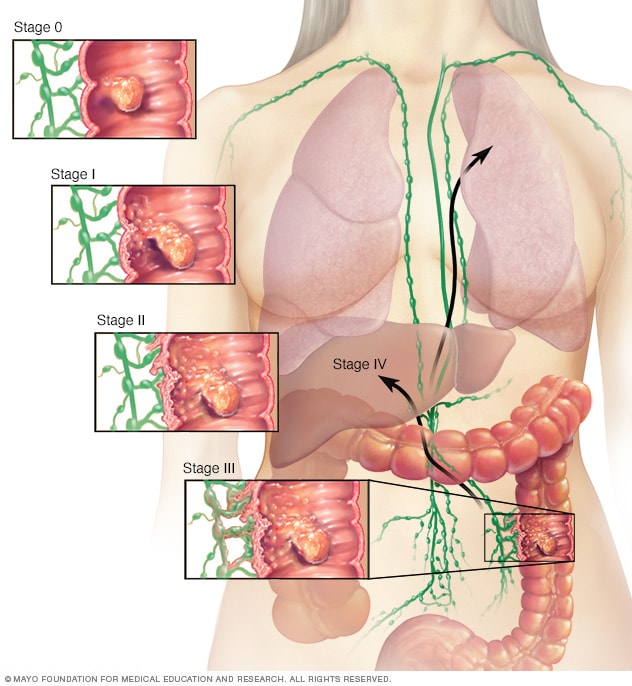
Determining the extent of the cancer
If you've been diagnosed with colon cancer, your doctor may recommend tests to determine the extent (stage) of your cancer. Staging helps determine what treatments are most appropriate for you.
Staging tests may include imaging procedures such as abdominal, pelvic and chest CT scans. In many cases, the stage of your cancer may not be fully determined until after colon cancer surgery.
The stages of colon cancer are indicated by Roman numerals that range from 0 to IV, with the lowest stages indicating cancer that is limited to the lining of the inside of the colon. By stage IV, the cancer is considered advanced and has spread (metastasized) to other areas of the body.

You must be logged in to post a comment.