
If you've ever stared at a blank page trying to write a product or service review that doesn't sound like every other generic "5 stars, would recommend" post online, you already know the problem. Good reviews are harder to write than they look. They need to feel honest, read naturally, and still do the job of helping someone make a decision, whether that's a customer deciding whether to buy, or a business owner trying to build credibility.
I've spent years writing and editing customer-facing content, including a fair number of reviews for ecommerce brands, local service providers, and SaaS companies. What I've learned is that content writing for reviews isn't really about writing at all. It's about listening. The best reviews start with real experience, real detail, and a structure that respects the reader's time.
In this guide, I'll walk you through how to write reviews that sound human, hold up to scrutiny, and actually help your content perform, whether you're writing them yourself or considering a customer review writing service to help scale the work.
Why Most Reviews Fail to Convert (Even When They're Positive)
Here's something most people get wrong: a glowing review isn't automatically a good review. If it reads like marketing copy, readers tune out immediately. People have gotten very good at spotting fake enthusiasm.
The reviews that actually influence a purchase decision usually share three traits:
-
Specificity: "Great product" tells the reader nothing. "The battery lasted 11 hours on a single charge during a full workday of video calls" tells them everything.
-
Balance: A review that mentions one minor drawback alongside the positives reads as far more credible than one that's all praise.
-
Context: Who is this review for? A review written for a first-time buyer needs different information than one aimed at someone comparing two similar products.
If your reviews are missing any of these, that's usually why they're not converting, even if the sentiment is positive.
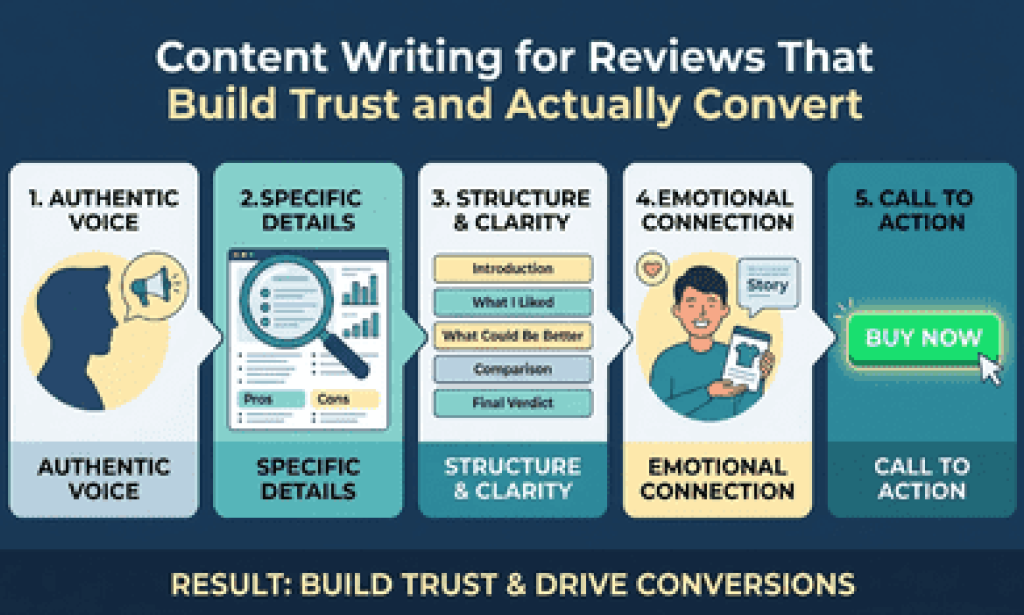
The Core Structure of a Review That Works
You don't need a rigid template, but a loose structure helps both the writer and the reader. Here's the format I default to for most review content:
1. Open with the real-world use case
Start with what the person was trying to accomplish, not with the product name and star rating. "I needed a CRM that my sales team would actually use" is a far stronger opening than "This CRM has many features."
2. Cover the specifics that matter to a buyer
Price, ease of use, customer support responsiveness, durability, delivery time: whatever's relevant to that category. Pull from actual experience or verified customer feedback rather than guessing.
3. Acknowledge limitations honestly
Even a five-star review can mention something that could be improved. This isn't just good ethics. It measurably increases trust and read-through rates.
4. End with a clear recommendation and who it's best for
"This is a strong option if you're a small team on a tight budget, but larger teams may find it limiting" is more useful than a generic "highly recommend."
Writing Reviews That Are Genuinely Helpful, Not Just SEO Bait
Google's Helpful Content guidance has made this a bigger deal than ever: content written primarily to rank, rather than to help a real person, tends to underperform over time, even if it briefly ranks well. This applies directly to review content.
A few practical habits that keep reviews on the right side of that line:
-
Answer the question the reader actually has: If someone is searching "is [product] worth it," answer that directly early in the piece, not buried three paragraphs down.
-
Avoid recycling the same five adjectives: Words like "amazing," "game-changing," and "seamless" show up constantly in low-effort reviews. Readers (and increasingly, search algorithms) notice the pattern.
-
Use first-hand language where it's true: Phrases like "in our testing" or "after using this for three months" only work if they're accurate. If a review is based on customer feedback or research rather than direct use, it's better to say so plainly than to fake experience.
This is also where featured snippet opportunities come in. A direct, 40-60 word answer to a common question like "Is [product] worth the price?" placed right after a relevant subheading gives Google a clean, quotable answer to pull into search results.
Common Mistakes That Undermine Review Credibility
I see the same handful of mistakes repeatedly, across industries:
Overpromising: Claims like "this will solve all your problems" invite skepticism. Readers trust measured language far more than superlatives.
Ignoring the comparison mindset: Most people reading a review are comparing at least two or three options. A review that never acknowledges alternatives feels incomplete.
Writing for the algorithm instead of the person: Keyword-stuffed headings and unnatural phrasing ("best [keyword] for [keyword] near me") are easy to spot and actively hurt trust.
Skipping the "who it's not for" section: This single addition does more for credibility than almost anything else in a review. It signals the writer isn't just trying to make a sale.
When to Handle Reviews In-House vs. Using a Customer Review Writing Service
Writing reviews at scale is a different challenge than writing one or two. If you're a business that needs dozens or hundreds of product or service reviews (for an ecommerce catalog, a directory site, or a content marketing campaign), doing this consistently well in-house gets difficult fast.
This is where a customer review writing service can genuinely help, provided it's the right fit. A good service should:
-
Base reviews on real product data, customer feedback, or testing rather than filler
-
Maintain a consistent, natural voice across a large volume of content
-
Follow ethical disclosure practices, especially around sponsored or incentivized reviews
-
Adapt tone and detail level to match your audience and platform (a review for a local plumbing service reads very differently than one for a software product)
The trade-off is usually about ownership and voice. In-house writing gives you tighter control over tone and product knowledge, but it takes more time. An outsourced service scales faster but needs clear guidelines and quality checks to avoid generic output. Many businesses land on a hybrid: an outsourced writer for volume, with an in-house editor doing a final pass for accuracy and voice.
If you're evaluating providers, it's worth asking to see samples in your specific industry before committing, since review writing for a restaurant and review writing for enterprise software require genuinely different skill sets.
A Quick Checklist Before You Publish
Before any review goes live, it's worth running through a short check:
-
Does it include at least one specific, concrete detail (a number, a timeframe, a named feature)?
-
Does it mention at least one limitation or trade-off?
-
Would a reader unfamiliar with the brand find this useful, even if they don't buy?
-
Is the language something a real person would actually say out loud?
-
Does it clearly state who the product or service is (and isn't) a good fit for?
If a review can't check most of these boxes, it's worth a second pass before publishing.
Final Thoughts
Good content writing for reviews comes down to respecting the reader enough to be specific, honest, and useful, even when the review is positive. That's what separates content that builds long-term trust and search visibility from content that gets skimmed and ignored.
If you're building out a larger content library, it's worth pairing this approach with a broader content strategy guide to keep your review content aligned with the rest of your site. And if you're weighing whether to write reviews in-house or bring in outside help, take the time to look at a few sample reviews from any customer review writing service before you commit. It'll tell you more than a sales pitch ever could.

You must be logged in to post a comment.