

Do the Right Thing by Yourself and Your Money!
So you have some extra cash and money to throw around? But what if you don’t? We will show you how to save some and what to do with that extra cash.
Imagine you are working a nine to five job and your salary is Rs. 100,000/-p.m. Not so much, not so little! But you can do many things with it. One of the best things you can do with it is to start saving and investing. Start saving 20% of your income every month. As a rule of thumb, it is optimal to save at least 20% of your income. Don’t let this money sit idle. This saving may well be invested in mutual funds. Mutual funds have provided a decent return of about 8-10% p.a. on average historically. So, saving and investing Rs. 20,000/-every month in mutual funds for a period of one year will leave you with Rs. 240,000/-as principal plus Rs. 14,400/-as profit @ 8% p.a. at the end of year 1, assuming the rate remains constant.
Now what do you plan to do with this money? Continue to invest in mutual funds and earn enough to outperform the inflation monster (Headline CPI was 6.2% Y-Y in December 2018)*? Perhaps this will not be enough for you.
What if you would like to spend this money? Would you like to buy that great sound system, that home theatre, that wardrobe, or that jewelry for your wife on her birthday? If you are thinking along any such lines, think again!
You know, there is so much that you can do with your money, but there is so little that you can take from it if you just keep it idle or spend it right away. It will thus translate into a loss-making story. How about making this a profitable story?
First and foremost, keep some money aside for emergencies. Who knows what’s going to happen tomorrow? There could be the odd illness, an accident, or a severe ailment that you or any family member could be affected by. What if your car gets damaged in an accident and you don’t have the cash or the insurance to get it repaired? For that purpose, you need some funds. This is where your emergency funds will come in handy and help you in your medical emergencies or in your immobile state (due to car damage) in a country where a decent transportation system is almost non-existent. So, keep some funds aside for your emergency needs.
Second of all, use some of this money to clear up any debts that you might have. Credit card bills can be a huge bite off your monthly salary. So settle these debts and set yourself free. If you have any loan payments or installments against your car or your house, try to clear off a big chunk of these payments without affecting a whole lot of your savings.
Thirdly, and most importantly, you can now use your hard-saved and invested money and put it to good use. But how do you put your money to good use? The answer lies in further investment. There are multiple asset classes to invest in nowadays that provide decent returns. You could invest in savings certificates, Treasury Bills, PIBs, commodities, money markets, real estate, mutual funds, and stocks. Each asset class has its pros and cons. If you keep your funds in savings accounts, while the funds are risk-free, the returns are nominal. In the case of savings certificates, while the returns are competitive, your funds may be locked-in for a long time. In the case of bonds, the returns are competitive, but there may be some limitations in terms of the tenure involved etc. Of all these asset classes, historically, the stock market has provided the best returns. This is illustrated by the graph below.
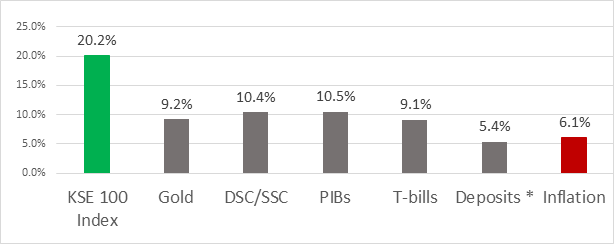
Historically, the KSE 100 Index stocks have given a return of 20.2% CAGR (Compounded Annual Growth Rate) in the last ten years and about 15.13% CAGR in the last 15 years. These figures compare fairly well with the returns gained from other investment vehicles.
So select the brokerage firm you want to do business with, open an account, and start investing in the stock market. Whether you do so in equities or in mutual funds or both is totally up to you. Because stock or equity mutual funds are a pool of professionally managed diversified portfolios of stocks, investing in mutual funds alongside direct equity or stock market is a good idea.
If you invest Rs. 150,000/-of your saved funds in the stock market and let them compound for several years, you can get a good return in the end. Instead of keeping them in a savings account or investing these funds in any other investment vehicle, investing them in the stock market for a period of five years, for example, can get you Rs 376,369/- (+), assuming the rate remains constant. This is more than double of what you started off with!
This shows that investing in the stock market is not only a better proposition than investing in any other asset class in terms of returns, historically speaking, but it will also equip you better to shield your funds from inflation. With just 20% of your salary saved and invested for a period of one year, you can save for emergencies, pay off some of your debt, and invest in the stock market (&/or mutual funds) and thus come out on top with a return of Rs 376,379/- (+) after five years of investment. So save more, invest more, and reap the benefits of stock market investing!

You must be logged in to post a comment.