

EGG EXPERIMENT
You will need:
- 1 plastic cup of water with a mouth wide enough to fit the egg.
- 1 10 (25 cm) piece of cardboard or a small tray with a SMOOTH bottom
- 1 cardboard tube (paper towel or toilet paper tubes work well)
- 1 Egg (uncooked for more drama)
What to do:
- Place the tray centered over the cup
- Place the tube on its end in the center of the tray
- Place the egg horizontally on the tube
- When ready, strike the tray hard enough with your palm to send the tray flying, but not so hard you hit the glass of water. If all goes well, the tray and paper tube will go flying, but the egg will safely drop into the water.
How does it work?
INERTIA describes an object in terms of how much energy is needed to move it or stop it from moving. Since the tray and tube are very low mass (lightweight) they have very little inertia, and will easily move out of the way.
The egg, however, is heavier (has more inertia) and so it is not easily moved, leaving it in place for gravity to bring it down into the cup.
Build A Soap Powered Model Boat
You will need:
- A foam tray (like the kind meat comes in) or a piece of cardboard
- A tray, bowl, or cookie sheet full of water
- Liquid dish soap
- A toothpick
What to do:
Cut the foam tray or cardboard into a boat shape as shown below:
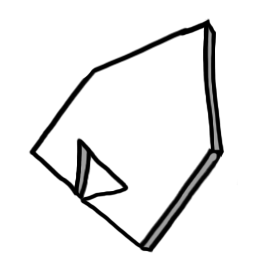 A good size seems to be about 2 inches long.
Dip the toothpick into the liquid soap and use the toothpick to put soap onto the sides of the notch at the back of the boat.
That’s it! Now carefully place the boat onto the surface of the water and watch it scoot across the water for several seconds – you’ve made a soap-powered boat! To demonstrate the boat again, you will need to rinse out the tray to remove any soap from the previous demonstration.
How does it work?
Soap is a surfactant – that means that it breaks down the surface tension of water. As the surface tension is broken up, it creates enough of a force to push the lightweight boat across the surface.
MAKE IT AN EXPERIMENT,
The project above is a DEMONSTRATION. To make it a true experiment, you can try to answer these questions:
- 1 Does liquid soap last longer than a solid piece of soap?
- 2 Does warm water work better than cold water?
- 3 What materials make the best floating boat?
-
To make a Paperclip Float,
-
You will need
clean dry paper clips
tissue paper
a bowl of water
pencil with eraserWhat to do
fill the bowl with water
try to make the paper clip float…not much luck, huh?
Tear a piece of tissue paper,
GENTLY drop the tissue flat onto the surface of the water
GENTLY place a dry paper clip flat onto the tissue (try not to touch the water or the tissue)
Use the eraser end of the pencil to carefully poke the tissue (not the paper clip) until the tissue sinks. With some luck, the tissue will sink and leave the paper clip floating!How does it work?
How is this possible? With a little thing we scientists call SURFACE TENSION. Basically it means that there is a sort of skin on the surface of water where the water molecules hold on tight together. If the conditions are right, they can hold tight enough to support your paper clip. The paperclip is not truly floating, it is being held up by the surface tension. Many insects, such as water striders, use this “skin” to walk across the surface of a stream.
MAKE IT AN EXPERIMENT
The project above is a DEMONSTRATION. To make it a true experiment, you can try to answer these questions:
1. How many paperclips can the surface tension hold?
2. Does the shape of the paperclip affect its floating ability?
3. What liquids have the strongest surface tension?
4. Can the surface tension of water be made stronger? (try sprinkling baby powder on the surface)

super
Funny fact very good
Nice
You must be logged in to post a comment.