
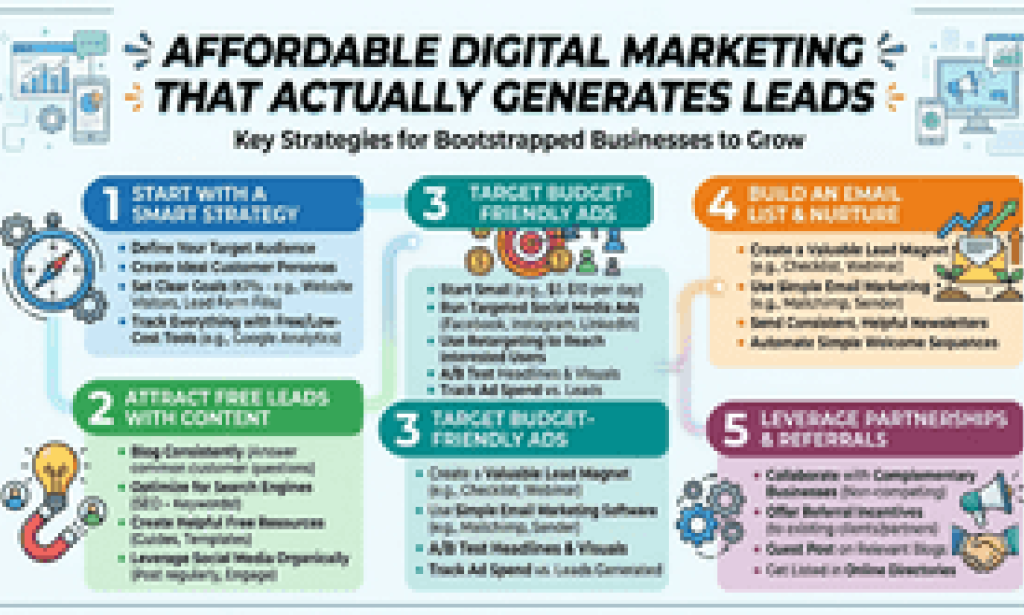
If you've ever typed "affordable digital marketing" into Google at 11pm while staring at a budget spreadsheet, I get it. You're not trying to build a billion-dollar brand. You just want your phone to ring, your inbox to get inquiries, and your ad spend to stop disappearing into a black hole.
I've worked with small business owners who burned through thousands on a "growth package" from an agency that never explained what they were actually doing. I've also seen a one-person bakery outrank national chains in local search with a modest monthly budget and a clear plan. The difference was never the size of the wallet. It was knowing exactly where the money should go.
In this guide, I'll walk you through what affordable digital marketing really looks like in 2026, which channels deliver the best return when your budget is tight, and how to build a lead generation marketing system that doesn't require a big retainer. No fluff, just what actually moves the needle.
What "Affordable" Actually Means in Digital Marketing
Before anything else, let's clear up a misconception. Affordable doesn't mean cheap, and it definitely doesn't mean free. It means spending money in proportion to what it returns.
A $500 monthly budget spent on a sloppy, untracked campaign is expensive, because you're paying for nothing measurable. The same $500 spent on a focused, well-targeted local SEO push or a tight email funnel can be genuinely affordable, because every dollar is doing identifiable work.
Here's a simple way to think about it: affordable marketing is marketing where you can draw a straight line from the money you spent to the leads you got. If you can't draw that line, the price doesn't matter, you're already overpaying.
Rough starting points I've seen work for small and mid-sized businesses: solo operators often start around a few hundred dollars a month, small teams in the low thousands, and growing businesses ready to scale push higher from there. None of this is a rule, it's just a sanity check so you're not flying blind.
The Highest ROI Channels When Money Is Tight
Not every marketing channel deserves your limited budget. Some are genuinely cost-effective for small businesses, others quietly drain cash while looking productive on a dashboard.
Local SEO and Google Business Profile
If you serve customers in a specific area, this is almost always your best starting point, and it's one of the few channels where the upfront cost is mostly your time, not your wallet. A fully optimized Google Business Profile, complete with accurate hours, real photos, and a steady stream of genuine reviews, regularly outperforms paid ads for local search visibility.
I've watched a local HVAC company move from page three to the top three map results in about four months, just by responding to every review, posting weekly updates, and fixing inconsistent business listings across directories. No ad spend involved.
Email Marketing
Email remains one of the most underrated tools for affordable digital marketing because the cost per contact is so low and the audience already knows you. A simple welcome sequence, a monthly newsletter, and an abandoned-cart or follow-up sequence can be built once and keep working for months.
The mistake most businesses make is treating email as an afterthought instead of a core lead generation marketing channel. A well-segmented list of 500 engaged subscribers will usually outperform 50,000 cold social media followers.
Content Marketing and SEO
This one takes patience, but it compounds. A blog post, service page, or how-to guide that answers a real question your customers are asking will keep bringing in organic traffic long after you've stopped actively promoting it. Unlike paid ads, the visibility doesn't switch off the moment your budget does.
Targeted Paid Ads (Used Sparingly)
Paid ads aren't off the table, but they need to be narrow and specific. Instead of broad brand-awareness campaigns, small budgets do better with hyper-targeted campaigns aimed at people actively searching for what you offer, like Google Search ads on long-tail, high-intent keywords, or retargeting ads aimed at people who already visited your site.
Building a Lead Generation Marketing System on a Small Budget
Here's where a lot of small businesses get stuck. They run ads or post on social media, get a trickle of attention, and then... nothing happens, because there's no system turning that attention into actual leads.
A basic lead generation marketing setup needs four pieces, and you genuinely don't need expensive software for any of them:
- A clear offer: Something specific people want, like a free quote, a checklist, a discovery call, or a discount code.
- A landing page: One page, one goal, no distractions. Even a simple page built with a free tool works fine to start.
- A capture method: A contact form or email signup that feeds into a spreadsheet or a free-tier CRM.
- A follow-up sequence: Most leads don't convert on the first contact. A short, automated email sequence that follows up over one to two weeks dramatically improves conversion without extra manual work.
I've seen businesses skip straight to "we need more traffic" when their real problem was that the traffic they already had was landing on a confusing page with no clear next step. Fix the system before you spend more on traffic.
Common Mistakes That Quietly Waste Marketing Budgets
A few patterns show up again and again with businesses trying to stretch a limited budget:
Spreading the budget too thin: Trying to be active on five platforms at once usually means being mediocre on all five. Pick one or two channels, do them well, then expand.
Chasing vanity metrics: Followers and likes feel good but don't pay bills. Track leads and conversions instead.
No tracking at all: If you don't know which channel brought in a customer, you can't decide where to spend next month. Free tools like Google Analytics and call tracking numbers solve this.
Stopping too early: SEO and content marketing especially need time, often three to six months, before results become clear. Many businesses quit right before momentum builds.
How Much Should Small Businesses Realistically Expect to Spend?
There's no single right answer, but a commonly used benchmark is allocating somewhere between 5% and 10% of revenue toward marketing for an established small business, a bit more for newer businesses still building awareness. The right number depends on your margins, goals, and how competitive your local market is.
What matters more than the exact figure is consistency. A modest, steady monthly budget spent every month outperforms a large one-time burst followed by silence.
Final Thoughts
Affordable digital marketing isn't about finding shortcuts or chasing the cheapest option available. It's about spending deliberately, on channels with a clear return, with a system in place to actually convert attention into leads. Local SEO, email marketing, useful content, and tightly targeted ads will outperform a scattered, expensive approach almost every time.
Start with one channel, build the basic lead capture system around it, track what happens, and expand once you see what's working. That's a far more reliable path than throwing money at every platform and hoping something sticks.
If you'd like a clearer picture of where your business currently stands, a good next step is requesting a free marketing audit or reading our guide on setting up a local SEO strategy from scratch, both will give you a concrete starting point rather than more guesswork.

You must be logged in to post a comment.