
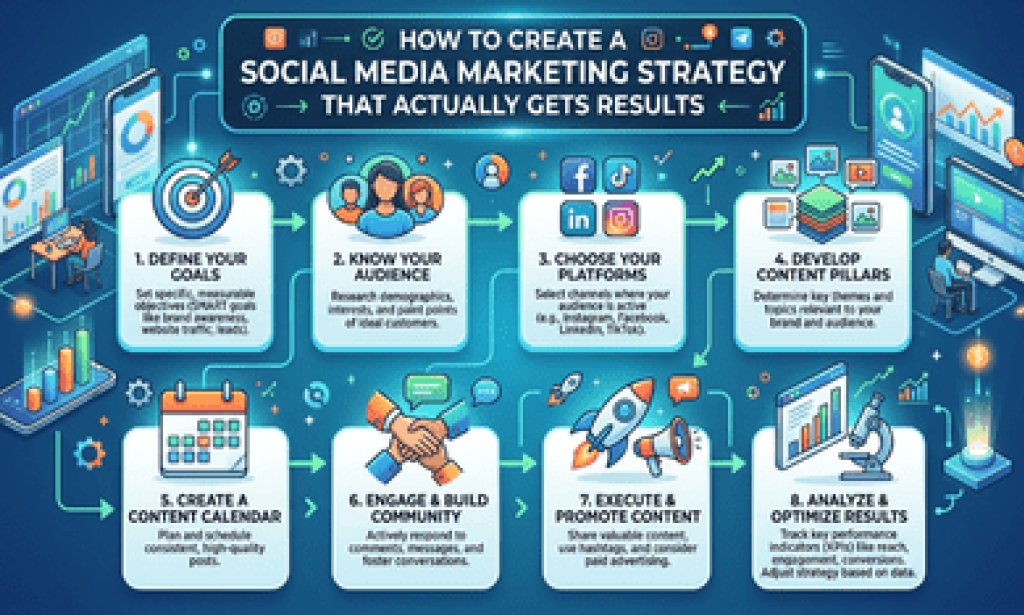
If you've ever posted on Instagram or LinkedIn and heard nothing but crickets, you're not alone. I've worked with dozens of small business owners who post consistently, use trending audio, even pay for ads, and still can't figure out why nothing moves the needle. Nine times out of ten, the problem isn't effort. It's the absence of a real social media marketing strategy behind that effort.
A strategy isn't a content calendar. It's not a list of hashtags either. It's the thinking that comes before any of that: who you're talking to, what you want them to do, and how you'll know it's working. In this guide, I'll walk you through exactly how to build one from scratch, using the same framework I use with clients, minus the agency jargon.
By the end, you'll know how to set goals that mean something, pick the right platforms, plan content that doesn't feel forced, and measure results without drowning in vanity metrics.
Start With a Goal You Can Actually Measure
Most social media plans fall apart at step one because the goal is too vague. "Grow our following" or "increase engagement" sounds fine in a meeting, but it doesn't tell you what to post or how to judge success.
Instead, tie your goal to something the business actually needs. A few examples that work well:
- Generate 30 qualified leads per month through Instagram DMs
- Drive 500 monthly visits to your website from social channels
- Build a community of 1,000 engaged followers who regularly interact with your brand
Notice each of these has a number and a timeframe. That's what makes a goal usable. If you're a local café owner, your goal might simply be filling more tables on weekday afternoons, and that's a perfectly good starting point, as long as you can trace a post back to a booking or a walk-in.
Common pain point: Many businesses set goals that copy what a competitor is doing, without checking whether that goal fits their own resources. If you have 20 minutes a day for social media, a goal built around daily video content across four platforms isn't realistic. Set goals your team can sustain for at least three months before judging results.
Know Who You're Actually Talking To
This is the step people skip, and it shows. Posting into the void without a clear picture of your audience means you're guessing at tone, timing, and topics.
Build a simple profile of your ideal follower: their age range, what problem they're trying to solve, and where they already spend time online. You don't need a 10-page persona document. Three or four honest sentences will do.
For example, a home renovation contractor might describe their audience as homeowners aged 35 to 55 who are frustrated by unreliable tradespeople and want to see proof of quality work before they commit. That single insight changes everything about the content plan. It points toward before-and-after photos, client testimonials, and behind-the-scenes process videos rather than generic inspiration quotes.
Choose Platforms Based on Where Your Audience Actually Is
A common mistake is trying to maintain a presence on every platform at once. This spreads effort thin and usually means every channel gets mediocre content instead of one or two getting great content.
Here's a quick, practical way to decide:
- Instagram and TikTok suit visual products, lifestyle brands, and younger audiences who respond to short video
- LinkedIn works best for B2B services, recruitment, and thought leadership content
- Facebook still performs well for local businesses and audiences over 40, especially for community groups and events
- Pinterest is worth testing for home, food, fashion, and DIY niches where people search for ideas
Pick one primary platform and one secondary platform to start. It's far better to post consistently and well on two channels than sporadically across five.
What If You're Not Sure Which Platform Fits?
Look at where your competitors get the most engagement, not just the most followers. A page with 2,000 followers and consistent comments is doing something right that a page with 20,000 silent followers is not. This is also a good moment to check whether your existing customer base has told you anything. A quick survey or even casual conversations at checkout can reveal where your customers actually spend their time.
Plan Content Around Themes, Not Random Ideas
Once you know your goal, audience, and platform, content planning gets much easier. Instead of asking "what should I post today," work from a small set of recurring content themes.
A reasonable starting mix looks like this:
- Educational content: tips, how-tos, and answers to common questions your audience asks
- Behind-the-scenes content: your process, your team, your workspace
- Social proof: reviews, testimonials, results, case studies
- Promotional content: offers, launches, and calls to action
A good rule of thumb is keeping promotional posts to no more than one in five. Audiences tune out feeds that feel like a constant sales pitch, and the algorithm on most platforms tends to suppress reach on posts it detects as overly promotional anyway.
Batch-create content in advance where possible. Sitting down once a week to plan and shoot content is far more sustainable than trying to come up with something fresh every single morning.
Set a Realistic Posting Schedule
Consistency matters more than frequency. Posting three times a week for six months will outperform posting daily for two weeks and then going quiet. Platforms reward accounts that show up reliably because it signals to the algorithm that you're an active, trustworthy source of content.
A workable starting schedule for most small teams:
- 3 to 4 posts per week on your primary platform
- 1 to 2 posts per week on your secondary platform
- Stories or short-form updates as time allows, since these require less production effort
Adjust based on what your analytics tell you after the first month, rather than guessing upfront.
Track the Metrics That Actually Matter
This is where a strategy either proves itself or falls apart. Vanity metrics like follower count feel good, but they rarely correlate with revenue. Focus instead on:
- Engagement rate relative to your follower count, not raw likes
- Click-through rate to your website or booking page
- Conversion actions: messages sent, forms filled, calls made
- Follower growth quality: are new followers matching your target audience
Review these numbers monthly, not daily. Social media results are noisy in the short term, and reacting to a single bad week often leads to abandoning strategies that were actually working.
Adjust and Refine as You Go
No strategy survives first contact with real data completely intact. Some content formats will outperform your expectations; others will flop despite looking good on paper. Treat your first three months as a learning phase. Keep what works, quietly retire what doesn't, and avoid the temptation to chase every new platform trend that appears in your feed.
If you're managing this alongside running a business, it's worth exploring how a content calendar template or a social media management tool can reduce the manual workload, or when it makes sense to bring in outside help for platforms like paid social advertising.
Key Takeaways
Building a social media marketing strategy isn't about mastering every platform trick. It's about clarity. Know your goal, know your audience, pick the right platforms, plan themed content, post consistently, and measure what actually matters. Get those fundamentals right, and the rest becomes far easier to figure out.
If you'd like a second opinion on your current approach, or want help auditing what's working and what isn't, reach out for a chat about your social media goals. Sometimes an outside perspective catches things you can't see from inside the business.

You must be logged in to post a comment.