
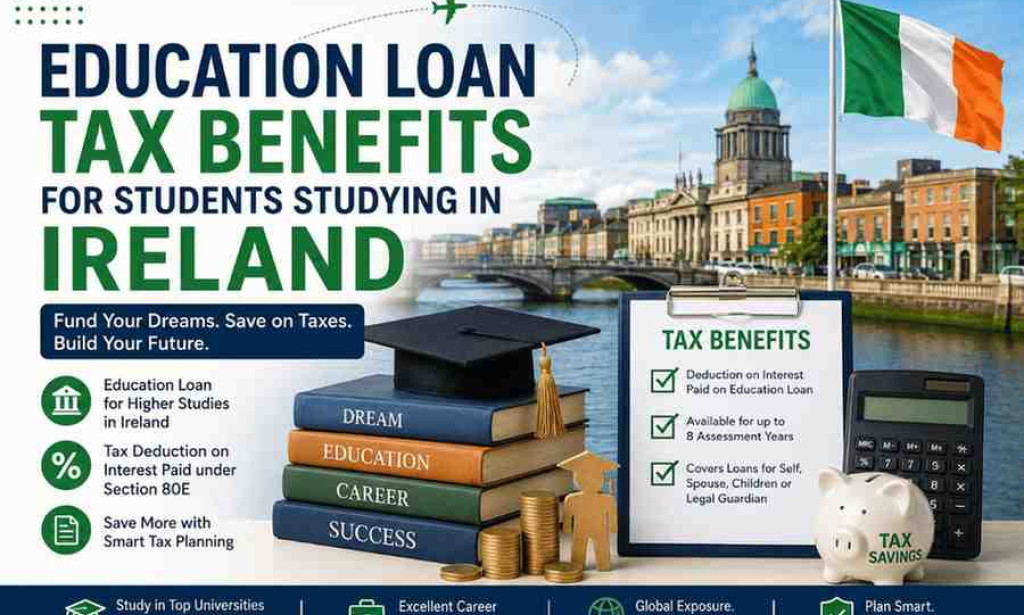
Studying in Ireland is an attractive choice for Indian students because of its globally recognised universities, strong employability outcomes, English-speaking environment, and post-study work opportunities. However, the total cost of education can be significant when tuition fees, accommodation, travel, health insurance, living expenses, visa documentation, and currency fluctuations are added together. For many families, an education loan becomes an important part of the study-abroad plan.
Students and parents often compare secured and unsecured loan options while searching for terms such as abroad education loan without collateral Ireland. While choosing the right loan matters, understanding the tax benefits linked to education loans is equally important. A well-planned education loan can not only help fund studies in Ireland but may also reduce the borrower’s tax burden in India through deductions on interest repayment.
This article explains the tax benefits available on education loans for students studying in Ireland, who can claim them, what expenses are covered, how Section 80E works, what documents are required, and how students and parents can plan repayments more efficiently.
Why Tax Planning Matters for Ireland Education Loans
Ireland is home to leading institutions in fields such as business, data science, computer science, finance, engineering, medicine, pharmaceuticals, public policy, and hospitality. Universities and institutes in Ireland attract students from across the world, and many Indian students finance their education through loans from banks, non-banking financial companies, and international lenders.
An education loan is usually taken to cover one or more of the following:
-
Tuition fees
-
Living expenses
-
Travel costs
-
Laptop or study equipment
-
Health insurance
-
Examination fees
-
Library or laboratory charges
-
Visa-related financial proof
-
Other course-related expenses
Since the repayment period can last several years, even a small tax benefit can make a meaningful difference. The biggest education loan tax benefit available to Indian taxpayers is under Section 80E of the Income Tax Act, 1961. This section allows eligible taxpayers to claim a deduction on the interest paid on an education loan taken for higher education.
The important point is that the tax benefit is not linked to whether the student studies in India or abroad. If the education loan is taken for higher education and meets the conditions under Section 80E, the borrower may claim the deduction even when the student is studying in Ireland.
What Is Section 80E?
Section 80E is a provision under Indian income tax law that provides a deduction for interest paid on an education loan taken for higher studies. This deduction is available to an individual taxpayer who has taken the loan for:
-
Their own higher education
-
Higher education of their spouse
-
Higher education of their children
-
Higher education of a student for whom the individual is a legal guardian
For students going to Ireland, Section 80E can be especially useful because international education loans often involve larger amounts and longer repayment periods. As a result, the interest component can be substantial, especially in the early years of repayment.
The deduction under Section 80E applies only to the interest paid on the education loan. The principal repayment is not eligible for deduction under this section.
Is an Ireland Education Loan Eligible for Tax Benefits in India?
Yes, an education loan taken for studying in Ireland can be eligible for tax benefits in India, provided the loan satisfies the requirements under Section 80E.
The law does not restrict the deduction only to Indian colleges or universities. The loan must be for higher education, and higher education generally refers to courses pursued after completing senior secondary education or its equivalent.
This means a loan for undergraduate, postgraduate, doctoral, professional, or specialised higher education courses in Ireland may qualify, subject to the other conditions of Section 80E.
For example, a student taking a loan for any of the following Ireland courses may be able to claim tax benefits through the eligible borrower:
-
Master’s in Data Analytics
-
MBA in Ireland
-
MSc in Computer Science
-
Master’s in Finance
-
Engineering postgraduate programmes
-
Public health or healthcare-related programmes
-
Undergraduate degree programmes
-
Doctoral or research programmes
-
Professional diploma or higher education programmes
The course and institution should be properly documented, and the loan should be taken from an eligible lender.
Who Can Claim the Education Loan Tax Benefit?
The person who repays the loan and pays the interest can claim the deduction, provided they are an individual taxpayer in India and the loan is in their name.
The deduction can typically be claimed by:
1. The Student
If the student takes the loan in their own name and later starts earning taxable income in India while repaying the loan, the student may claim the deduction on the interest paid.
This may apply when a student returns to India after completing education in Ireland or has taxable Indian income while repaying the loan.
2. The Parent
Many education loans for Ireland are taken by parents as the primary borrower or co-borrower. If the parent is paying the interest, the parent may claim the deduction, provided the loan meets the requirements.
This is common when the student is not earning during the study period and the parent begins paying simple interest or EMI.
3. The Spouse
If an individual takes an education loan for their spouse’s higher education in Ireland and pays the interest, they may be eligible to claim the deduction.
4. The Legal Guardian
A legal guardian who takes and repays an eligible education loan for a student’s higher education may also claim the deduction.
What Amount Can Be Claimed as Deduction?
Under Section 80E, the entire interest amount paid during the financial year can be claimed as a deduction, subject to the conditions of the section.
There is no specific upper monetary limit mentioned for the interest deduction under Section 80E. This makes it different from many other deductions that are capped at a fixed amount.
For example, suppose a parent pays ₹2,40,000 as interest on an education loan in a financial year for their child’s master’s degree in Ireland. If the loan is eligible, the parent may claim ₹2,40,000 as a deduction from taxable income for that year.
However, only the interest portion qualifies. If the total EMI paid during the year is ₹5,00,000, and out of this ₹2,40,000 is interest while ₹2,60,000 is principal repayment, only ₹2,40,000 can be claimed under Section 80E.
How Long Can the Section 80E Deduction Be Claimed?
The deduction is available for a limited period. It can be claimed for up to eight assessment years, starting from the year in which repayment of interest begins, or until the interest is fully repaid, whichever happens earlier.
This is important for Ireland education loan planning because many students opt for a moratorium period during the course duration and for a few months after course completion. During the moratorium, some lenders may charge simple interest, while others may add the interest to the outstanding loan amount.
Borrowers should understand when interest repayment actually begins and maintain records from that point onward.
Example: How Section 80E Works for an Ireland Education Loan
Let us understand this with an example.
Assume a student takes an education loan of ₹35 lakh for a master’s degree in Ireland. The parent is the co-borrower and starts repaying the loan after the course is completed. During the first year of repayment, the total EMI paid is ₹6 lakh. Out of this, ₹3.2 lakh is interest and ₹2.8 lakh is principal.
In this case:
-
Total EMI paid: ₹6,00,000
-
Interest component: ₹3,20,000
-
Principal component: ₹2,80,000
-
Deduction available under Section 80E: ₹3,20,000
The deduction reduces taxable income, not tax directly. The actual tax saving depends on the borrower’s income tax slab.
For example, if the borrower falls in a higher tax bracket, the tax saving from the deduction may be more significant than for someone in a lower tax bracket.
Secured vs Unsecured Education Loans for Ireland
Students planning to study in Ireland usually compare two broad loan categories: secured loans and unsecured loans.
Secured Education Loans
A secured loan requires collateral. The collateral may include property, fixed deposits, government bonds, or other acceptable assets. Secured loans often come with larger sanction amounts and comparatively lower interest rates.
Unsecured Education Loans
An unsecured education loan does not require collateral. These loans are often chosen by students who do not have property or other assets to pledge. However, unsecured loans may have stricter eligibility criteria, higher interest rates, and stronger dependence on the co-applicant’s income profile.
A student comparing a study loan for Ireland education should not look only at the loan amount. They should compare interest rate, processing fee, moratorium terms, repayment tenure, prepayment rules, collateral requirement, tax benefit eligibility, exchange-rate risk, and whether the lender is acceptable for visa documentation.
The tax benefit under Section 80E is linked to the interest paid on an eligible education loan, not directly to whether the loan is secured or unsecured. However, the lender must meet the eligibility conditions under the law.
Which Lenders Are Eligible for Section 80E?
To claim the deduction, the loan should be taken from a recognised financial institution or an approved charitable institution as defined under the Income Tax Act.
Generally, loans from scheduled banks and eligible financial institutions may qualify. Borrowers should be careful when taking loans from informal sources, relatives, friends, or unrecognised private lenders, because such loans may not qualify for Section 80E deduction.
Before finalising an Ireland education loan, students and parents should ask the lender for clarity on:
-
Whether the loan is eligible for Section 80E benefits
-
Whether the lender provides an annual interest certificate
-
Whether the borrower can access repayment statements
-
Whether the loan sanction letter clearly states the purpose as higher education
-
Whether the loan covers the Ireland course and institution details
The annual interest certificate is especially important because it helps the borrower calculate and claim the deduction correctly while filing the income tax return.
Documents Required to Claim Education Loan Tax Benefit
To claim the education loan tax benefit for studying in Ireland, the borrower should maintain proper documentation.
Important documents include:
1. Loan Sanction Letter
This document proves that the loan was taken for higher education. It usually includes the sanctioned amount, borrower and co-borrower names, repayment terms, moratorium period, interest rate, and course details.
2. Interest Certificate
This is one of the most important documents for claiming the deduction. The lender issues an interest certificate showing how much interest was paid during the financial year.
Only the interest portion is eligible for deduction, so this certificate helps avoid confusion between principal and interest.
3. Repayment Schedule
The repayment schedule shows the EMI structure, interest component, principal component, and outstanding balance.
4. Proof of Admission
The admission letter or offer letter from the Irish university helps establish that the loan was taken for higher education.
5. Fee Receipts
Tuition fee receipts and other education-related payment receipts should be preserved.
6. Bank Statements
Bank statements showing EMI or interest payments can support the claim if required.
7. Tax Filing Records
Copies of income tax returns and deduction details should be maintained for future reference.
Can Parents Claim Tax Benefits If the Student Studies Abroad?
Yes. Parents can claim the tax deduction if they have taken the education loan for their child’s higher education and are paying the interest.
This is particularly relevant for Indian students studying in Ireland because many students may not have taxable income during the study period. Parents often support repayment during the moratorium or early EMI years.
However, the parent should be a borrower or co-borrower and should be the person actually paying the interest. If the loan is only in the student’s name but the parent is informally transferring money, tax treatment may become less straightforward. Proper loan structuring at the application stage is therefore important.
Can Students Claim the Benefit After Moving Abroad?
This depends on the student’s tax status and income.
If the student has taxable income in India and is repaying an eligible education loan, they may be able to claim the deduction under Section 80E while filing an Indian income tax return.
If the student is working in Ireland and does not have taxable income in India, the practical benefit of Section 80E may be limited because the deduction reduces taxable income in India. Students should consult a tax advisor if they have income in both India and Ireland, or if their residential status changes.
Is Principal Repayment Eligible for Tax Deduction?
No. Principal repayment is not eligible under Section 80E.
This is one of the most common misunderstandings about education loan tax benefits. Many borrowers assume that the entire EMI qualifies for deduction. In reality, only the interest component qualifies.
For example:
-
EMI paid in a year: ₹4,80,000
-
Interest component: ₹2,10,000
-
Principal component: ₹2,70,000
-
Eligible deduction: ₹2,10,000 only
Borrowers should rely on the lender’s interest certificate rather than estimating the amount manually.
Does the Deduction Apply During the Moratorium Period?
The answer depends on whether interest is actually paid during the moratorium period.
Many education loans offer a moratorium covering the course duration plus an additional grace period. During this time, the borrower may not be required to pay full EMIs. However, interest may continue to accrue.
Some borrowers choose to pay simple interest during the moratorium to reduce the total loan burden. If eligible interest is paid during the financial year, it may be considered for deduction, subject to Section 80E conditions.
If interest is not paid and is only accumulated or capitalised, the deduction generally becomes relevant when the borrower actually starts paying interest.
Borrowers should check the repayment structure with the lender and maintain annual certificates.
Ireland-Specific Cost Factors That Affect Loan and Tax Planning
The size of the education loan depends on the total cost of studying in Ireland. Students should plan beyond tuition fees because living expenses in cities such as Dublin, Cork, Galway, and Limerick can vary significantly.
Important Ireland-specific cost factors include:
Tuition Fees
Tuition fees differ based on university, course level, and subject area. Business, technology, medicine, and specialised master’s programmes may have higher fees.
Living Expenses
Accommodation is often one of the largest expenses in Ireland. Students should budget for rent, utilities, groceries, transport, mobile bills, study materials, and personal expenses.
Visa Financial Proof
Students applying for an Irish student visa need to demonstrate sufficient financial capacity. Education loan sanction letters may help support the visa application, but students should always check the latest Irish immigration requirements before applying.
Currency Fluctuation
Since the loan may be sanctioned in Indian rupees while expenses are in euros, exchange-rate movement can affect the final cost.
Part-Time Work
Many students plan to support part of their living expenses through part-time work, but loan planning should not depend entirely on expected part-time income.
Post-Study Work Period
Ireland’s post-study work opportunities can help students gain international experience, but repayment planning should include conservative assumptions about job search timelines and salary.
Ireland Tuition Fee Tax Relief: Is It Relevant for Indian Students?
Ireland has its own tax relief rules for qualifying third-level tuition fees. However, this is separate from India’s Section 80E education loan deduction.
In general, Ireland’s tuition fee tax relief may be relevant to individuals who are within the Irish tax system and who have paid qualifying tuition fees for approved courses. For Indian students, this may become relevant if they are earning taxable income in Ireland and satisfy Irish tax conditions.
However, students should not confuse the two systems:
-
Section 80E is an Indian income tax deduction for interest paid on an eligible education loan.
-
Ireland tuition fee relief is an Irish tax relief linked to qualifying tuition fees under Irish rules.
A student or parent should consult a qualified tax professional if they are dealing with both Indian and Irish tax systems.
How to Claim Section 80E While Filing Income Tax Return
The process of claiming the deduction is generally straightforward if documents are in order.
Step 1: Get the Interest Certificate
Request the lender to provide an annual interest certificate for the relevant financial year. This certificate should clearly show the interest paid.
Step 2: Confirm Eligibility
Check whether the loan was taken from an eligible lender and whether it was used for higher education.
Step 3: Calculate the Deduction
Use the interest amount mentioned in the certificate. Do not include principal repayment.
Step 4: Enter the Deduction in the ITR
While filing the income tax return, enter the eligible interest amount under Section 80E.
Step 5: Keep Records
The documents may not always need to be uploaded with the return, but they should be preserved in case the tax department asks for proof later.
Common Mistakes to Avoid
Mistake 1: Claiming the Full EMI
Only the interest component is eligible. The principal component is not deductible under Section 80E.
Mistake 2: Taking a Loan from an Ineligible Source
Loans from friends, relatives, or informal lenders may not qualify.
Mistake 3: Not Collecting the Interest Certificate
Without an interest certificate, it becomes difficult to support the deduction claim.
Mistake 4: Assuming Tax Benefit Applies Automatically
The borrower must claim the deduction while filing the income tax return.
Mistake 5: Confusing Tuition Fee Relief with Loan Interest Deduction
India’s Section 80E deduction is for education loan interest. It is not a tuition fee deduction.
Mistake 6: Poor Loan Structuring
If parents plan to claim the deduction, they should ensure that the loan structure supports their role as borrower or co-borrower.
Mistake 7: Ignoring Repayment Timing
The deduction is available for a limited number of years. Borrowers should plan repayment with this timeline in mind.
Tax Benefit Example for Parents Funding Ireland Education
Suppose a parent takes an education loan for their child’s postgraduate course in Ireland. The loan amount is ₹45 lakh. The repayment starts after the course is completed.
In the first repayment year:
-
Total EMI paid: ₹7,20,000
-
Interest paid: ₹4,10,000
-
Principal repaid: ₹3,10,000
The parent may claim ₹4,10,000 as a deduction under Section 80E, assuming all eligibility conditions are met.
If the parent falls in a higher income tax slab, this deduction can reduce the tax outgo meaningfully. The exact tax saving will depend on the applicable tax regime, income level, surcharge, cess, and other deductions.
New Tax Regime vs Old Tax Regime: Check Before Claiming
Indian taxpayers should also consider the applicable tax regime. Over recent years, India’s tax regime options have changed, and the new tax regime has become the default for many taxpayers.
Deductions available under different tax regimes can vary. Therefore, borrowers should check whether Section 80E deduction is available under the tax regime they choose for the relevant assessment year.
Before filing the return, compare tax liability under both applicable options, where permitted, and choose the one that gives the better result. A tax professional or income tax calculator can help with this comparison.
Education Loan Planning Tips for Students Going to Ireland
1. Compare More Than Interest Rates
A low interest rate is important, but it is not the only factor. Compare processing fee, margin money, moratorium period, repayment tenure, prepayment charges, collateral requirement, insurance cost, and disbursement process.
2. Ask for Section 80E Documentation
Before finalising the lender, ask whether they provide annual interest certificates for tax filing.
3. Decide Who Should Be the Borrower
If the parent will claim the deduction, the loan structure should support that. If the student will claim it later, the student’s income and residential status should be considered.
4. Pay Simple Interest During Moratorium If Possible
Paying simple interest during the moratorium may reduce total loan cost and may also create a record of interest payment. However, this should be planned based on cash flow.
5. Keep All Ireland Education Documents
Preserve admission letters, fee invoices, visa documents, rent estimates, insurance receipts, and university communication.
6. Avoid Over-Borrowing
Borrow enough to cover realistic expenses, but avoid taking a much larger loan than required. Higher borrowing means higher interest burden.
7. Plan for Currency Risk
If the rupee weakens against the euro, costs may increase. Keep a buffer in the financial plan.
8. Start Repayment Planning Before Graduation
Do not wait until the first EMI is due. Plan repayment based on expected salary, job location, living costs, and family support.
Frequently Asked Questions
1. Can I claim tax benefits for an education loan taken for studying in Ireland?
Yes, if the loan is taken for higher education from an eligible lender and the borrower pays interest on the loan, the deduction may be claimed under Section 80E, subject to applicable conditions.
2. Is there any maximum limit for Section 80E deduction?
There is no fixed monetary cap on the interest deduction under Section 80E. The eligible interest paid during the financial year can be claimed, subject to the law.
3. Can I claim deduction on principal repayment?
No. Only interest paid on the education loan is eligible. Principal repayment is not covered under Section 80E.
4. Can parents claim the deduction for a child studying in Ireland?
Yes. Parents may claim the deduction if they have taken the loan for their child’s higher education and are paying the interest, subject to eligibility conditions.
5. Can I claim the benefit if the loan is unsecured?
The deduction is not based solely on whether the loan is secured or unsecured. The key requirement is that the loan must be from an eligible financial institution or approved charitable institution and must be for higher education.
6. Can I claim tax benefit for a loan from relatives?
No. Loans from relatives, friends, or informal sources generally do not qualify for Section 80E deduction.
7. For how many years can I claim Section 80E deduction?
The deduction can be claimed for up to eight assessment years starting from the year in which interest repayment begins, or until the interest is fully repaid, whichever is earlier.
8. Does Ireland provide separate tax relief on tuition fees?
Ireland has its own tuition fee tax relief rules for qualifying third-level courses. This is separate from India’s Section 80E and may be relevant only if the person claiming falls within the Irish tax framework and meets Irish tax conditions.
9. Is the deduction available if the student works in Ireland after graduation?
The deduction is useful only against taxable income in India. If the student has no taxable income in India, the practical benefit may be limited. Cross-border tax situations should be reviewed with a tax advisor.
10. What is the most important document for claiming the deduction?
The annual interest certificate from the lender is the most important document because it shows the exact interest paid during the financial year.
Final Thoughts
An education loan can make studying in Ireland more accessible, but smart repayment and tax planning can make the loan more manageable over time. For Indian students and parents, Section 80E offers a valuable deduction on the interest paid on eligible education loans for higher studies, including studies in Ireland.
The most important things to remember are simple: only interest is deductible, the loan must be from an eligible lender, the deduction is available for a limited period, and proper documentation is essential.
Before choosing a lender, students and families should compare secured and unsecured options, understand repayment obligations, check tax documentation support, and plan the borrower structure carefully. With the right planning, an Ireland education loan can support both academic goals and long-term financial efficiency.
This article is for general informational purposes only. Tax rules may change, and individual situations can differ. Students and parents should consult a qualified tax advisor before making tax or loan decisions.

You must be logged in to post a comment.