
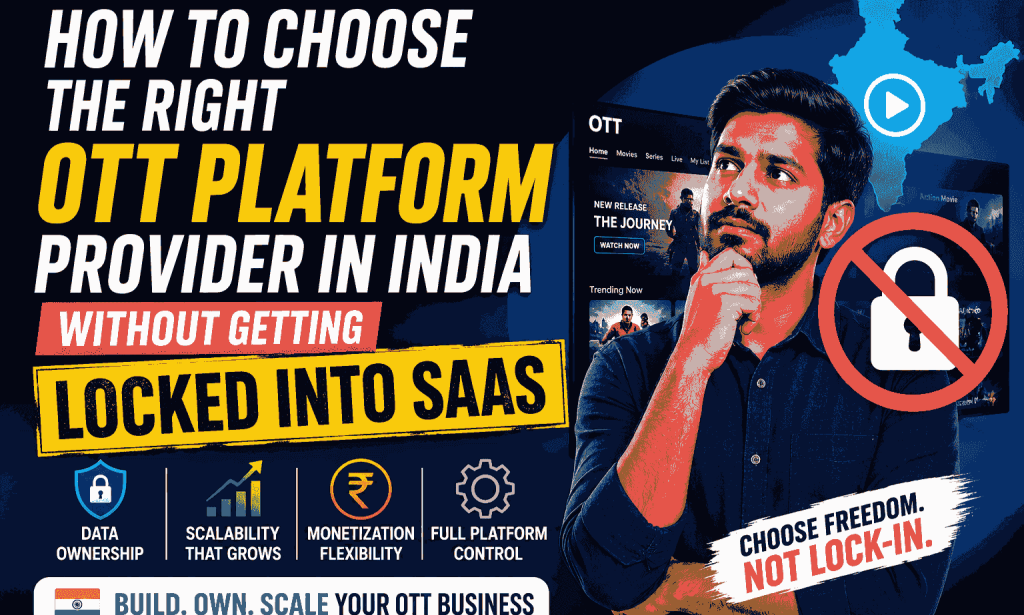
The OTT industry in India is growing faster than ever. From entertainment platforms and regional streaming apps to EdTech, fitness, faith-based content, and microdrama startups, businesses across industries are launching their own streaming ecosystems to build direct relationships with audiences.
But while launching an OTT platform has become easier, choosing the wrong OTT infrastructure can create long-term scalability problems.
Many businesses start with SaaS OTT platforms because they offer quick deployment and low upfront costs. However, as subscriber numbers grow, limitations around customization, monetization, data ownership, and recurring platform fees often become major operational challenges.
This is why businesses planning for long-term OTT growth are now evaluating platforms differently. Instead of only looking at launch speed, they are focusing on ownership, scalability, revenue control, and infrastructure flexibility before selecting an OTT platform provider in India.
Why Choosing the Right OTT Platform Matters in 2026
India’s OTT ecosystem is no longer limited to large entertainment companies. Today, creators, media brands, educators, broadcasters, and startups are building niche streaming platforms for highly targeted audiences.
The competition is increasing, but so are audience expectations.
Users now expect:
- Multi-device streaming
- Personalized recommendations
- Smooth playback
- Subscription flexibility
- Regional language accessibility
- AI-powered content discovery
To support these expectations, businesses need OTT infrastructure that can scale without forcing them into long-term dependency on third-party ecosystems.
That’s where the difference between SaaS OTT platforms and ownership-based OTT solutions becomes critical.
Understanding SaaS OTT Platforms
A SaaS OTT platform is essentially a subscription-based streaming solution where the provider manages the infrastructure, hosting, updates, and backend systems.
These platforms are popular because they:
- Launch quickly
- Require minimal technical setup
- Offer pre-built monetization tools
- Reduce initial operational complexity
For early-stage creators or small businesses, this can seem like the ideal starting point.
However, the real challenges usually appear during scale.
The Problem With OTT Platform Lock-In
Many OTT businesses realize too late that they are building their audience on infrastructure they do not actually control.
As the platform grows, businesses often encounter limitations such as:
- Rising recurring subscription costs
- Revenue-sharing models
- Restricted feature customization
- Limited backend access
- Migration difficulties
- Dependency on platform-specific ecosystems
- Limited control over audience data
This is commonly referred to as vendor lock-in.
Once thousands of users, subscriptions, payment systems, and apps are connected to a SaaS provider, migrating to another platform becomes expensive and technically complex.
For growing OTT businesses, this can directly impact profitability and operational flexibility.
Why Data Ownership Is Becoming a Major OTT Advantage
One of the biggest shifts happening in the OTT industry is the growing importance of first-party audience data.
Streaming platforms now rely heavily on:
- Viewer behavior analysis
- Retention tracking
- Personalized recommendations
- Ad targeting
- Content performance analytics
- Subscription optimization
When businesses do not fully own or control this data, they lose a major competitive advantage.
Ownership-focused OTT infrastructure allows businesses to:
- Control subscriber databases
- Access complete user analytics
- Build independent marketing systems
- Reduce dependency on third-party algorithms
- Improve monetization strategies over time
For businesses building long-term digital assets, data ownership is no longer optional.
SaaS vs Ownership-Based OTT Platforms
Choosing between SaaS and ownership-based OTT infrastructure depends on long-term business goals.
SaaS OTT Platforms
Best suited for:
- Fast MVP launches
- Small creator communities
- Short-term experimentation
- Businesses prioritizing speed over control
Advantages:
- Faster deployment
- Lower upfront investment
- Managed hosting and maintenance
Limitations:
- Scaling costs increase over time
- Limited deep customization
- Platform dependency
- Shared infrastructure environment
Ownership-Based White-Label OTT Platforms
Ownership-focused OTT platforms are designed for businesses that want greater infrastructure control, long-term scalability, and independent monetization flexibility.
These solutions typically offer:
- White-label branding
- Self-hosted or dedicated infrastructure
- Full data ownership
- Flexible monetization systems
- Custom integrations
- Advanced scalability options
Instead of renting platform access, businesses build OTT as a long-term digital asset.
This model is becoming increasingly popular among regional OTT startups, enterprises, broadcasters, and businesses building subscription-driven ecosystems.
Key Factors to Evaluate Before Choosing an OTT Platform Provider
1. Monetization Flexibility
Your OTT platform should support multiple monetization models such as:
- SVOD (subscriptions)
- AVOD (advertising)
- TVOD (pay-per-view)
- Hybrid monetization
Businesses that rely on only one revenue stream often struggle to optimize long-term profitability.
2. Data Ownership & Analytics
Before selecting any OTT provider, understand:
- Who owns the audience data?
- Can you export subscriber information?
- Do you control analytics independently?
- Is data accessible for future migration?
The more control you have over your audience insights, the stronger your long-term business position becomes.
3. Multi-Device App Support
Modern OTT platforms must support:
- Android
- iOS
- Smart TVs
- Web streaming
- Fire TV
- Apple TV
Viewers expect seamless streaming experiences across all devices.
4. Scalability Infrastructure
Many platforms perform well initially but struggle during traffic spikes or subscriber growth.
Evaluate:
- CDN infrastructure
- Auto-scaling capability
- Live streaming performance
- Concurrent user handling
- Video optimization systems
Scalability directly impacts user retention and revenue stability.
5. Customization Capability
As OTT businesses grow, they often require:
- Custom workflows
- Unique monetization systems
- AI integrations
- Regional features
- Third-party integrations
Platforms with rigid structures can slow innovation significantly.
6. Security & DRM Protection
Premium content requires strong protection systems including:
- DRM security
- Dynamic watermarking
- Screen recording prevention
- Secure payment systems
Content piracy remains one of the biggest OTT industry challenges globally.
Emerging OTT Trends Businesses Should Prepare For
The OTT industry in India is evolving beyond traditional streaming.
Several major trends are shaping platform decisions in 2026:
AI-Powered Content Discovery
Modern OTT platforms increasingly use AI to:
- Improve recommendations
- Analyze viewer behavior
- Generate automated metadata
- Optimize engagement
- Increase retention rates
Advanced platforms are also exploring AI facial recognition for scene-level search and interactive content experiences.
Regional & Niche OTT Growth
Regional language OTT platforms are growing rapidly due to:
- Smartphone penetration
- Affordable internet access
- Localized storytelling demand
Businesses targeting niche communities often outperform generalized platforms because of stronger audience loyalty.
Hybrid Monetization Models
OTT businesses are moving beyond subscription-only models by combining:
- Ads
- Subscriptions
- Pay-per-view
- Sponsorship integrations
This diversification helps reduce revenue dependency on a single monetization source.
Microdrama & Short-Form OTT
Short episodic storytelling formats are seeing rapid growth, especially on mobile-first streaming platforms.
Microdrama content increases:
- Engagement frequency
- Binge behavior
- Viewer retention
- Content consumption speed
This trend is influencing how OTT infrastructure is designed for mobile audiences.
The Real Cost of Choosing the Wrong OTT Platform
Many businesses focus only on launch pricing while ignoring long-term operational costs.
Hidden OTT costs often include:
- Revenue-sharing fees
- Bandwidth overages
- App maintenance charges
- Upgrade limitations
- Migration costs
- Feature unlock fees
What appears affordable initially can become significantly more expensive as the platform scales.
That’s why businesses increasingly evaluate Total Cost of Ownership (TCO) instead of only monthly subscription pricing.
Final Thoughts
Choosing the right OTT platform provider in India is no longer just a technical decision. It directly impacts your scalability, revenue model, operational flexibility, and long-term business ownership.
SaaS OTT platforms can be useful for rapid deployment and early experimentation, but businesses planning to scale should carefully evaluate the risks of platform dependency and vendor lock-in before committing long term.
The future of OTT is moving toward greater ownership, data control, AI-driven personalization, and independent monetization ecosystems.
Businesses that invest in scalable, ownership-focused OTT infrastructure today will be in a stronger position to adapt, monetize, and grow as the streaming industry continues evolving across India and global markets.
Author BioNishit Kachiya is focused on OTT infrastructure, white-label streaming technology, and scalable digital media ecosystems. Through Regal Streaming Solutions, he works with businesses building ownership-driven OTT platforms with advanced monetization and AI-powered streaming capabilities.

You must be logged in to post a comment.