
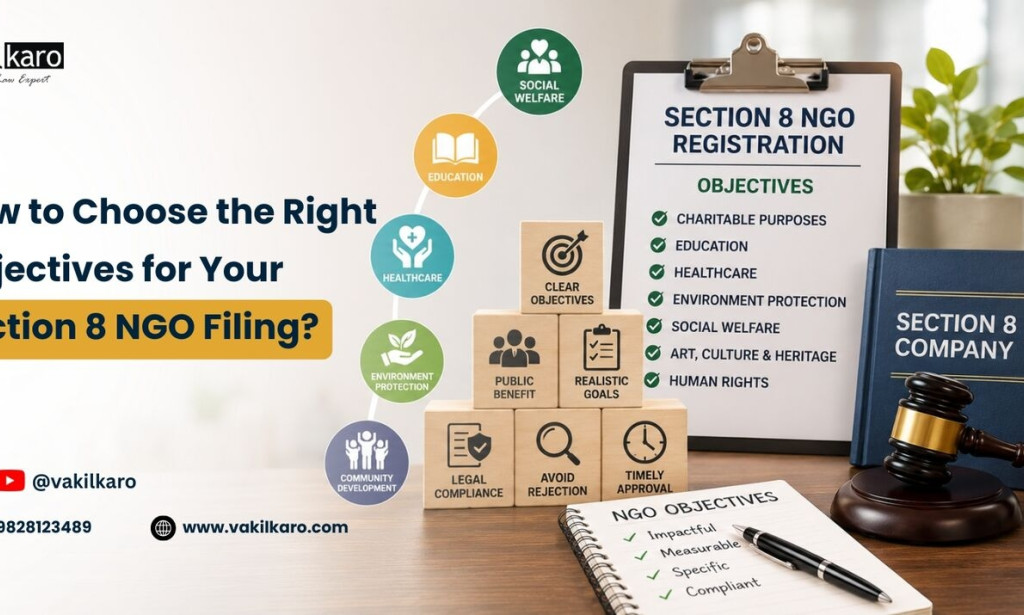
Writing down the objectives is Definitely the most critical part of Section 8 NGO incorporation. Surprisingly, plenty of the applications are delayed, require resubmission, or scrutinized because the founders either copy the general objectives from the internet or they do not describe well enough their planned activities. The objectives that are taken into account while registration are something important for future operations, getting donations, compliance requirements, and expansion of the organization. Making the right choice is So key to the development of a strong and long-lasting NGO.
Choose the Right Objectives for Your Section 8 NGO Filing: Detailed Explanation
The Update
The objectives clause is the most thoroughly looked-at part of a Section 8 Company application and it accounts for a very big share in a Registration process going on without any difficulty.
The Impact
Substandard objectives, if drafted, might be a trap resulting in regulatory objections, after a while, leading to operational restrictions and funding issues, not to mention complying problems down the road.
The Action
Entities must write unambiguous, purpose-oriented, and law-adhering objectives not only depicting the current activities but also set the achievement of social impact as their goal in the long run.
Why Objectives Matter in Section 8 Registration?
The objectives clause is kind of like the base layer of basically every Section 8 Company. It tells you why the organization exists, who it wants to support, and what approach it will use to create social impact. In the middle of Section 8 NGO Company Registration Process, regulators will look closely at whether the planned objectives actually support charitable, educational, environmental, scientific, or social welfare causes.
Many founders end up concentrating mostly on paperwork and incorporation formalities, as if the objectives clause is just a routine box to tick. But honestly, the objectives section affects almost every part of how the organization will work later on. If the drafting is weak, it can lead to registration delays, MCA observations, funding limitations, compliance problems, and even constraints on what the organization can do in the future. Because of that, the way you write the objectives should get careful attention right from the start, not after everything else is done.
Understand the Purpose of a Section 8 Company
Before drafting objectives, founders should really get a handle on the legal purpose behind a Section 8 Company. Unlike a regular business setup, a Section 8 Company basically exists to push public welfare and social progress, not to churn out profits for its own members, you know.
Under the law, these organizations may take up work tied to education, health services, environmental protection, scientific research, art and culture, sports encouragement, financial inclusion, rural development, skill building, women empowerment, and several other charitable causes. Any money that comes in from operations must be used for those goals alone, and it cannot be shared, distributed, or handed out to members. Grasping this idea matters a lot, because every objective written into the incorporation papers should show a real commitment to public good rather than something that looks like commercial advantage or gain.
Start with Your Long-Term Vision
Founders should avoid the error of creating objectives solely around their immediate project ideas and ignoring the potential for future growth and expansion. Absolutely, planning short-term activities is essential. Though, the objectives, will that be, ought to also act as a catalyst for growth and expansion otherwise everything will become a little dull, like nothing changes around.
Before drafting anything, a company needs to stop and think about their actual broad mission. For example, what is the social problem that you intend to tackle? Who are your beneficiaries? What is the impact that you want to make last forever? Finally, is it a good idea to expand to the areas that are close to yours later on?
Take as an example a company which started out with literacy programs. Later, it might come up with digital education programs, vocational training, scholarship support, or even lastly, teacher training efforts. Well-written objectives can always support that sort of change, being at the same time strong and flexible enough, without constantly requiring changes every few months.
Avoid Copy-Paste Objective Clauses
A lot of applications get extra scrutiny because founders just copy objective clauses from online templates and thats it, maybe with a few tweaks but not much. I mean, those templates can look helpful or convenient, yet they often don’t really capture the organization’s real mission and what they’re actually doing day to day.
When the objectives stay generic, you can get inconsistencies between what the organization says it’s for, and what it plans to run in practice. They tend to feel too sweeping, or kind of unrealistic, and sometimes they are plainly disconnected from the founder’s actual intended work. And regulators, when they review incorporation documents, can usually spot that something was taken from a template, especially if it wasn’t customized in a proper way.
On the other hand customized objectives signal seriousness, credibility, and a solid grasp of the organization’s purpose. They also lay down a more durable base for later compliance checks, and fundraising conversations.
Be Specific Without Becoming Restrictive
Effective objectives sort of land between clarity and flexibility. If the objectives are too broad, they can look kind of vague, and if they are overly narrow they can end up restricting future operations more than needed.
For example, saying the organization exists “to promote social welfare” might be way too general. But if the group only runs one specific training program, in one exact location, it can cause real operational headaches later, especially if the organization wants to broaden its work.
A better way is to lay out the intended field of work clearly, yet still leave enough breathing space for growth. In other words objectives ought to spell out what activities are, who the beneficiaries are, and the wider social intent, without loading in unnecessary limits.
Include Both Primary and Supporting Objectives
Strong Section 8 applications usually sort things out between primary goals and supporting goals. The primary goals basically spell out the organization core mission, while the supporting goals describe the way, or more like the means, through which that mission will get done.
Say an organization that’s focused on education might treat educational advancement as its primary objective, but then it can list awareness programs, research initiatives, training workshops, community outreach, and capacity-building activities as the supporting objectives. Not just that, it helps show the overall picture a bit better, even if the wording gets a little indirect.
In the end, this kind of setup builds a more complete organizational framework and it also signals careful forethought during section 8 ngo registration online.
Align Objectives with Future Funding Opportunities
A lot of NGOs lean on grants, CSR contributions, philanthropic funding and donor support, so, the founders need to think about how their own objectives might later affect funding eligibility. Like, if the aims are written in a certain way, funders can read them differently, even if the intention was noble.
You can often see more backing in sectors like education, healthcare, women empowerment, environmental sustainability, financial inclusion, skill development, and rural development. Donors and corporate CSR programs usually have a clear preference for those, at least in many places. Still, objectives should not be framed only to “get money”, even if it sounds practical. When the goals are matched with real social impact, it can actually boost future fundraising chances.
Also, having clear objectives that are well structured really matters, because potential donors can quickly grasp the organization’s mission, and they can judge whether the fit is right for partnerships or collaboration.
Avoid Commercial Language
One of the quickest ways to trigger regulatory attention is to use wording that sort of looks like a business expansion plan, rather than a charitable mission. If you have objectives that really push profit generation, market growth, commercial development, or financial returns it might cause people to wonder whether the organization actually qualifies as a Section 8 Company. So, the safest path is to keep the narrative centered on public benefit, social impact, community welfare, education, healthcare, environmental protection, or other clearly charitable outcomes.
The line between social purpose and commercial intent is still a core matter when it comes to section 8 ngo company registration, and it really matters in practice.
Think Beyond Geography
Another, kind of common drafting mistake is when people unnecessarily clamp down activities to one particular city or district. Yes, an organization might start out in just one place at first, but later, new possibilities can pop up across several regions, and it can feel a bit odd to pretend otherwise.
Where it makes sense, the objectives should really leave enough geographic room, so they can stretch into different cities, states, or even nationwide programs. That way, there is less pressure for amendments down the road, as the organization develops, diversifies, and broadens its reach.
Conclusion
Choosing the right objectives is one of those really important steps in section 8 ngo company registration. The objectives kind of spell out what the organization is for, they shape what happens next, they can affect funding opportunities, and they also have a big say in regulatory approval. If the objectives are poorly drafted, it can lead to long-term problems, on the other hand, if they are prepared with care, that same work can keep supporting growth and compliance for years to come.
Whether you are pursuing section 8 ngo registration in India, working through ngo registration under section 8, or even completing section 8 ngo registration online, objective drafting should be handled strategically. Objectives that are clear, realistic, mission driven, and legally aligned help not only to boost the odds of getting registered, but also they give a solid base for real and lasting social impact.
About Vakilkaro
Vakilkaro is a platform, owned by Jsons Solicitors Private Limited that simplifies access to legal and compliance advice in India. It connects people to registered practitioners such as Advocates, Chartered Accountants and Company Secretaries to handle NBFC Company Registration, documentation, drafting contracts and compliance requirements.
Besides that, the platform offers easy-to-understand explanations and the latest developments in corporate law taxation insolvency, and other areas so that businesses are always well-informed. Vakilkaro is not a law firm, nor does it provide legal advice directly. Instead, it is a medium through which users get connected with professionals, and services are offered both online and offline.

You must be logged in to post a comment.