

Most EMS students remember the moment they realized shared classroom equipment was holding them back. A stethoscope with weak acoustics, a blood-pressure cuff that no longer holds calibration, or a notepad that turns illegible after one shift in the rain, these small issues add up quickly during skills labs and clinical rotations. They distract from learning and quietly erode confidence at exactly the time students need to focus on mastering assessments.
Having personal, reliable tools changes that experience entirely. When every instrument is ready and familiar, practice becomes more consistent and clinical time is spent refining technique rather than locating gear. The difference is subtle at first, but it compounds over a semester into noticeably stronger habits and calmer performance under pressure.
MedTechKits addresses this need with three straightforward kits designed to match the typical progression through EMS training. Whether you are beginning an EMT program and want a complete starter set, already own basic protective items and need only vital-signs instruments, or are advancing into paramedic coursework and require professional-grade acoustics and documentation tools, one of these options aligns precisely with your current stage.
Three Kits for Three Stages of Training
MedTechKits builds its clinical and vitals kits around a simple observation: EMS students don’t all need the same tools at the same time. What feels essential in week one of an EMT course can feel limiting by the first paramedic clinical, while some learners already own half the basics and only need specific pieces to round out their practice.
The three kits below follow the natural progression most students experience. Each is complete on its own, priced for student budgets, and designed to eliminate the daily frustration of borrowed, broken, or missing equipment.
- The basic clinical kit is the true all-in-one starter. It is a good choice for new EMT students because it covers every tool required for initial skills labs and entry-level clinical rotations.
- The basic vitals kit serves students who either already own protective gear and shears or who want to focus exclusively on mastering blood pressure, pulse oximetry, and auscultation before branching into broader assessments.
- The intermediate vitals kit becomes the logical next step when students transition to paramedic coursework or advanced EMT training. It replaces entry-level instruments with professional-grade equivalents, most notably a Littmann stethoscope, and adds the documentation tools needed for detailed patient-care reporting.
Whichever stage you are in right now, one of these kits aligns precisely with your current coursework and clinical requirements, personal equipment that supports consistent skill development without unnecessary complexity or cost.
Basic Clinical Kit
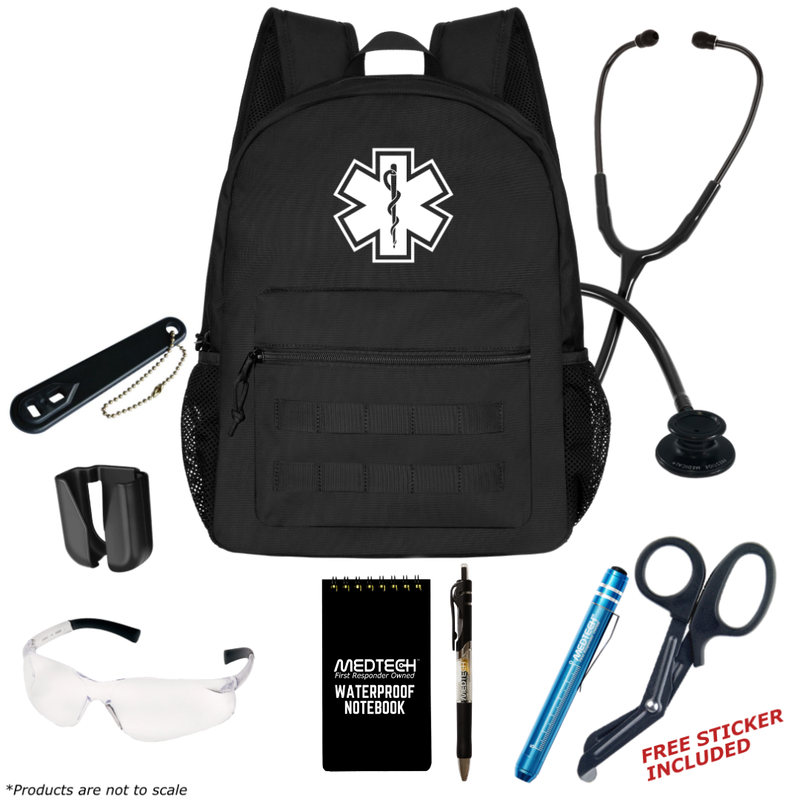
MedTechKits.com basic clinical emt kit gives EMS students the essential tools needed for early hands-on practice during classroom sessions, skills labs, and entry-level clinical work. Each item supports a core part of training, allowing students to learn how to perform assessments safely and with consistency.
The kit helps new learners stay organized from day one, making it easier to follow lesson requirements without having to search for equipment individually. Its tools focus on simple but important functions. The stethoscope allows students to begin recognizing basic heart and lung sounds, which becomes the foundation of all future assessment skills.
Trauma shears provide reliable cutting ability for clothing, tape, and bandage materials, while the penlight supports quick pupil checks and low-light assessments. Together, these tools help students build routine habits that carry into fieldwork.
What the Basic Clinical Kit Includes
-
Prestige clinica lite stethoscope
- Stethoscope holder
- EMS backpack (optional)
-
Trauma shears
-
Safety glasses
-
Waterproof notepad
-
Oxygen wrench
-
Pen light medical
- Free sticker
Basic Vitals Kit
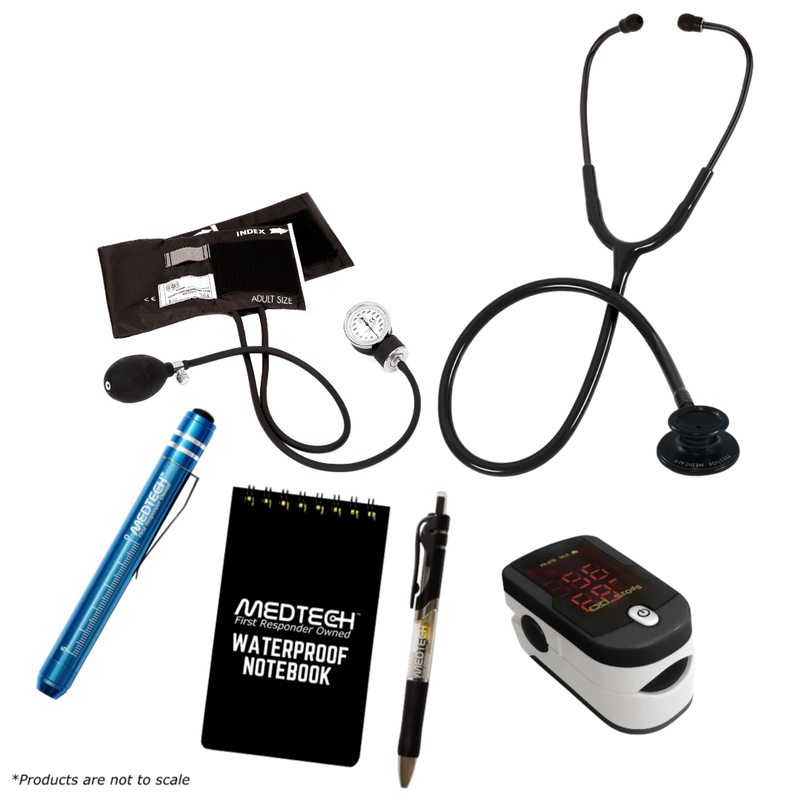
MedTechKits.com emt basic vitals kit provides EMS students with the core tools required to practice routine vital sign assessments during early skills labs and clinical sessions. It focuses on helping learners gain confidence with essential measurements such as blood pressure, pulse, and respiratory rate.
Each tool plays a specific role in building foundational skills. The manual blood pressure cuff helps students learn how to perform accurate auscultation-based readings, while the stethoscope supports early recognition of heartbeats and general cardiovascular assessment.
A penlight assists with pupil checks, low-light assessments, and simple neurological observations. By working with these instruments repeatedly, learners improve their speed and accuracy as they prepare for more advanced coursework.
What the Basic Vitals Kit Includes
-
Prestige clinical lite stethoscope
-
Fingertip pulse oximeter
-
Blood pressure cuff
- Waterproof notepad
-
Penlight Medical
Intermediate Vitals Kit
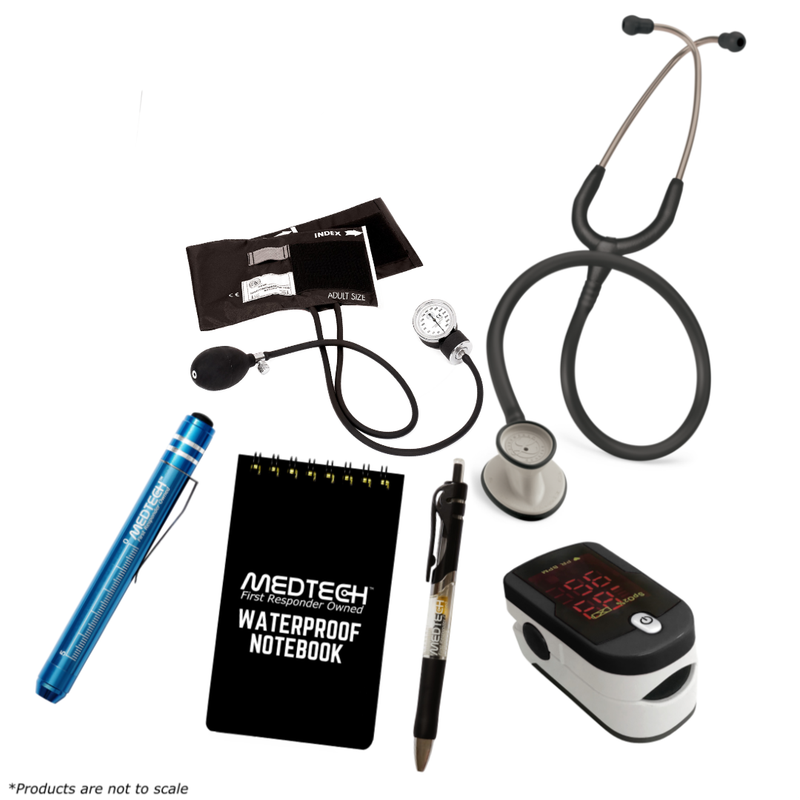
MedTechKits.com intermediate vital sign kit supports EMS students who are progressing into more precise and detailed vital sign assessments. It combines higher-quality tools with practical accessories to help learners perform accurate readings during skills labs, clinical rotations, and early field experiences.
Its tools are selected for accuracy and performance. The Littmann lightweight II stethoscope offers clear acoustics for distinguishing heart and lung sounds, giving students an advantage as they move into more advanced assessments.
The fingertip pulse oximeter provides quick oxygen saturation and pulse-rate readings, while the manual blood pressure cuff supports repeated practice with auscultated measurements. A penlight allows for neurological and low-light checks, and the included writing tools help students track and document findings efficiently.
What the Intermediate Vitals Kit Includes
-
Littmann lightweight II S.E. stethoscope
-
Fingertip pulse oximeter
-
Manual blood pressure cuff
-
Penlight medical
-
Waterproof notepad
How Students Typically Choose
EMS students tend to follow a predictable path when selecting a kit, based on their program stage and prior experience. This progression reflects the way skills and responsibilities build over time, allowing learners to invest in tools that match their immediate needs without overbuying.
Most entering EMT students select the MedTech basic clinical kit as their first purchase. It provides a complete set of equipment that EMT students and paramedics need the most. It supports everything from basic airway practice to initial patient assessments.
Students who already own some protective items, such as shears, gloves, or safety glasses from a previous first-aid course, or who prefer to focus first on vital signs mastery frequently choose the basic vitals kit.
This streamlined option allows them to concentrate on accurate blood pressure readings, pulse oximetry, and auscultation without unnecessary duplicates, making it especially popular early in the semester when vital-signs stations dominate lab time.
As learners advance into paramedic coursework or accelerated EMT programs with heavier clinical hours, the majority upgrade to the intermediate vitals kit from MedTechKits. The superior acoustics of the Littmann stethoscope and the inclusion of reliable all-weather documentation tools align closely with the increased expectations for precision and detailed charting.
Regardless of the starting point, the common pattern is clear: begin with the kit that addresses current coursework demands, then expand as skills and clinical exposure grow. This approach keeps costs manageable while ensuring consistent access to dependable equipment throughout training.
Building Strong Clinical Skills with MedTechKits
Students begin with a complete kit for foundational practice and gradually move to specialized tools as their assessments grow more complex. This progression helps them build habits that last well beyond the classroom. The medkit supports this journey by providing equipment that feels reliable from the first lab session, eliminating the common frustration of mismatched or unavailable tools that can disrupt early confidence.
By offering kits tailored to each training stage, MedTechKits ensures that beginners have everything needed for airway checks and basic evaluations, while intermediate learners gain access to instruments that sharpen their precision without overwhelming their budgets. This structure keeps the focus on skill development, allowing students to practice consistently and accurately whether they’re in a controlled skills lab or an unpredictable clinical rotation.
MedTechKits also emphasizes practical details like portability and durability, so tools withstand daily use, from the stethoscope’s clear acoustics to the notepad that survives spills and rain. For thousands of EMS students, these kits become the quiet foundation of their training: dependable gear that reinforces good habits and prepares them seamlessly for the demands of professional practice.
Final Thoughts
Every EMS student reaches a point where shared classroom gear no longer feels sufficient. The stethoscope that worked fine in week one starts to miss subtle findings. The borrowed cuff loses calibration just before clinicals. The notepad you grabbed from the station turns to mush the first time it rains.
MedTechKits removes those small but constant frustrations by giving you personal, program-specific equipment from day one. Whether you choose the complete basic clinical kit to cover every early skill station, the focused basic vitals kit to master accurate readings immediately, or the professional-grade intermediate vitals kit as you step into paramedic rotations, you gain the same advantage: tools that are always ready, always yours, and always reliable.
The result is simpler than it sounds: you spend less time searching and more time practicing. Your assessments become smoother, your documentation clearer, and your confidence noticeably stronger, both to your instructors and more importantly to yourself.
Frequently Asked Questions
Q1: Is the stethoscope in the Basic kits really good enough for clinicals?
A: The Prestige Clinical Lite is widely used in EMS programs across the country and performs well for EMT-level assessments. It provides clear sound quality for basic lung, heart, and blood pressure evaluations. Most students only upgrade to a Littmann when they begin working in louder environments or want enhanced acoustic detail.
Q2: How do I clean the stethoscope and cuff after labs?
A: Both the stethoscope and blood pressure cuff can be wiped down with alcohol pads or disinfectant wipes to remove surface contaminants. These materials are non-porous, making them safe and simple to sanitize after each skills session. Regular cleaning also helps extend the lifespan of the equipment during repeated training use.
Q3: What colors can I choose?
A: The stethoscope and pulse oximeter, when included, come in a range of colors such as black, navy blue, red, purple, teal, and pink. Students can choose whichever option best fits their personal preference or program style. All colors are offered at no extra cost, making customization easy.
Q4: Will the pulse oximeter work on pediatric patients?
A: Yes, the fingertip pulse oximeter is designed to read accurately on both adult and pediatric fingers. It uses the same style of sensor found in many EMS training programs during pediatric practice sessions. Students can expect reliable readings during basic skill development and simulated clinical scenarios.

You must be logged in to post a comment.