

Selecting the right EV charging technology and vendor is the most strategic decision industrial project developers and energy companies face when deploying EV charging infrastructure in India. With India's public charging network exploding from 25,000 chargers in early 2024 to ~120,000 in early 2026, the market offers unprecedented opportunities but also significant vendor selection complexity. Making the wrong choice can result in costly interoperability issues, poor uptime, and failed ROI projections
This guide provides a comprehensive framework for evaluating EV charging technology & equipment vendor selection specifically for the Indian market, backed by latest market data and industry insights.
Research Insight: India currently needs 1.3 million charging stations by 2030 but has only 26,000+ stations as of 2026, representing a 50x growth gap that makes vendor selection critical for scalable deployment.
Understanding EV Charger Types in India: AC vs DC Fast Charging
AC Charging: The Foundation for Base-Load Deployment
AC chargers deliver alternating current through the vehicle's onboard converter, making them ideal for locations where vehicles stay parked 2+ hours. AC charging operates at 3.3kW–22kW power output with charging times of 4–6 hours for 20-80% battery capacity.
Key AC Charger Characteristics:
-
Equipment cost: ₹15,000–₹40,000
-
Installation cost: ₹5,000–₹7,000
-
Single-phase electrical connection required
-
Type 2 connector (standard in India)
-
Revenue per session: ₹150–₹300
-
Charging cost to user: ₹5–8/kWh (home), ₹12–18/kWh (public)
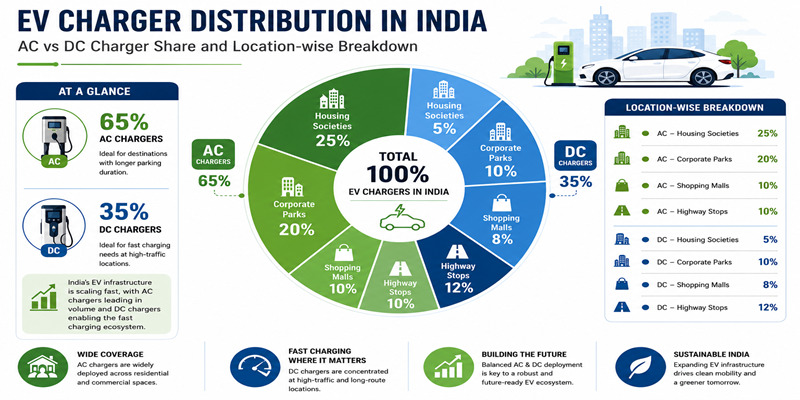
Research Insight: India's current public charging infrastructure is roughly 65% AC and 35% DC, with AC chargers dominating housing societies, corporate parks, and shopping malls where base-load parking is common.
DC Fast Charging: Essential for High-Turnaround Locations
DC fast chargers bypass the vehicle's onboard converter, feeding DC directly into the battery with external AC-to-DC converters handling 30kW–240kW+ power. This enables 20-80% charging in 20–60 minutes, making DC essential for highway stops and fleet operations.
DC Fast Charger Specifications:
-
Power output: 30kW–240kW+ (common: 60kW–120kW)
-
Equipment cost: ₹3 lakh–₹15 lakh
-
Installation cost: ₹50,000–₹5 lakh
-
Three-phase connection with dedicated transformer
-
CCS2 connector (India standard)
-
Revenue per session: ₹400–₹800
-
Charging cost: ₹18–25/kWh (public)
Research Insight: A 60kW DC charger can take a vehicle from 20% to 80% in approximately 40 minutes, matching meal-break duration—critical for Delhi-Mumbai Expressway and other major highway networks requiring DC fast chargers every 50–100 km.
Strategic Deployment Recommendation
The optimal strategy combines both technologies: AC chargers for base-load parking locations and DC fast chargers for quick-turnaround spots. Leading Charge Point Operators (CPOs) deploy mixed configurations:
Location-Specific Configuration:
-
Shopping malls: 4–6 AC chargers + 1–2 DC fast chargers
-
Housing societies: All AC chargers (3.6–7.5 kW) with smart load management
-
Highway stops: 2–4 DC fast chargers + 2 AC chargers
-
Corporate parks: 10+ AC chargers across parking levels + 1–2 DC for visitors
Research Insight: When evaluating EV charging station equipment selection in India, ask four critical questions: vehicle parking duration (>2 hours = AC sufficient, <1 hour = DC needed), electrical capacity (limited power = start with AC, three-phase available = DC feasible), budget (under ₹1 lakh = AC, ₹3 lakh+ = consider DC), and target users (residents/employees = AC, highway travelers/fleets = DC).
AC vs DC Charger Comparison
|
Feature |
AC Charger (7.5kW) |
DC Fast Charger (60kW) |
|
Power Output |
3.3kW–22kW |
30kW–240kW+ |
|
Charging Time (20-80%) |
4–6 hours |
20–60 minutes |
|
Equipment Cost |
₹15,000–₹40,000 |
₹3 lakh–₹15 lakh |
|
Installation Cost |
₹5,000–₹7,000 |
₹50,000–₹5 lakh |
|
Revenue per Session |
₹150–₹300 |
₹400–₹800 |
|
Best Use Case |
Homes, workplaces, parking |
Highways, fast-charging stations |
EV Charging Infrastructure India Standards: CCS2, Bharat, and Type 2
Understanding India's Charging Connector Standards
India has standardized on three primary connector types for EV charging infrastructure. Understanding these standards is fundamental.
-
CCS2 (Combined Charging System Type 2): The dominant standard for DC fast charging in India, CCS2 supports 30kW–350kW power levels and is mandatory for all new EVs sold in India. This is the connector used at highway fast-charging stations.
-
Type 2 (Mennekes): The standard for AC charging in India, Type 2 connectors support 3.3kW–22kW power output and are used in housing societies, corporate parks, and shopping malls.
-
Bharat Standards (AC001/DC001): India's indigenous charging standards developed under the Bharat EV Charging Initiative. Bharat AC001 supports up to 5kW, while Bharat DC001 supports up to 20kW. These are primarily used in public charging stations in government facilities and older deployments.
Research Insight: The Ministry of Power's revised charging guidelines in 2025 mandate CCS2 for all DC fast charging and Type 2 for AC charging in new deployments, making Bharat standards increasingly legacy technology for new vendor selections
Compliance Requirements for Vendor Selection
When evaluating EV charger vendor evaluation criteria India, ensure vendors provide:
-
IS 17017 (Part 1 & 2) certification for charging equipment
-
BIS (Bureau of Indian Standards) certification
-
OCPP 1.6J or OCPP 2.0.1 compliance for smart charging
-
Grid compatibility with Indian voltage standards (230V single-phase, 415V three-phase)
-
Thermal management suitable for Indian climate (40°C–50°C operating range)
Research Insight: NITI Aayog's EV Handbook identifies IS 17017 certification and BIS compliance as mandatory requirements, with non-certified equipment facing regulatory penalties and insurance coverage issues.

EV Charger Vendor Evaluation Criteria India: A Comprehensive Framework
Technical Capability Assessment
The foundation of EV charging station equipment selection India lies in evaluating vendor technical capabilities across multiple dimensions:
Hardware Quality Metrics:
-
Mean Time Between Failures (MTBF): Target >50,000 hours
-
Uptime guarantee: Minimum 95% (industry leading: 98%+)
-
Thermal management: Liquid cooling for DC chargers >60kW
-
Weatherproofing: IP54 minimum, IP65 preferred for outdoor deployment
-
Cable management: Retract systems for DC chargers to prevent damage
Research Insight: Top Indian CPOs report average charger uptime of 94-96%, with Tata Power EZ Charge achieving industry-leading 98% uptime through proactive maintenance and redundant hardware systems.
Software and CMS Platform Capabilities
Modern EV charging hardware vs software selection (CMS platforms) requires evaluating Charge Management System features:
Essential CMS Features:
-
Real-time charger monitoring and remote diagnostics
-
Dynamic load balancing for multi-charger installations
-
User authentication (RFID, app, credit card)
-
Payment processing with multiple payment gateways
-
API integration for fleet management systems
-
Energy analytics and reporting
-
OCPP compliance for interoperability
Research Insight: Numocity's white-label CPO software powers ~30+ smaller CPOs in India, demonstrating that software-only vendors can provide scalable CMS solutions, but hardware-CPO integrated vendors (like Tata Power, Statiq) offer better end-to-end reliability.
Scalability and Support Infrastructure
Vendor Scalability Assessment:
-
Manufacturing capacity: Minimum 5,000 chargers/year production
-
Installation network: Coverage across target deployment regions
-
Maintenance team: Dedicated technicians within 100km of deployment
-
Spare parts inventory: 48-hour replacement guarantee
-
Training programs for site operators
Research Insight: India's ~10 dominant CPOs control ~120,000 chargers as of 2026, with Tata Power (35,000 chargers), Statiq (15,000 chargers), and ChargeZone (12,000 chargers) leading the market, proving scale matters for vendor selection.
Financial Stability and Business Model
Vendor Financial Evaluation:
-
Revenue model transparency (hardware sale vs lease vs revenue-share)
-
Total cost of ownership (TCO) projections over 5-7 years
-
Warranty terms: Minimum 2 years on hardware, 5 years on critical components
-
Service contract pricing: Per-charger/month or percentage of revenue
-
Exit clauses and equipment removal policies
Research Insight: PM E-DRIVE funding and revised 2025 charging guidelines have improved charging infrastructure economics, making revenue-share models (15-25% of charging revenue to vendors) increasingly viable for capital-constrained developers.
Top EV Charging Vendor Comparison in India
|
Vendor |
Chargers Deployed |
Focus Area |
Uptime |
Hardware Ownership |
|
Tata Power EZ Charge |
~35,000 |
Urban + Utility integration |
98% |
Own hardware |
|
Statiq |
~15,000 |
Mixed (own + reseller) |
95% |
Own + reseller |
|
ChargeZone |
~12,000 |
Highway + DC fast-charging |
96% |
Own hardware |
|
Adani TotalEnergies |
~8,000 |
JV with TotalEnergies |
94% |
Own hardware |
|
BPCL/IOC/HPCL |
~20,000 (combined) |
Fuel station retrofit |
93% |
Mixed |
OCPP Compliant EV Charging Solutions India: Ensuring Interoperability
Why OCPP Compliance Matters
EV charging interoperability and compatibility India hinges on OCPP (Open Charge Point Protocol) compliance. OCPP is the global standard for communication between charging stations and CMS platforms, enabling:
-
Multi-vendor charger compatibility within single CMS
-
Switching CMS providers without hardware replacement
-
Integration with third-party apps and payment systems
-
Future-proofing against vendor lock-in
Research Insight: OCPP 1.6J is the current dominant version in India, with OCPP 2.0.1 adoption growing among new deployments. Non-OCPP chargers face 30-40% higher total cost of ownership due to integration limitations and vendor lock-in.
OCPP Implementation Checklist
When selecting OCPP compliant EV charging solutions India, verify:
-
OCPP version certification (1.6J or 2.0.1)
-
Smart charging features (remote start/stop, scheduling)
-
Firmware update capability via OCPP
-
Metering data transmission accuracy (<2% error)
-
Emergency stop functionality compliance
Research Insight: Leading CPOs like Tata Power and Statiq achieve OCPP 2.0.1 compliance, enabling advanced features like dynamic pricing and renewable energy integration that non-OCPP chargers cannot support.
How IMARC Engineering Can Help
Imarc Engineering helps industrial project developers and energy companies deploy EV charging infrastructure in India with end-to-end expertise. We assist in selecting the right EV charging technology (AC vs DC), evaluating vendors against India-specific criteria (CCS2, OCPP compliance, BIS certification), and designing optimal mixed deployments. Our team provides vendor due diligence, TCO analysis, installation planning, and ongoing maintenance support. With knowledge of India's 120,000+ charger market and regulatory standards, we ensure 95%+ uptime and scalable deployments for housing societies, corporate parks, and highway stops.
Consult our EV experts today: https://www.imarcengineering.com/contact?service=ev-charging-infrastructure-advisory
Conclusion: Making the Right Choice for Long-Term Success
Choosing the right EV charging technology and vendor in India requires balancing technical requirements, financial constraints, and long-term scalability. The market's rapid growth from 25,000 to 120,000 chargers in two years demonstrates both opportunity and complexity.
Key Takeaways:
-
AC chargers dominate (65%) for base-load locations; DC fast chargers (35%) for highway/high-turnaround sites
-
CCS2 and Type 2 are mandatory standards; ensure OCPP 1.6J/2.0.1 compliance
-
Prioritize vendors with 95%+ uptime guarantees, BIS certification, and local maintenance teams
-
Consider mixed AC+DC deployments for optimal revenue and user experience
-
Evaluate total cost of ownership, not just hardware costs, including maintenance and energy efficiency
With India needing 1.3 million charging stations by 2030, strategic vendor selection today positions your project for scalable growth in this transformative market.
Contact Us:
IMARC Engineering
Phone: +91-120-433-0800
Email: [email protected]
India: C-130, Sector 2, Noida, Uttar Pradesh 201301
LinkedIn: https://www.linkedin.com/showcase/imarc-engineering/

You must be logged in to post a comment.