
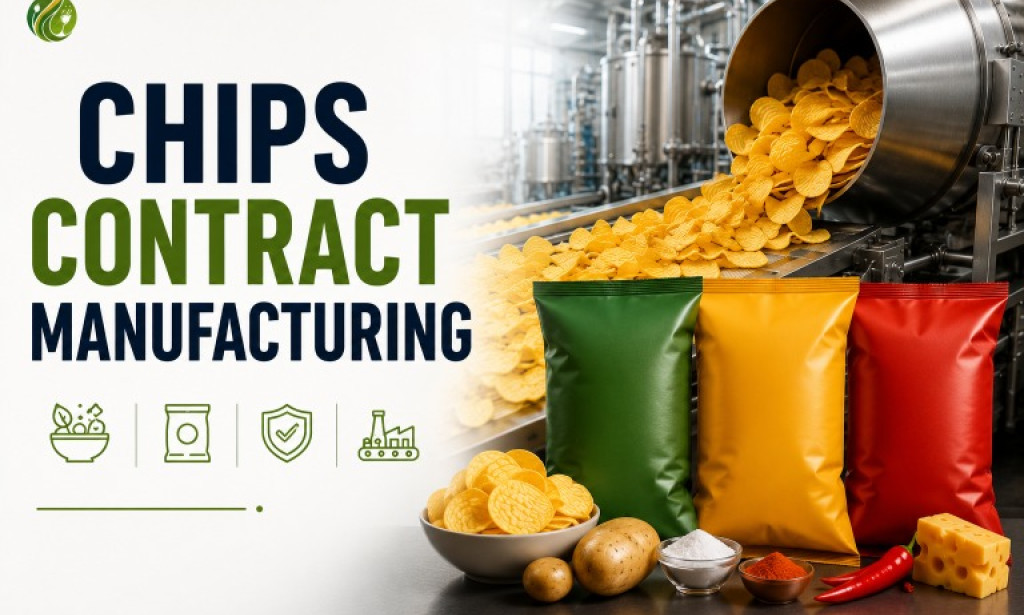
Chips contract manufacturing is the practice of outsourcing the production of potato, extruded or vegetable chips to a specialised third-party manufacturer instead of building an in-house plant. For most D2C snack founders and FMCG teams, this decision comes up early — right after a recipe is finalised and before the first retail order ships. This guide walks through how the model actually works, what a manufacturing partner should cover end-to-end, and the checks that separate a dependable partner from a risky one.
What Chips Contract Manufacturing Actually Means
In a contract manufacturing arrangement, the brand owns the recipe, the label and the market relationship, while the manufacturer owns the plant, the equipment and the day-to-day production discipline. Depending on the agreement, the manufacturer may handle everything from raw material procurement to final packaging, or only specific stages such as frying and seasoning, with the brand supplying pre-processed inputs.
This is different from simply buying a manufacturer's existing product and slapping a label on it. Genuine contract manufacturing usually starts with the brand's own formulation, flavour direction and quality expectations, and the manufacturer's job is to reproduce that consistently at scale.
Why More Brands Are Outsourcing Chips Production
India's organised salty snacks and chips category has continued to grow at a strong pace, helped by rising incomes, retail modernisation and rapid e-commerce reach into smaller towns. At the same time, only a modest share of India's large potato crop is currently processed into packaged snacks, which leaves meaningful headroom for regional and private label brands that don't want to compete head-on with the largest national players.
Building an in-house frying, extrusion or baking line requires significant capital, food-safety certification, and technical staff — a cost structure that rarely makes sense for a brand still validating demand. Contract manufacturing lets a founder test a flavour, a format or a full range without that upfront investment.
Contract Manufacturing Models for Chips: Private Label, White Label and Co-Packing
|
Model |
Recipe Ownership |
Branding |
Typical Use Case |
|
Private label / custom contract manufacturing |
Brand-owned, exclusive recipe |
Fully custom |
Brands that want a differentiated flavour or format |
|
White label |
Manufacturer's existing recipe |
Brand's label applied to a stock product |
Fast market entry at lower cost |
|
Co-packing / toll manufacturing |
Brand supplies the finalised recipe or ingredients |
Brand's label |
Brands whose formulation is already locked |
What a Reliable Chips Manufacturing Partner Should Handle End-to-End
● Raw material sourcing and incoming quality checks (potato variety, oil, seasoning inputs)
● Slicing, extrusion, frying or baking under controlled process parameters
● Seasoning application and batch-to-batch flavour consistency
● Packaging formats, nitrogen flushing and shelf-life protection
● Quality control, microbial testing and shelf-life validation
● Regulatory labelling under FSSAI and, where relevant, export documentation
● Dispatch and logistics coordination with the brand's distribution network
How to Evaluate a Chips Contract Manufacturing Partner
|
Evaluation Criteria |
What to Check |
|
Certifications |
Valid FSSAI licence, and ideally ISO 22000, FSSC 22000 or HACCP for larger orders |
|
Production capacity |
Type of line (batch vs continuous), capacity per hour, and headroom for your growth |
|
MOQ flexibility |
Whether the minimum order quantity matches your current sales volume and cash flow |
|
Formulation support |
Whether their technical team can refine flavour and shelf life, not just run production |
|
Track record |
Years in operation and existing brands they have worked with, where they can share this |
|
Packaging capability |
Pouch formats offered, and whether printing and design are in-house or outsourced |
Common Mistakes Founders Make When Outsourcing Chips Production
● Choosing on price alone without verifying hygiene certifications or plant conditions
● Sharing recipe and flavour details before signing a proper non-disclosure agreement
● Underestimating the minimum order quantity relative to available working capital
● Skipping shelf-life and transport-stability testing before committing to a full production run
● Finalising a partner without a plant visit or a documented sample-approval step
Where Food Formulation Fits Into the Manufacturing Decision
Even with a dependable manufacturing partner, a chip's success is largely decided upstream — during food product development, well before the first production run. Brands that treat formulation as a distinct, disciplined stage, locking the sensory profile, shelf-life target and cost of goods before approaching a manufacturer, tend to see shorter production ramp-up times and fewer costly reworks on the line.
Specialist teams such as Flavor Catalystz support exactly this stage through structured food product development, helping a brand arrive at a manufacturer with a validated, production-ready recipe rather than an untested kitchen idea.
Frequently Asked Questions
1. What is chips contract manufacturing?
It is an arrangement where a brand outsources production of its chips to a third-party manufacturer that owns the plant and equipment, while the brand retains ownership of the recipe, label and market relationship.
2. What is the difference between contract manufacturing and private label chips manufacturing?
Contract manufacturing can cover any arrangement, including reproducing the brand's own recipe. Private label manufacturing specifically implies a custom or brand-exclusive formulation, as opposed to white label, where the manufacturer's existing recipe is simply rebranded.
3. What certifications should a chips manufacturing partner have?
At minimum, a valid FSSAI licence. For larger retail or export orders, look for ISO 22000, FSSC 22000 or HACCP certification as well, since these indicate a more mature food safety system.
4. How much MOQ do chips contract manufacturers usually require?
MOQ varies widely by manufacturer, format and packaging complexity, ranging from a few thousand units per flavour for smaller runs to considerably higher volumes for fully custom packaging. It is best confirmed directly with each shortlisted manufacturer.
5. Can I get a custom flavour developed by a contract manufacturer?
Many manufacturers offer basic flavour customisation, but for a fully differentiated sensory profile, it usually helps to complete recipe formulation separately before approaching the manufacturer for scale-up.
6. How long does it take to start commercial production after finalising a recipe?
Once a recipe is finalised, most manufacturers need a few weeks for sampling, packaging finalisation and a trial run before the first bulk production batch, though this varies by product complexity and manufacturer queue.
7. Is contract manufacturing suitable for a first-time snack brand founder?
Yes. It is often the more practical starting point for first-time founders, since it avoids the capital and regulatory burden of setting up an in-house plant while still allowing a fully branded, differentiated product.

You must be logged in to post a comment.