
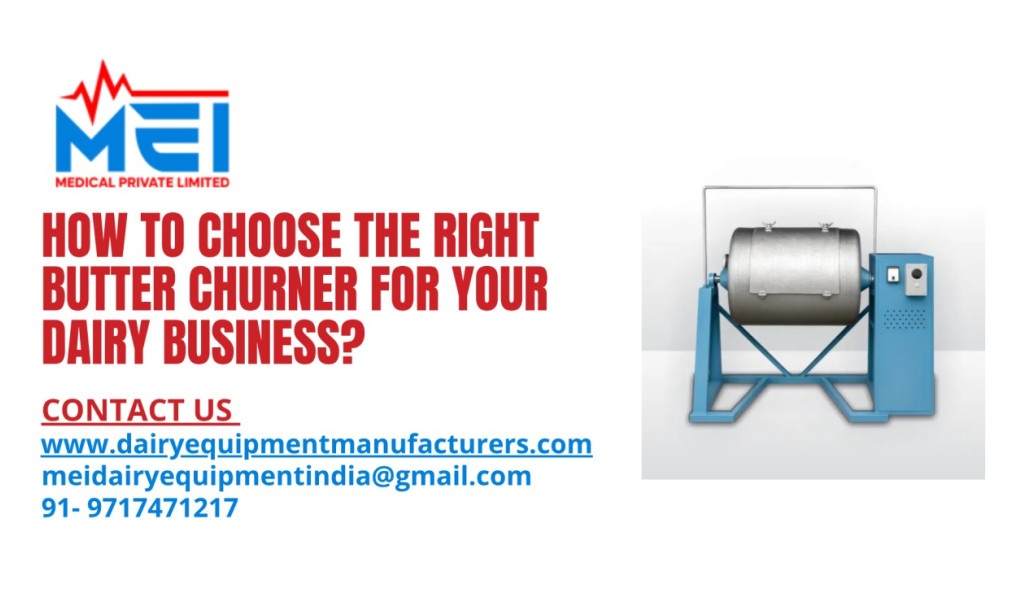
A wrong Butter Churner doesn’t just slow production. It quietly eats your cream, your time, your labour cost, and honestly, your patience too.
I’ve seen dairy owners buy machines only by looking at capacity on paper. “This one says 100 litres, so it’ll work.” Sounds practical, right? Not always. Because butter making isn’t only about litres. It’s about cream fat percentage, batch consistency, motor strength, hygiene, cleaning time, and how the machine behaves after six months of real use.
And that’s where most businesses get it wrong.
First, Be Honest About Your Actual Production Need
Look, don’t buy for ego. Buy for your daily workload.
If your dairy currently processes 40–50 litres of cream per batch, jumping straight to a very large churner may look future-ready, but it can create poor batch control if you don’t fill it properly. On the other side, an undersized machine forces repeated batches, extra labour, and inconsistent butter texture.
Here’s the thing: the right size should match your present demand with some growth room.
Not fantasy growth. Real growth.
For small dairies, cafés, sweet shops, ghee units, and farm-level processing setups, a compact churner with easy handling may be enough. For commercial dairy plants, you’ll need heavier construction, stronger drive systems, and better discharge design. MEI Medical focuses on practical product solutions where the machine should fit the workflow, not disturb it.
A Good Butter Churner Should Handle More Than Just Churning
Most buyers ask, “How much capacity?” Fair question. But incomplete.
You should also look at how the machine separates butter granules, how smoothly it rotates, whether the drum design supports uniform agitation, and how easily the buttermilk drains out. These small things decide your final yield.
A proper churner should help you maintain:
- Consistent butter texture
- Lower manual handling
- Faster batch turnaround
- Easier cleaning after production
That last point matters more than people admit. If cleaning takes too long, your team will either waste time or cut corners. Neither is good for a food business.
Don’t Ignore Material Quality — It’s Not Just “Steel”
A lot of machines look shiny in photos. Big deal.
For dairy processing, stainless steel quality matters. SS 304 is commonly used for food-contact equipment because it offers good corrosion resistance and is easier to clean. In more demanding environments, some buyers may ask about SS 316, especially where cleaning chemicals or higher corrosion risk are involved.
The inner surface should be smooth. Welds should be clean. Corners shouldn’t trap cream residue.
Sounds basic? You’d be surprised.
I’ve seen buyers regret cheaper machines because butter smell stayed inside the drum after washing. This is very unattractive, and it is a hygiene concern. For business owners with dealing with repeat customers such as hotels, distributors and institutional buyers, product consistency and cleanliness are key.
Selecting a Manual, Semi-Automatic, and Fully Automatic Butter Churner Models
In very small setups, manual churners are reasonable. These make sense on traditional production lines as well. They’re simple, affordable, and easy to maintain. But let’s be real — once your daily production increases, manual work becomes a bottleneck.
Semi-automatic machines are usually a better fit for growing dairy businesses. You get motorized operation, better control, and reduced labour dependency without going into a fully automated plant-level setup.
Automatic machines are for businesses where batch timing, repeatability, and volume matter every day. If you’re supplying butter, white butter, makhan, or ghee input material at scale, automation can protect consistency.
But automatic isn’t always better.
It’s better only when your production volume justifies it.
Compare Butter Churner Manufacturers in India Like a Buyer, Not a Bargain Hunter
Price matters. Nobody’s denying that.
But when you’re comparing Butter Churner Manufacturers in India, don’t stop at the quotation. Ask about motor brand, steel grade, drum thickness, spare parts, warranty support, customization, and delivery timeline. Also check whether they understand dairy applications or just fabricate general-purpose equipment.
There’s a difference.
Good Butter Churner Suppliers will ask about your cream volume, fat percentage, expected batch frequency, space availability, and power connection before suggesting a model. Weak suppliers will simply send a price list.
That tells you enough.
Check Space, Power, and Cleaning Before You Finalize
This is boring stuff, I know. But it saves headaches.
Before placing the order, confirm your floor space, drainage arrangement, electrical load, and operator movement area. A churner that fits on paper may still create workflow problems if the discharge side is blocked or cleaning water has nowhere to go.
Also ask whether the machine can be cleaned manually or supports CIP-style cleaning arrangements. Not every dairy needs CIP, but every dairy needs a cleaning method that your team can actually follow daily.
FAQs
What capacity Butter Churner is best for a small dairy business?
For small dairies, the best capacity depends on cream processed per batch, not milk handled per day. A machine slightly above your regular batch size is usually safer than buying too large too early.
Are Butter Churner Suppliers in India able to customize machines?
Yes, many Butter Churner Suppliers in India offer customization in capacity, motor power, drum design, discharge outlet, and contact-part material. Always confirm this before ordering.
Why is stainless steel necessary in butter churning equipment?
The benefit of food-grade stainless steel in butter churners includes hygiene and safety, along with easy cleaning, and corrosion resistance. It is not worth trying to cut costs in this area.
Is it better to buy from local suppliers or well-known manufacturers?
Local support is useful, but manufacturing quality matters more. Ideally, choose experienced Butter Churner Manufacturers in India who can provide proper build quality, spare parts, and after-sales guidance.
Final Word
The right Butter Churner isn’t the cheapest machine, the biggest machine, or the one with the shiniest brochure. It’s the one that matches your cream volume, protects butter quality, cleans easily, and keeps running when production pressure gets real. For a dairy business, that’s not an expense — that’s operational common sense.

You must be logged in to post a comment.