
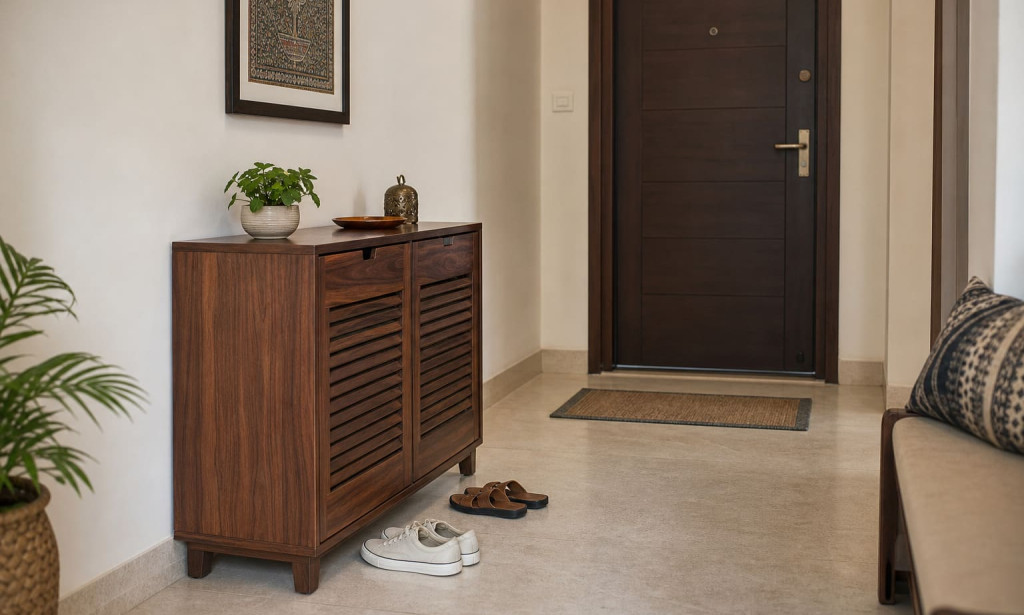
An online product photograph can tell you whether a shoe rack looks attractive. It cannot tell you whether the cabinet will block your front door, accept your tallest shoes or become inconvenient during the monsoon. Those questions need a fit test.
This guide uses a seven-step process rather than a one-size-fits-all recommendation. It is designed for apartments and family homes where the entrance may also contain a doormat, switchboard, security door or narrow passage. Complete the steps with a tape measure and a list of your footwear before comparing products.
1. Audit Shoes by Shape, Not Just Pair Count
Take every pair that you want to store and divide it into four groups: flat footwear, everyday shoes, tall or bulky footwear, and wet-use footwear. Slippers and sandals use less shelf volume than high-top sneakers, heels or ankle boots. Two households with the same number of pairs can therefore need very different cabinets.
Place the widest pair and tallest pair beside your measuring tape. These become your minimum usable shelf requirements. Product capacity claims, when available, should be treated as estimates because shoe sizes and shelf layouts differ.
Add a small reserve for new purchases, but do not buy a large cabinet merely for hypothetical storage. In a narrow foyer, unused furniture volume has a daily cost: it takes away walking space.
A useful allocation test
- Daily pairs: should be reachable without moving other shoes.
- Formal and occasional pairs: can use less accessible shelves.
- Children’s shoes: need a height that children can use safely.
- Wet or muddy footwear: needs a drying zone outside a closed cabinet.
This audit is more reliable than choosing a two-door, three-door or four-door unit only from family size.
2. Measure the Entrance as a Working Space
Measure the available wall width, cabinet depth and usable height. Then measure the open position of every nearby door. A cabinet that fits against the wall can still fail if its depth interferes with the main door, security door or walking route.
Mark the proposed footprint on the floor with removable masking tape. Stand inside the marked area, open the door and walk past it while carrying a bag. This simple rehearsal reveals problems that a floor plan can miss.
Also check skirting boards, switchboards and projecting handles. Finally, measure the delivery route. Marks & Spencer’s furniture measuring guide recommends checking doorways, hallways, fixtures and turning space, not only the final position of the furniture.
3. Match the Storage Format to the Location
Open and closed storage solve different problems. The correct format depends on where the rack will stand and which shoes it will hold.
Closed cabinet
A closed cabinet keeps footwear out of sight and can make a living-room-facing entrance look calmer. It is better suited to dry shoes and pairs that are not needed every few hours. Buyers should still check how the design supports airflow and whether the doors can open comfortably.
Open rack
An open rack gives quick access and exposes footwear to more room air. It can work in a utility zone or for frequently used pairs. The trade-off is visible clutter and more direct exposure to household dust.
Shoe rack with a seat
A seated design can help people who tie laces, assist children, or prefer to sit while putting on shoes. It needs more usable width, and the buyer must verify the manufacturer’s stated use and load information rather than assuming every cabinet top is a seat.
DeckUp’s current collection includes two-, three- and four-door engineered-wood cabinets, open storage and purpose-designed models with seating. That range makes it possible to compare formats on one Shoe Rack Online collection page. Product availability, dimensions and prices can change, so verify the individual listing before ordering.
4. Build a Dry-to-Store Monsoon Routine
The storage plan should include what happens before a shoe enters the cabinet. During wet weather, create a landing zone with a washable mat or tray. Remove loose mud, allow footwear to dry, and only then return it to enclosed storage.
This is not merely an appearance issue. The US Environmental Protection Agency says that doormats and removing shoes at the entrance can reduce dirt and other contaminants tracked in from outdoors. Its indoor microbiome guidance also recommends controlling moisture and promptly drying wet areas.
Do not translate that guidance into unsupported health promises for a particular shoe cabinet. A rack is an organisation tool, not a medical product. Its useful role is to give outdoor footwear a defined place and support a repeatable entry routine.
For engineered-wood furniture, follow the seller’s care instructions. DeckUp advises drying wet footwear before closed storage, using a dry soft cloth for routine cleaning, wiping spills promptly and keeping the rack away from damp walls or direct rain.
5. Judge Material Through Care and Placement
“Wooden shoe rack” can describe different constructions, so read the material field rather than relying on the search title. Engineered wood, solid wood, metal and plastic have different weights, finishes and care needs.
Engineered wood is commonly used for furniture-style cabinets because it can support consistent panels and contemporary finishes. Its suitability still depends on board specification, hardware, assembly and protection from moisture. Do not infer waterproofing, a lifetime or a load capacity unless the product listing explicitly states it.
Metal or open-frame racks may suit a utility space where airflow and quick access matter more than a concealed appearance. Lightweight plastic storage can be easier to move. The honest comparison is not “best material”; it is “best material for this location, use pattern and maintenance routine.”
6. Check Evidence on the Product Page
Before buying, look for information that can be checked after delivery:
- Overall width, depth and height.
- Internal shelf dimensions or a clear layout image.
- Material and finish description.
- Whether the product is open, closed or purpose built for seating.
- Assembly and installation requirements.
- Cleaning and moisture care instructions.
- Current delivery, return and warranty terms.
Do not use a sale percentage as evidence of product quality. Do not assume the number of doors equals a fixed pair capacity. Reviews can help identify recurring experiences, but dimensions and written policies should be verified in the seller's own current information.
Trust also depends on recognising limits. An online guide cannot inspect the reader’s entrance or guarantee that every shoe shape will fit. The buyer remains responsible for comparing the recorded measurements with the selected model.
7. Use This 60-Second Decision Rule
After completing the audit, choose the first statement that matches your home:
- Visible foyer + mostly dry footwear: shortlist a closed cabinet that clears the door and passage.
- Utility area + frequently used pairs: compare open racks for access and ventilation.
- Need to sit while wearing shoes: Consider a purpose-designed shoe rack with a seat after verifying its specifications.
- Narrow entrance: prioritise measured depth and door clearance over the number of compartments.
- Many bulky shoes: prioritise internal shelf height and layout over advertised pair count.
- Monsoon exposure: create a separate drying zone and keep engineered wood away from direct rain or damp walls.
If two statements apply, the entrance may benefit from a hybrid routine: a cabinet for dry footwear and a small mat or open zone for the day’s active pairs.
Final Checklist Before Ordering
Write down the following five answers:
- Largest safe cabinet footprint: ___ × ___ cm
- Tallest or bulkiest shoe: ___ cm
- Number of everyday pairs: ___
- Storage type: open/closed/seated
- Drying zone available: yes/no
Only shortlist products that pass all five checks. A shoe rack should reduce friction at the entrance, not introduce a new obstacle. When the choice is based on real shoes, real measurements and a realistic wet-footwear routine, buying online becomes a more informed decision rather than a guess from photographs.

You must be logged in to post a comment.