
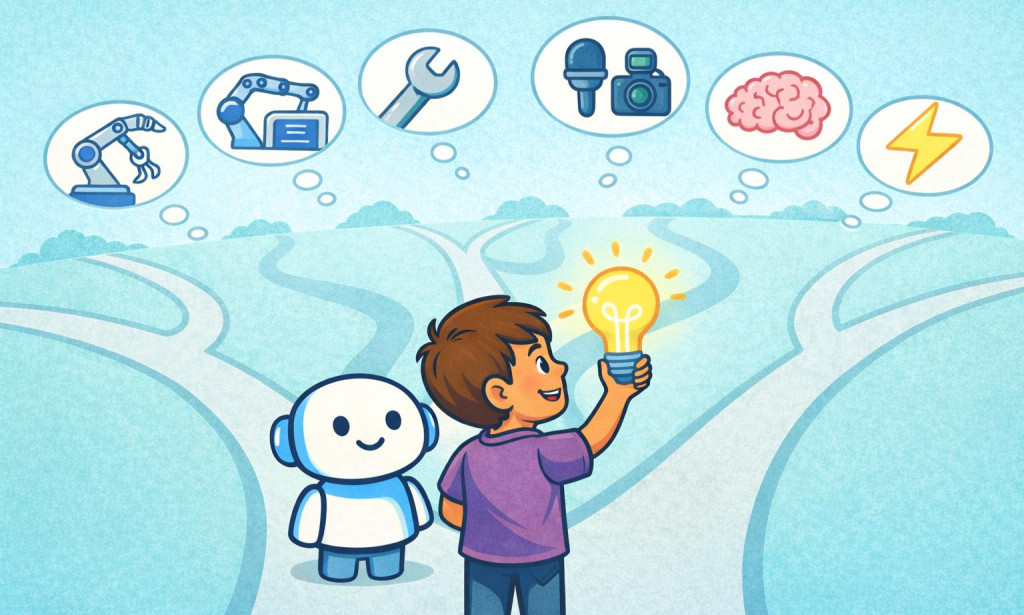
Preparing Kids for the Jobs of Tomorrow
The Jobs Your Child Will Do Might Not Exist Yet
It's a strange but true reality: many careers today's young children will eventually hold haven't been invented. That uncertainty makes one thing clear — the goal of early education can't just be memorizing facts. It has to be building the underlying ability to think, question, and solve problems, wherever those skills end up being applied.
That's exactly what STEM skills for kids are designed to do.
What STEM Really Teaches (It's Not Just Science Facts)
STEM — Science, Technology, Engineering, and Math — gets misunderstood as simply "harder" content. In early childhood specifically, STEM education early childhood programs aren't about advanced formulas. They're about:
-
Asking "why" and "what if" instead of accepting the first answer
-
Testing an idea, watching it fail, and trying again
-
Breaking a big problem into smaller, manageable steps
-
Recognizing patterns and predicting what comes next
These are critical thinking activities for children in disguise — dressed up as building a block tower, sorting objects by size, or figuring out why a paper boat sinks.
Why Future-Ready Skills Matter More Than Ever
The World Economic Forum's Future of Jobs Report 2025, based on survey data from over 1,000 global employers, confirms this directly: analytical thinking remains the single most in-demand core skill for employers today, with seven out of ten companies rating it essential — ahead of any specific technical skill.
Unlike specialized technical knowledge, which can become outdated, the habit of thinking critically and solving unfamiliar problems transfers to whatever field a child eventually enters — a genuinely future ready skills for kids approach to early education.
The Confidence Factor
There's also a confidence dimension that's easy to overlook. Children who are regularly encouraged to test ideas and learn from failure in a low-stakes STEM activity build resilience toward being wrong — a trait that pays off far beyond any single subject.
Simple STEM Habits Parents Can Build at Home
-
Ask prediction questions:"What do you think will happen if we mix these?" before revealing the answer
-
Celebrate the "why," not just the right answer: Ask kids to explain their reasoning even when they're correct
-
Use everyday objects:Sorting laundry by color, counting stairs, or comparing which container holds more water are all real STEM practice
-
Let mistakes be part of the process:Resist the urge to correct immediately — let a child notice the mistake themselves when possible
How a STEM Learning App Fits In
A well-designed STEM learning app turns these habits into structured, repeatable practice — presenting a problem, letting a child experiment with an answer, and adjusting based on how they respond, all wrapped in game mechanics that keep young learners engaged.
Learning games for kindergartners builds its Math and Science content around exactly this kind of hands-on problem-solving, so children build reasoning skills alongside academic ones.
You can't predict the exact job your child will hold in 20 years. But you can help them build the thinking skills that will make them adaptable no matter what that job looks like. That's the real promise of STEM in early childhood — not a head start in science trivia, but a head start in thinking.
Want to build critical thinking through play? ExploreZape Learning App for Math and Science content designed around real problem-solving.
FAQs
Is STEM education appropriate for toddlers, or is it only for older kids?
Simple STEM concepts — sorting, counting, cause-and-effect — are appropriate even for toddlers when presented through play rather than formal instruction.
Do I need special equipment to teach STEM at home?
No — everyday household items like blocks, water, and kitchen containers are enough to introduce core STEM concepts like measurement, prediction, and cause-and-effect.
How is STEM different from just "more advanced" math and science?
STEM emphasizes the process — asking questions, testing ideas, and problem-solving — rather than just memorizing facts or formulas.
Can gamified apps genuinely build critical thinking, or just repetition?
When designed well, gamified best app for 5 year olds present problems that require reasoning and adapt based on a child's approach, rather than rewarding rote repetition alone.

You must be logged in to post a comment.