

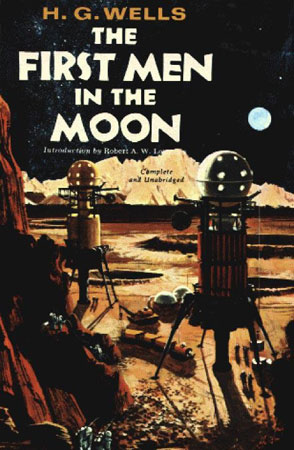
 The concept of space travel has been fantasized by writers for eons. They have been speculating on a theory that allows humans to cover large distances in space. The idea is to explore new worlds and strange people that may live in undiscovered areas. The first such account of space travel in literature dates back to the second century. The Greek author, Lucian of Samosa ta, wrote A True Story which is a satire of outlandish tales. The journey of Lucian and his fellow travelers is put off course by a storm. They reach a land where rivers are made of wine. They are again caught in a strong wind that takes them to the Moon. Lucian provides differentiating features between life on Earth and the Moon. Similarly, The Man in the Moon by Francis Godwin describes the tale of Gonzales from Spain, who somehow reaches the moon after traveling on a giant swan. The tales by Lucian and Godwin are based on fantasy, as science was barely a part of their stories.
The earliest published work of science fiction with space travel was The Other World: a Comical History of the States and Empires of the Moon by French novelist Cyrano de Bergerac. He explains the story written in a first-person narrative.
He attempts to travel to the moon to find evidence of life after launching himself in a flying machine with rockets attached to it. He finds that Mars is inhabited by four-legged strange beings that use fantastical weapons. Off on a Comet by Jules Verne is a space travel novel, but includes more fantasy than science. The extraordinary tale is about a comet that hits Earth and takes a piece of land with it. The area that the comet takes away with itself is inhabited by 36 people. They include French, English, Spanish and Russian nationalities. They are unaware that they are on a comet until their experience weightlessness.
John Jacob Astor IV, an American writer, published A trip to Other Worlds: A Romance of the Future in 1894. The story is set in 2000. He speculates about technological invention, solar power, and air travel. He suggests that the US has become a multi-continental superpower while the socialist governments govern over Europe. Jacob writes about how the world in 2000 is a business-led technocracy and human life is being improved by advancements in technology.
John Jacob Astor IV, an American writer, published A trip to Other Worlds: A Romance of the Future in 1894. The story is set in 2000. He speculates about technological invention, solar power, and air travel. He suggests that the US has become a multi-continental superpower while the socialist governments govern over Europe. Jacob writes about how the world in 2000 is a business-led technocracy and human life is being improved by advancements in technology.
Over the year’s authors have explored the vastness of space and new life on Mars, the Moon, and other planets. Robert A. Heinlein (Space Cadet, 1948), The Voyage of the Space Beagle (A.E. van Vogt, 1950), Marooned on Mars (Lester del Rey, 1952), Missing Men of Saturn (Robert S. Richardson, 1953), Starman’s Quest (Robert Silver berg, 1958), Ice (Lora Johnson, 2002), The Martian among others are prominent literary works in this genre.

You must be logged in to post a comment.