

Space elevators are often dismissed as a science fiction dream, but I believe they will exist soon—perhaps in two or three decades. Throughout my career as an aerospace engineer and physics professor, I keep coming back to the concept of a cable stretching from Earth to space, along which people and cargo can easily travel. In recent years I and other researchers have found new ways to tinker with designs and answer questions about how space elevators could work.
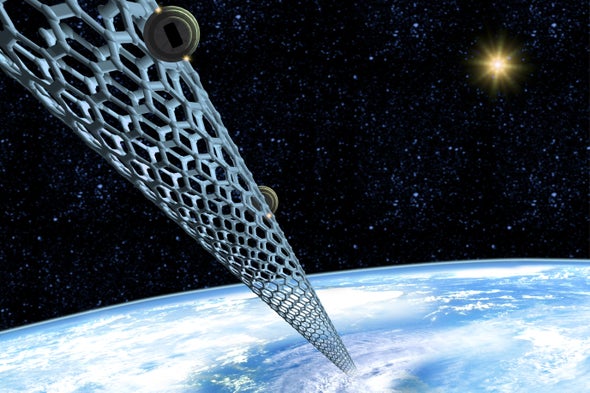
There are many reasons to build a space elevator. The obvious one is the major energy and cost savings; it’s a much more practical way to get to orbit than rockets. Another reason that is often overlooked is accessibility. The word “space mission” would be replaced by “transit,” as trips to space become routine and mostly independent of weather conditions. Transits involving humans would be safer than current practices, whereby astronauts must accept a nonnegligible risk to their lives with each launch. A space elevator becomes a bridge to the entire solar system. Release a payload in the lower portion, and you orbit Earth, but do so in the upper portion, and you orbit the sun; all without fuel.
Although I may come across as a space elevator advocate, the truth is, I simply enjoy studying their mechanics. In a world with monumental problems, dreaming of such projects allows me to envision a scenario where we have become responsible custodians on this planet.
When the Space Shuttle Columbia lifted off on April 12, 1981, from Kennedy Space Center, Fla., to begin the first space shuttle mission, the dream of a reusable spacecraft was realized. Since then, NASA has launched more than 100 missions, but the price tag of space missions has changed little. Whether it is the space shuttle or the non-reusable Russian spacecraft, the cost of a launch is approximately $10,000 per pound ($22,000 per kg).
A new space transportation system being developed could make travel to Geostationary Earth Orbit (GEO) a daily event and transform the global economy.
A space elevator made of a carbon nanotubes composite ribbon anchored to an offshore sea platform would stretch to a small counterweight approximately 62,000 miles (100,000 km) into space. Mechanical lifters attached to the ribbon would then climb the ribbon, carrying cargo and humans into space, at a price of only about $100 to $400 per pound ($220 to $880 per kg).
In this article, we'll take a look at how the idea of a space elevator is moving out of science fiction and into reality.
The potential global impact of the space elevator is drawing comparisons to another great transportation achievement -- the U.S. transcontinental railroad. Completed in 1869 at Promontory, Utah, the transcontinental railroad linked the country's east and west coasts for the first time and sped the settlement of the American west. Cross-country travel was reduced from months to days. It also opened new markets and gave rise to whole new industries. By 1893, the United States had five transcontinental railroads.
The idea of a space elevator shares many of the same elements as the transcontinental railroad. A space elevator would create a permanent Earth-to-space connection that would never close. While it wouldn't make the trip to space faster, it would make trips to space more frequent and would open up space to a new era of development. Perhaps the biggest factor propelling the idea of a space elevator is that it would significantly lower the cost of putting cargo into space. Although slower than the chemically propelled space shuttle, the lifters reduce launch costs from $10,000 to $20,000 per pound, to approximately $400 per pound.
Current estimates put the cost of building a space elevator at $6 billion with legal and regulatory costs at $4 billion, according to Bradley Edwards, author of the "The Space Elevator, NIAC Phase II Final Report." (Edwards is also the Dr. Bradley Carl Edwards, President and Founder of Carbon Designs.) By comparison, the cost of the space shuttle program was predicted in 1971 to be $5.2 billion, but ended up costing $19.5 billion. Additionally, each space shuttle flight costs $500 million, which is more than 50 times more than original estimates.
The space elevator could replace the space shuttle as the main space vehicle, and be used for satellite deployment, defense, tourism and further exploration. To the latter point, a spacecraft would climb the ribbon of the elevator and then would launch toward its main target once in space. This type of launch would require less fuel than would normally be needed to break out of Earth's atmosphere. Some designers also believe that space elevators could be built on other planets, including Mars.

You must be logged in to post a comment.