
Introduction
When parents think about maths, they usually imagine counting numbers, learning addition, or solving simple equations. What many don't realise is that mathematical learning actually begins much earlier. Before children start working with numbers, they begin observing patterns, comparing objects, and recognising shapes around them.
A child pointing to a round clock and calling it a circle or identifying a square window may seem like a small achievement. In reality, these moments are helping build the foundation for future mathematical thinking.
Shape recognition is one of the earliest skills children develop, and it plays an important role in strengthening problem-solving abilities, spatial awareness, logical thinking, and geometry concepts. Through hands-on activities and play-based learning, children gradually develop the skills needed to succeed in mathematics later in life.
Let's explore how shape recognition contributes to stronger maths skills and why it should be an essential part of every child's early learning journey.
What Is Shape Recognition?
Shape recognition is the ability to identify, name, compare, and understand different geometric shapes such as circles, squares, triangles, rectangles, and ovals.
At first, children learn to recognise shapes visually. Over time, they begin noticing the characteristics that make each shape unique. They learn that a triangle has three sides, a square has four equal sides, and a circle has no corners.
This process encourages children to observe details, compare objects, and develop logical thinking skills that support future mathematical learning.
Why Shape Recognition Is Important in Early Childhood
Children encounter shapes everywhere. From books and toys to furniture and buildings, geometric forms are constantly present in their environment.
As children begin identifying these shapes, they develop the ability to organise information and recognise relationships between objects. These early experiences help strengthen observation skills and encourage children to think critically about the world around them.
The more children interact with shapes, the more confident they become in understanding patterns, structures, and spatial relationships.
Shape Recognition Creates a Strong Foundation for Geometry
Geometry is an important branch of mathematics, and shape recognition serves as its starting point.
Before children can understand concepts like angles, symmetry, area, and perimeter, they must first become familiar with basic geometric shapes. Learning about shapes helps children understand sides, corners, edges, and how different objects relate to one another.
For example, when a child learns that a square has four equal sides, they are already being introduced to a key geometric concept.
These early experiences make future geometry lessons much easier to understand.
Shapes Help Children Develop Spatial Awareness
Spatial awareness is the ability to understand where objects are located and how they relate to one another in space.
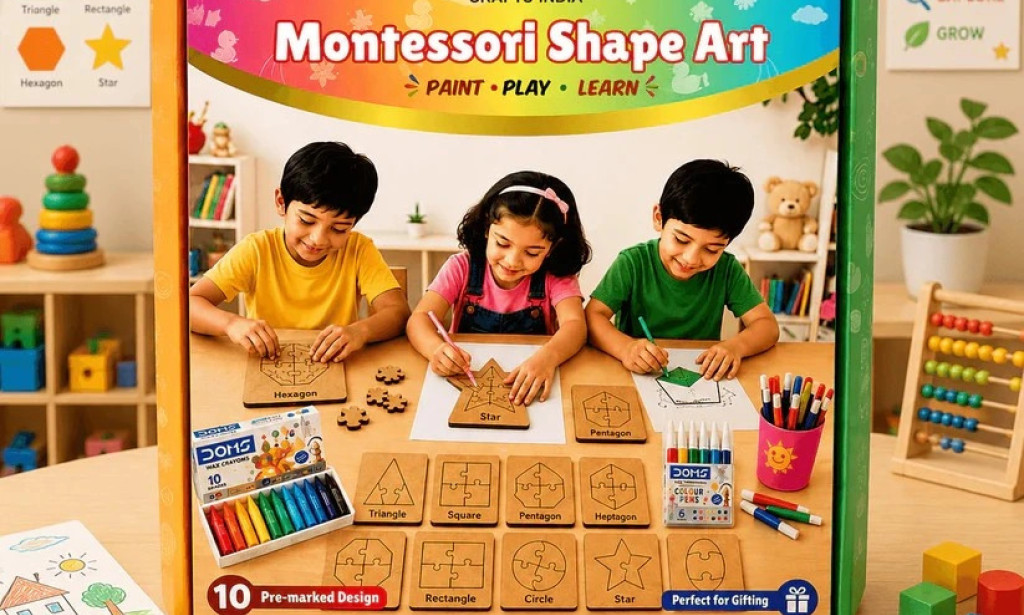
Children develop this skill when they compare shapes, rotate puzzle pieces, or fit objects into matching spaces. Activities involving a wooden shapes puzzle kit for kids are particularly useful because children can physically explore how different shapes fit together.
As children improve their spatial awareness, they become better at visualising objects, understanding directions, and solving geometry-related challenges.
Research has shown that strong spatial reasoning skills are closely linked to success in mathematics and STEM-related subjects later in life.
Shape Recognition Encourages Problem-Solving Skills
Every shape-based activity presents children with small challenges to solve.
Whether they are matching shapes, sorting objects, or completing puzzles, children must analyse information and make decisions based on what they observe.
Sometimes they make mistakes and try again. Sometimes they find the solution quickly. Both experiences contribute to cognitive growth.
Through repeated practice, children learn to:
-
Observe carefully
-
Compare options
-
Identify patterns
-
Test solutions
-
Make decisions confidently
These are the same problem-solving skills they will use when tackling mathematical questions in school.
Understanding Shapes Helps Children Recognise Patterns
Patterns form the foundation of many mathematical concepts.
Before children work with numerical patterns, they often begin by recognising visual patterns involving shapes. For example:
-
Circle, square, circle, square
-
Triangle, rectangle, triangle, rectangle
-
Square, square, circle, square, square, circle
By identifying what comes next in a sequence, children develop logical thinking and prediction skills.
These abilities later support more advanced concepts such as multiplication, algebra, coding, and data analysis.
Shape Activities Strengthen Fine Motor Skills
Mathematics isn't only about thinking. Young children also need strong physical skills to participate effectively in learning activities.
Shape tracing, drawing, matching, and puzzle-solving activities help improve hand-eye coordination and fine motor control.
Using geometric shape stencils allows children to trace shapes accurately while strengthening pencil control and hand movements. These activities help prepare children for writing numbers, drawing diagrams, and completing classroom assignments.
It's a simple activity, but the long-term benefits can be significant.
Learning Through Hands-On Activities
Children often learn best when they can interact directly with educational materials.
Hands-on activities allow them to explore concepts through touch, movement, and experimentation rather than simply memorising information.
Shape tracing, sorting, matching, and puzzle-solving activities encourage active participation and make learning more enjoyable.
When learning feels like play, children tend to stay engaged for longer periods and retain information more effectively.
The Montessori Approach to Shape Learning
Montessori education focuses on hands-on exploration and self-directed learning.
Rather than relying solely on worksheets, children are encouraged to interact with physical learning materials that help them discover concepts independently.
Shape-based Montessori activities allow children to:
-
Explore geometric concepts
-
Develop concentration
-
Improve problem-solving skills
-
Strengthen fine motor abilities
-
Build confidence through independent learning
This approach makes shape recognition more meaningful and memorable.
Supporting Maths Skills at Home
Parents don't need complicated materials to help children develop shape recognition skills.
Simple activities such as:
-
Shape hunts around the house
-
Shape tracing exercises
-
Matching games
-
Puzzle-solving activities
-
Sorting objects by shape
can all contribute to stronger mathematical thinking.
The key is to make learning fun, interactive, and consistent.
Small daily activities often have a bigger impact than occasional formal lessons.
Conclusion
Strong maths skills begin long before children start solving equations. They begin with simple observations—recognising a circle, identifying a square, or figuring out where a puzzle piece belongs.
Shape recognition helps children develop spatial awareness, logical thinking, pattern recognition, and problem-solving abilities. These foundational skills support future success in geometry, mathematics, and many other areas of learning.
By encouraging shape-based activities and providing opportunities for hands-on exploration, parents can help children build confidence and develop a strong mathematical foundation. Sometimes the journey to becoming good at maths starts with something as simple as recognising a shape.
FAQ
Why is shape recognition important for maths?
Shape recognition helps children develop geometry awareness, spatial reasoning, pattern recognition, and problem-solving skills. These abilities form the foundation for future mathematical learning.
At what age should children start learning shapes?
Most children begin recognising basic shapes between the ages of 2 and 4 years. However, learning can start earlier through play and everyday interactions.
How do shape puzzles improve maths skills?
Shape puzzles encourage children to analyse, compare, and solve problems. They also improve spatial awareness and logical thinking, which are important for mathematics.
What activities help children learn shapes?
Shape tracing, matching games, shape hunts, sorting activities, puzzles, and stencil-based activities are all effective ways to teach shape recognition.
Can shape learning improve problem-solving skills?
Yes. Shape-based activities require children to observe, compare, test solutions, and make decisions, all of which strengthen problem-solving abilities.

You must be logged in to post a comment.