
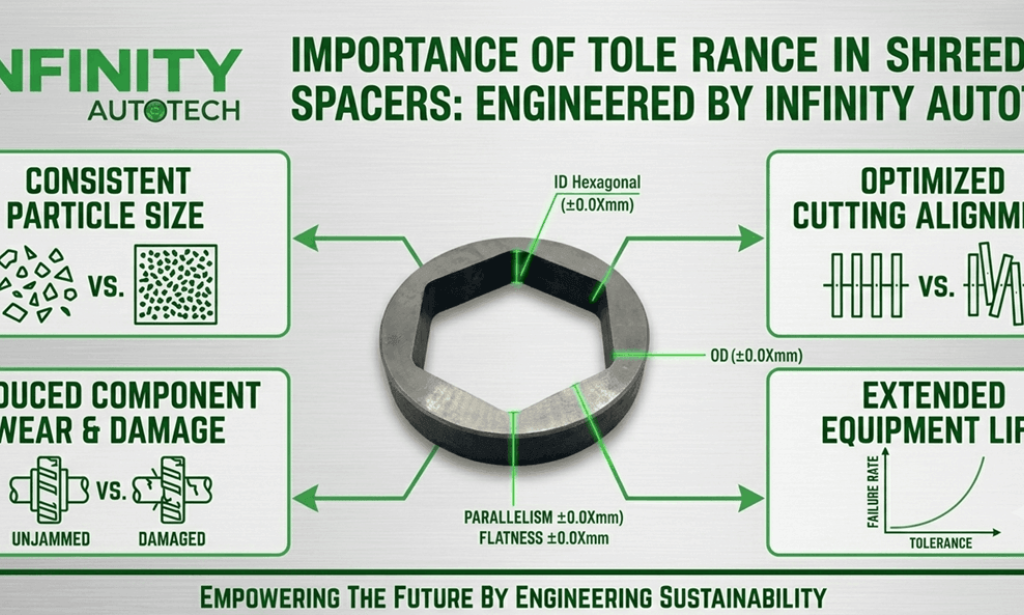
Walk into any industrial shredding operation and ask an experienced maintenance engineer what causes the most unplanned downtime, and blades rarely top the list on their own. More often, the real culprit sits quietly between the blades: the spacer. These unassuming cylindrical components are easy to overlook, yet they determine whether a shredder's cutting assembly runs true for years or begins destroying itself within weeks. The difference between a spacer machined to a tight, specified tolerance and one that's merely "close enough" can mean the difference between a shredder that delivers thousands of hours of reliable service and one that chews through blades, bearings, and shafts at an alarming rate.
This article takes a close look at why tolerance the permissible variation in a component's dimensions matters so much in spacer design, how imprecise spacers cause lateral movement that cascades into much larger mechanical problems, and why investing in precision-manufactured spacers is one of the most cost-effective decisions a shredder operator can make.
What Is a Spacer, and Why Does It Matter in a Shredder Assembly?
In a plastic or industrial shredder, the cutting assembly consists of a rotor shaft fitted with alternating blades and spacers, all stacked together and locked into position with end plates, keys, or splines. The blades do the visible work of cutting, but the spacers are what hold everything in its correct geometric position. They control the exact spacing between blade faces, maintain consistent gaps for shearing action, and keep the entire rotor assembly rigid and balanced as it spins at operating speed.
It's tempting to think of a spacer as a simple, passive part a metal cylinder that just fills space between two blades. But in reality, spacers are precision structural components. They bear significant axial and radial loads, they're subject to constant vibration and impact forces transmitted from the cutting edges, and their exact dimensions directly determine how well adjacent blades interact with one another. A spacer that's even a fraction of a millimeter out of specification doesn't just sit there quietly it actively degrades the performance of everything around it.
Understanding Tolerance: More Than Just a Number on a Drawing
In mechanical engineering, tolerance refers to the total permissible variation in a dimension — the acceptable range between the maximum and minimum size a manufactured part is allowed to have while still functioning correctly within an assembly. A spacer specified at, say, 50 millimeters in length with a tolerance of ±0.02 millimeters must fall between 49.98 and 50.02 millimeters to be considered acceptable.
That might sound like an extraordinarily fine margin for a part that seems as simple as a metal cylinder, but tight tolerances exist for a reason: mechanical systems are cumulative. When you stack a dozen or more spacers and blades along a single rotor shaft, even small dimensional errors in each individual component add up. This phenomenon, known in manufacturing as "tolerance stack-up," means that a spacer manufactured just slightly outside its intended tolerance doesn't cause a proportionally small problem it can compound with every other component in the stack to produce a significant cumulative misalignment across the entire rotor assembly.
Tolerance isn't a single, universal standard either. Engineers typically specify tolerances according to established systems like ISO 286, which defines standardized fits and tolerance grades (IT grades) for mechanical components. A spacer designed for a high-speed, heavy-duty industrial shredder will typically require a tighter IT grade than, say, a bracket in a low-stress static assembly, precisely because the consequences of dimensional error are so much more severe in a rotating, load-bearing system.
How Imprecise Spacers Cause Lateral Movement
Lateral movement sometimes called axial play or float occurs when components along a rotor shaft are not held rigidly in their intended position and are able to shift slightly from side to side during operation. This might sound like a minor issue, but in a shredder assembly spinning at operational speed under heavy cutting loads, lateral movement is a serious mechanical problem with a domino effect of consequences.
Here's how it happens. If a spacer is manufactured undersized even by a small margin it creates a gap in the stack-up along the shaft. Under load, particularly the repeated impact forces generated every time a blade encounters plastic scrap, that gap allows the blades and spacers to shift slightly along the axis of the shaft. Every time the assembly shifts, blade faces that were designed to run with a precise, consistent clearance relative to their neighboring blade or counter-blade suddenly find themselves running either too tight or too loose.
If the gap closes too far, blade edges can clash directly against one another or against fixed counter-knives, causing chipping, edge rounding, and rapid wear. If the gap opens too far, the shearing action between blades becomes inconsistent, and material begins slipping through without being cleanly cut — leading to ragged, inconsistent output and increased load on the motor as it struggles to force material through an inefficient cutting zone.
Worse, lateral movement is rarely a static, one-time event. Once a spacer stack has play in it, that play tends to get worse over time. Repeated impacts hammer against the loose gap, accelerating wear on the mating faces of the spacers and blades, which in turn increases the gap further. It's a self-reinforcing cycle: a small manufacturing tolerance error becomes a growing mechanical problem that compounds with every hour of operation.
Why Blade Interaction Depends Entirely on Spacer Precision
Shredder blades are designed to work in extremely close relationship with one another. In multi-blade rotor assemblies, cutting efficiency depends on maintaining a very specific, consistent clearance between adjacent rotating blades, and between rotating blades and fixed bed knives. This clearance often just fractions of a millimeter is what allows the blades to create a clean shearing action rather than a crushing or tearing action.
Spacers are the component responsible for maintaining that clearance. Every blade's position along the shaft is a direct function of the cumulative length of the spacers positioned before it. If those spacers are manufactured to precise, consistent tolerances, each blade sits exactly where the engineering design intended, and the clearances between cutting edges remain within the narrow window required for efficient, clean shearing.
If spacers vary in length even slightly, and even if the variation is inconsistent from one spacer to the next blade clearances become unpredictable across the length of the rotor. Some blade pairs might run with too little clearance, causing metal-on-metal contact that dulls or chips cutting edges within hours of operation. Others might run with excessive clearance, allowing material to pass through without being properly sheared, which reduces throughput and forces the operator to run the material through the shredder multiple times to achieve the desired particle size.
This is why blade and spacer specifications can never really be considered independently. A perfectly sharpened, precision-ground blade will still underperform and wear out prematurely if it's paired with spacers that don't hold it in its correct position. The entire cutting system, not just the blade edge itself, needs to be engineered and manufactured as a matched, precision system for a shredder to perform as designed.
The Ripple Effect: How Spacer Tolerance Impacts the Entire Machine
It's easy to think of spacer tolerance as a localized issue affecting only the blades directly adjacent to a given spacer. In reality, the effects ripple outward through the entire shredder assembly.
Bearing wear. Lateral movement in the rotor assembly doesn't stay contained within the cutting chamber. It transmits axial loads back through the shaft to the bearings supporting the rotor. Bearings are designed to handle specific, predictable load patterns; when they're subjected to unplanned axial thrust from a loose spacer stack, they wear far faster than their rated service life, leading to premature bearing failure and unplanned downtime.
Shaft fatigue. Repeated impact loading from misaligned blades and spacers introduces cyclical stress into the rotor shaft itself. Over time, this can contribute to fatigue cracking, particularly at keyways and other stress-concentration points a failure mode that's far more expensive and dangerous to address than simply replacing worn spacers early.
Motor and gearbox strain. When blade clearances are inconsistent, the shredder has to work harder to achieve the same cutting result. Motors draw more current, gearboxes experience higher torque loads, and overall energy consumption rises all because a handful of undersized spacers allowed the cutting geometry to drift out of specification.
Vibration and noise. A rotor assembly with lateral play doesn't spin as smoothly as one that's rigidly and precisely constrained. This shows up as increased vibration and noise during operation, both of which are early warning indicators that something in the mechanical stack-up isn't right, and both of which accelerate wear on virtually every other component in the machine.
Output quality. Ultimately, all of this mechanical degradation shows up in the shredder's output. Inconsistent particle size, increased fines, and higher rates of "long" or unshredded material are common symptoms of a cutting assembly that's drifted out of tolerance, even when the blades themselves still have plenty of usable cutting life remaining.
Unplanned downtime. Perhaps the most costly consequence of all is unplanned downtime. A shredder that's had to be shut down because of blade clash, bearing failure, or shaft damage isn't just a repair cost it's lost production capacity, delayed processing schedules, and, for facilities running shredders as part of a continuous recycling line, a bottleneck that can halt an entire operation.
Precision Manufacturing: How Tight-Tolerance Spacers Are Made
Achieving the level of dimensional accuracy that industrial shredder spacers require isn't something that happens with standard cutting or casual machining. It demands a deliberate, controlled manufacturing process from raw material selection through final inspection.
Material Selection
Precision spacers are typically manufactured from hardened alloy steel or similar wear-resistant metals capable of withstanding constant impact and compressive loading without deforming. Material consistency matters here too inconsistent raw stock can lead to dimensional drift during machining and heat treatment, even when the machining process itself is executed correctly.
CNC Machining
Computer numerically controlled (CNC) machining is the standard method for producing spacers to tight tolerances. Unlike manual machining, CNC processes remove material with extremely high repeatability, ensuring that the tenth spacer produced in a batch is dimensionally identical to the first. This repeatability is essential in shredder applications, since even a single out-of-tolerance spacer in an otherwise precise stack can introduce the lateral movement problems described earlier.
Grinding for Final Precision
For the tightest tolerance requirements particularly on the critical faces that contact adjacent blades precision grinding is often used as a finishing process after initial machining. Grinding removes material in extremely small increments, allowing manufacturers to hold tolerances far tighter than standard turning or milling alone can achieve, while also producing the smooth, flat surface finish needed for consistent, even contact between spacer and blade faces.
Heat Treatment and Dimensional Stability
Hardening processes improve wear resistance but can also introduce dimensional changes if not carefully controlled. Reputable manufacturers account for this by performing heat treatment before final precision grinding, ensuring that any minor dimensional shift caused by hardening is corrected in the final finishing pass rather than left as an uncontrolled variable in the finished part.
Quality Control and Inspection
Precision spacer manufacturing isn't complete without rigorous inspection. Coordinate measuring machines (CMMs), micrometers, and dial gauges are used to verify that finished spacers fall within their specified tolerance range before they're approved for use. Batch consistency checks are particularly important for shredder applications, since as discussed above the cumulative effect of multiple spacers in a stack means that even statistically small variations between individual parts in a batch can add up to a meaningful assembly-level problem.
The Cost of Cutting Corners on Spacer Precision
It's worth being direct about the economics here, because the temptation to save money on "simple" components like spacers is understandable and misguided. A spacer manufactured with loose tolerances or from lower-grade materials will almost always cost less upfront than a precision-ground, tightly toleranced equivalent. But that upfront saving is rarely a genuine saving once the full lifecycle cost is considered.
Replacing a set of low-cost, imprecise spacers might seem like routine maintenance, but the damage caused while those spacers were in service accelerated blade wear, bearing degradation, increased energy consumption, and lower-quality output often costs far more than the price difference between a budget spacer and a precision one. In many cases, operators find themselves replacing not just the spacers but the blades, bearings, and even shaft components that were damaged as a downstream consequence of lateral movement introduced by out-of-tolerance parts in the first place.
There's also a productivity cost that's easy to underestimate. A shredder running with degraded cutting geometry doesn't just wear out faster it processes material less efficiently in the meantime, requiring more energy and more passes to achieve the same throughput and output quality that a properly toleranced machine would deliver as a matter of course. Over months of operation, that efficiency loss can represent a substantial hidden cost that never shows up as a single line item but steadily erodes the operation's overall productivity and profitability.
Precision-manufactured spacers, by contrast, are a component you essentially stop thinking about. When they're manufactured correctly, matched precisely to the blade and shaft specifications of the shredder they're installed in, they simply do their job maintaining rigid, consistent geometry for the full service interval they were designed for, without contributing to unplanned wear anywhere else in the machine.
Matching Spacers to Blades: A System, Not a Set of Parts
One of the most important principles in shredder maintenance is recognizing that blades and spacers are not independent components to be sourced separately and assumed to work together. They form a matched system, and their tolerances need to be considered jointly, not in isolation.
A blade manufactured to an extremely tight tolerance on its cutting geometry will still underperform if it's installed with a spacer that doesn't hold it in exactly the axial position the design calls for. Likewise, a perfectly toleranced spacer paired with a worn or improperly specified blade won't deliver the cutting performance the shredder is capable of. For this reason, operators looking to maximize shredder reliability and cutting performance are well served by sourcing blades and spacers from a supplier who engineers them as a coordinated system rather than treating them as generic, interchangeable stock components. A well-matched set of precision shredder blades designed to work in concert with correctly toleranced spacers ensures that the cutting assembly performs as a unified system rather than a collection of parts that merely happen to fit together.
This systems-level thinking extends to replacement cycles as well. Because spacers and blades wear at different rates and are subject to different load patterns, it's worth tracking their condition independently, but replacing them with an eye toward maintaining consistent overall assembly tolerance rather than simply swapping out whichever component looks most visibly worn.
Specifying Spacers Correctly: What Operators Should Know
For operators and maintenance teams involved in specifying or ordering replacement spacers, a few practical points make a significant difference in outcomes.
Always match original equipment specifications.
Spacer dimensions should match the original design tolerances of the shredder, not just its approximate size. "Close enough" substitutes sourced from generic industrial suppliers may fit on the shaft but rarely hold the same tight tolerances as parts manufactured specifically for that shredder model.
Understand the tolerance grade required.
Ask suppliers what IT grade or equivalent tolerance standard their spacers are manufactured to, and confirm that it matches or exceeds what your shredder's original design calls for. This is particularly important for high-speed or heavy-duty shredders, where tolerance requirements tend to be tighter than in lighter-duty equipment.
Request material and hardness certification.
Because spacers experience significant compressive and impact loading, the material grade and hardness treatment matter as much as the dimensional tolerance. Reputable manufacturers can provide certification confirming both.
Consider batch consistency, not just individual part tolerance.
If you're ordering a full set of spacers for a rotor rebuild, consistency across the entire batch matters more than any single spacer meeting tolerance in isolation. Ask suppliers about their quality control process for batch production, not just single-part inspection.
Don't mix old and new spacers indiscriminately.
Worn spacers, even ones that were originally manufactured to tight tolerances, may have degraded in service. Combining worn spacers with new precision-manufactured ones can reintroduce the very lateral movement problems that precision components are meant to prevent.
Inspecting and Maintaining Spacers Over Time
Precision manufacturing solves half the equation; the other half is ongoing inspection and maintenance to ensure spacers remain within tolerance throughout their service life.
Routine visual inspection during scheduled blade maintenance is a good first line of defense looking for visible wear, pitting, or deformation on spacer faces. But visual inspection alone won't catch dimensional drift that hasn't yet become visually obvious. Periodic measurement with micrometers or calipers, particularly on spacers that have been in service for extended periods, helps catch wear before it progresses to the point of causing lateral movement problems.
It's also worth paying attention to broader machine symptoms as indirect indicators of spacer condition. Increased vibration, unusual noise during operation, declining output consistency, or unexpected increases in energy consumption can all be early signs that something in the cutting assembly's tolerance stack has drifted, even before a direct inspection confirms which specific component is responsible.
Establishing a proactive replacement interval rather than waiting for visible failure is generally the most cost-effective approach for high-utilization shredders. Because the cost of a spacer is small relative to the cascading damage that out-of-tolerance components can cause elsewhere in the machine, scheduled replacement based on operating hours or cumulative material throughput is often far cheaper in the long run than a reactive, failure-driven maintenance approach.
Why Tolerance Deserves the Same Attention as Blade Sharpness
In many shredder maintenance programs, disproportionate attention goes toward blade sharpness and edge condition, while spacers are treated as a low-priority, generic consumable. This is understandable blade wear is visible, directly affects cutting performance in an obvious way, and is easy to diagnose by simply looking at the cutting edge. Spacer tolerance issues, by contrast, are largely invisible until they've already caused downstream damage.
But as this article has laid out, spacer tolerance is not a secondary consideration it's foundational to the performance of the entire cutting assembly. A shredder with perfectly sharp blades but poorly toleranced spacers will still suffer from inconsistent cutting clearances, lateral movement, and accelerated wear across multiple components. Conversely, a shredder with correctly toleranced, precision-manufactured spacers gives every other component in the assembly blades, bearings, shaft, motor the chance to perform and wear as designed, without compounding problems introduced by dimensional drift in a part that's easy to overlook.
For operators serious about maximizing shredder uptime, minimizing total cost of ownership, and maintaining consistent output quality, spacer tolerance deserves the same level of scrutiny, specification rigor, and maintenance attention as the blades themselves. It's rarely the most visually dramatic point of failure in a shredder, but it's very often the root cause behind failures that appear to originate elsewhere in the machine.
A Practical Scenario: How a Small Tolerance Error Becomes a Big Problem
It's useful to walk through a concrete example of how this plays out on a real shredder rotor, because the abstract engineering language can obscure just how quickly a small manufacturing error compounds into a serious mechanical issue.
Imagine a single-shaft shredder rotor fitted with twelve blades separated by twelve spacers, all stacked along the shaft and locked in place with an end plate and retaining nut. The design calls for each spacer to be manufactured to a length of 40 millimeters, with a tolerance of ±0.01 millimeters. In a correctly manufactured stack, the cumulative length of the twelve spacers should fall within a tightly controlled range, and the end plate can be torqued down to hold the entire assembly rigidly in place with no float.
Now suppose a lower-cost supplier delivers a batch of spacers where the actual tolerance achieved is closer to ±0.15 millimeters still visually indistinguishable from precision parts, and still within a range that might pass a cursory glance or a quick caliper check on a single part. Across twelve spacers, that seemingly small per-part variation can accumulate into a stack-up error of well over a millimeter, depending on which direction the individual errors happen to fall.
A millimeter of unaccounted play in a rotor stack might not sound like much, but at operating speed, under constant impact loading from cutting plastic scrap, that play is more than enough to allow blades to shift axially with every cutting cycle. Within days, blade edges that were designed to run with a precise 0.1-millimeter shearing clearance against their neighbors begin intermittently clashing. Within weeks, visible chipping appears on cutting edges that would otherwise have had months of useful life remaining. Within a few months, the bearings supporting the rotor never designed to absorb this kind of repeated, unplanned axial thrust begin showing signs of premature wear, and the operator is left wondering why a "simple" spacer replacement seems to have triggered a cascade of unrelated mechanical problems.
This scenario isn't hypothetical exaggeration it's a pattern that shows up repeatedly in shredder maintenance records wherever operators have substituted precision-manufactured spacers with lower-cost, loosely toleranced alternatives. The lesson is straightforward: tolerance errors that look trivial on a single component drawing rarely stay trivial once they're multiplied across a full assembly and subjected to real operating loads.
Frequently Asked Questions
How much lateral movement is considered acceptable in a shredder rotor?
Acceptable lateral movement, sometimes called axial play, is typically specified by the original equipment manufacturer and is often held to just a few hundredths of a millimeter in precision-toleranced assemblies. Any measurable play beyond the manufacturer's specification is generally a sign that spacers, bearings, or retaining components have worn beyond their intended tolerance and should be inspected.
Can worn spacers be reconditioned instead of replaced?
In some cases, spacers can be reground to restore flat, parallel faces, provided enough material remains to keep the part within its required length tolerance after grinding. However, once a spacer has worn beyond the point where reconditioning would bring it back within specification, replacement with a precision-manufactured part is the more reliable option.
Do all shredder models use the same spacer tolerances?
No. Tolerance requirements vary depending on rotor speed, cutting load, blade design, and the overall precision of the shredder's original engineering. Heavy-duty, high-speed industrial shredders generally require tighter spacer tolerances than smaller or lighter-duty machines, since the consequences of dimensional error scale with operating speed and impact force.
How often should spacers be inspected or replaced?
Inspection intervals depend on usage intensity, material type being processed, and the presence of contaminants in the feedstock, but many operators build spacer inspection into the same maintenance schedule used for blade sharpening or replacement, since both components are typically accessed together during rotor maintenance.
Is it possible to identify a spacer tolerance problem without disassembling the rotor?
Indirect signs including increased vibration, unusual noise, inconsistent output particle size, or rising energy consumption can suggest a tolerance-related issue before a full inspection is performed. However, confirming the root cause typically requires measuring the spacers directly during a scheduled maintenance interval.
Conclusion
Spacers may not carry the same visual prominence as cutting blades, but their role in a shredder assembly is every bit as critical. Precision tolerance in spacer manufacturing is what prevents lateral movement along the rotor shaft, maintains the exact blade clearances required for clean, efficient cutting, and protects every other component in the machine from bearings to the motor itself from the cascading wear that results when a cutting assembly drifts out of its intended geometry.
"Close enough" might save a small amount on the initial purchase of a spacer, but it rarely saves money once the full cost of accelerated wear, reduced output quality, and unplanned downtime is factored in. Precision-manufactured spacers, matched carefully to the tolerances of the blades and shaft they're installed alongside, are one of the most effective and most overlooked investments an operator can make in the long-term reliability of their shredder. When blades and spacers are engineered and sourced as a coordinated system, the entire machine benefits: smoother operation, longer component life, more consistent output, and fewer unplanned interruptions to production.

You must be logged in to post a comment.