
Manufacturing industries are operating under increasing pressure to improve dimensional accuracy, reduce material wastage, lower machining time, and maintain tighter mechanical tolerances without compromising structural strength. Automotive transmission systems now require lighter yet stronger forged components capable of handling higher rotational loads. Aerospace assemblies demand extremely precise dimensional control while maintaining fatigue resistance under fluctuating thermal stress. Heavy industrial equipment manufacturers are expected to reduce production inefficiencies while supplying components capable of surviving continuous mechanical loading over long operational periods.
Under these conditions, conventional manufacturing methods often create limitations related to excessive machining allowance, inconsistent material utilization, dimensional variation, and unnecessary production loss. This is one major reason modern industries are rapidly increasing their dependence on advanced precision forging techniques.
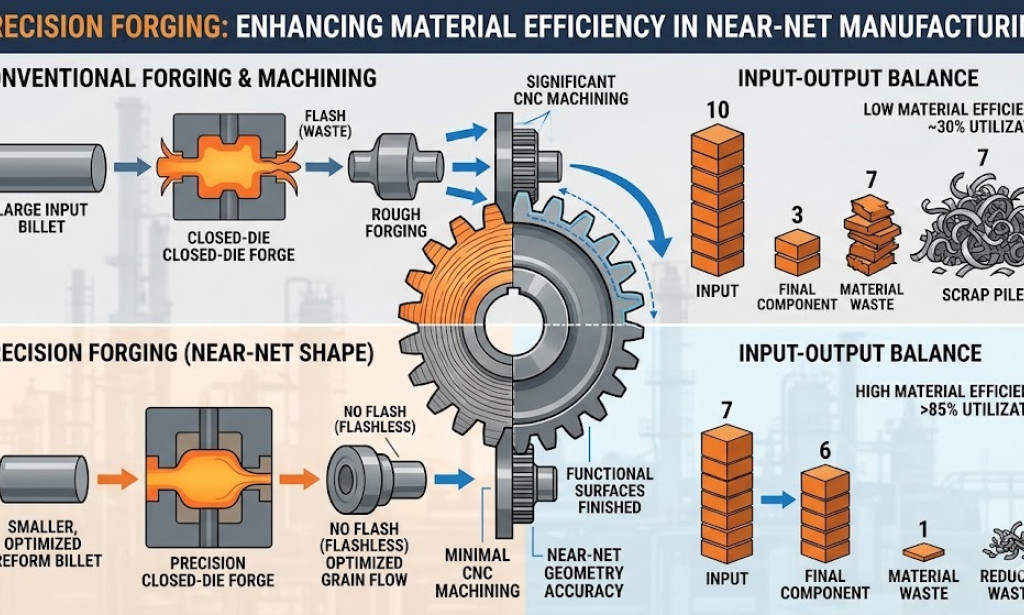
Unlike traditional forging methods where substantial post-machining is required after deformation, precision forging focuses on producing near-net shape components with extremely tight dimensional accuracy directly during the forging cycle itself. The process minimizes excess material removal while improving grain continuity, structural integrity, and production efficiency simultaneously.
The engineering importance of this approach extends far beyond cost reduction alone. Near-net shape manufacturing changes how industrial components behave mechanically, how efficiently raw material is utilized, and how manufacturers maintain repeatability across high-volume production environments.
Modern engineering sectors increasingly view precision forging not merely as a production method, but as a highly controlled metallurgical and dimensional optimization process.
Near-Net Shape Manufacturing Reduces Unnecessary Material Removal
Traditional manufacturing operations often involve large machining allowances after forging or casting. Excess material is intentionally retained during shaping so that final machining can later achieve required dimensions and surface finish.
While effective, this method creates several inefficiencies simultaneously.
Large-scale machining increases:
- Raw material consumption
- Production cycle duration
- Tool wear
- Power consumption
- Scrap generation
- Dimensional variation risk
Near-net shape manufacturing significantly reduces these losses because the forged component exits the die much closer to final dimensions.
In advanced precision forging operations, dimensional tolerances may often remain within fractions of a millimeter depending on component geometry and alloy system. This reduces secondary machining requirements substantially.
For example, traditional forged drivetrain components may require machining removal allowances exceeding 4 mm to 6 mm in certain regions. Near-net shape forged components can reduce this allowance dramatically, lowering overall material waste while improving manufacturing efficiency.
This reduction becomes financially significant in high-volume production sectors such as:
- Automotive transmission systems
- Bearing assemblies
- Industrial gear manufacturing
- Aerospace structural components
- Railway drivetrain systems
- Heavy engineering equipment
Material efficiency now carries major economic importance because alloy steel costs, machining energy consumption, and production lead times continue increasing globally.
Controlled Grain Flow Improves Mechanical Reliability
The structural advantage of precision forging extends well beyond dimensional accuracy.
During controlled forging deformation, the grain structure aligns according to the geometry of the component itself. This directional grain flow significantly improves fatigue resistance and impact strength compared to cast or heavily machined alternatives.
In conventional machining operations, material removal cuts through natural grain orientation, sometimes weakening load-bearing continuity in critical regions. Precision-forged components maintain grain-flow alignment more effectively because less material removal occurs after forging.
This metallurgical continuity improves:
|
Structural Characteristic |
Mechanical Benefit |
|
Directional grain flow |
Better fatigue resistance |
|
Reduced machining cuts |
Improved load continuity |
|
Higher material density |
Better impact strength |
|
Refined microstructure |
Stable stress distribution |
|
Lower discontinuity risk |
Reduced crack formation |
These properties become especially valuable in rotating or cyclically loaded industrial systems where repeated stress gradually weakens structurally inconsistent materials.
Modern industrial sectors increasingly prioritize grain-flow optimization because operational life expectancy has become a major engineering requirement across heavy-duty applications.
Dimensional Accuracy Has Become a Competitive Manufacturing Requirement
Industrial systems now operate under tighter dimensional tolerances than earlier manufacturing generations.
Modern gearbox assemblies, bearing systems, steering components, couplings, and transmission mechanisms require extremely accurate geometry because even small dimensional deviation affects alignment behavior, vibration levels, thermal expansion characteristics, and rotational stability.
Advanced precision forging systems therefore integrate closely controlled die engineering, thermal monitoring, and deformation management throughout production.
The process often includes:
- Computer-aided die simulation
- Controlled billet heating
- Digital press-force monitoring
- Automated deformation sequencing
- Coordinate dimensional verification
Hydraulic and mechanical presses used for high-accuracy forging applications frequently operate between 1,500 tons and 8,000 tons depending on component geometry and alloy requirement.
The purpose is not only shaping the component accurately. The larger objective is maintaining consistent dimensional repeatability across thousands of production cycles without introducing metallurgical instability.
Billet Heating Stability Influences Final Accuracy
The quality of a precision-forged component begins before deformation starts.
Billet heating consistency strongly affects material flow behavior during forging. Uneven thermal distribution creates unstable deformation patterns and dimensional variation during die filling.
Overheated billet regions may develop coarse grain structure while underheated areas resist compression, causing incomplete die filling or internal stress concentration.
Modern precision forging operations therefore use digitally controlled reheating systems capable of maintaining carefully monitored thermal zones throughout the heating cycle.
For many alloy steels, billets are commonly heated between approximately 1,050°C and 1,250°C depending on deformation requirement and material composition.
Large industrial facilities increasingly use infrared monitoring systems and automated furnace controls because thermal consistency directly influences:
- Die filling accuracy
- Grain refinement behavior
- Surface quality
- Dimensional repeatability
- Tool life stability
The thermal stage quietly determines whether the final component achieves both dimensional precision and metallurgical consistency simultaneously.
Die Engineering Has Become Increasingly Sophisticated
Precision forging dies operate under severe mechanical and thermal conditions while maintaining extremely accurate geometry during repeated production cycles.
Modern die systems are no longer designed through trial-and-error manufacturing approaches alone. Advanced simulation software is now commonly used to predict:
- Material flow behavior
- Thermal distribution
- Stress concentration zones
- Flash formation
- Die wear progression
- Grain orientation paths
This predictive engineering helps reduce production variation before actual manufacturing begins.
Die materials themselves are typically produced using specialized hot-work tool steels capable of resisting thermal fatigue and mechanical wear under continuous operational loading.
In large-scale precision forging environments, die surfaces may repeatedly experience temperatures above 300°C while absorbing enormous compressive force during each forging cycle.
Maintaining die stability under such conditions directly affects dimensional repeatability and surface consistency throughout production.
Material Utilization Has Become Economically Critical
Modern manufacturing industries are under growing pressure to improve raw-material efficiency because alloy costs and energy expenses continue rising globally.
Traditional machining-intensive production methods often convert substantial portions of raw material into scrap during finishing operations. Near-net shape forging reduces this waste significantly.
Depending on component geometry and production volume, advanced precision forging processes may improve material utilization rates by 15% to 35% compared to conventional machining-heavy manufacturing methods.
This efficiency becomes extremely important in sectors processing expensive alloy systems including:
- Chromium-molybdenum steels
- Nickel-based alloys
- High-strength automotive steels
- Aerospace-grade materials
- Heat-resistant industrial alloys
Reducing unnecessary material removal also lowers energy consumption during machining operations while shortening production cycles.
Manufacturers increasingly recognize that material efficiency is no longer only a cost concern. It is becoming a major operational and environmental requirement.
Inspection Systems Support High-Accuracy Manufacturing
Precision manufacturing requires equally precise inspection systems.
Modern forging facilities increasingly rely on advanced quality-control methods rather than manual inspection alone. Even small dimensional inconsistency or internal discontinuity may affect long-term performance in critical engineering systems.
Inspection technologies commonly used in advanced precision forging operations include:
- Coordinate measuring systems
- Ultrasonic testing
- Hardness mapping
- Optical scanning
- Surface roughness analysis
- Spectrochemical verification
Coordinate measurement machines now routinely evaluate micron-level dimensional variation in high-precision industrial components.
The strongest manufacturers use inspection data continuously to improve process stability and reduce variation across large production batches.
One example of companies operating within this increasingly precision-focused manufacturing environment is Sendura Forge, where forged-component production aligns closely with modern dimensional control, metallurgical refinement, and industrial reliability requirements.
Automation Is Improving Repeatability Across Production Cycles
Automation is becoming increasingly important in precision forging operations because process consistency directly influences final component quality.
Earlier forging environments depended heavily on operator experience and manual adjustments during production. Modern manufacturing systems now rely more heavily on automated process monitoring and digitally controlled equipment.
Automation helps maintain stable:
- Billet temperature
- Press-force distribution
- Die alignment
- Cycle timing
- Cooling behavior
- Dimensional repeatability
This consistency reduces production variation significantly across high-volume manufacturing environments.
The transition toward digitally monitored production systems is helping precision forging facilities meet increasingly strict industrial tolerance requirements without compromising structural reliability.
Final Perspective
The growing industrial importance of precision forging is closely connected with the rising demand for dimensional accuracy, material efficiency, and long-term mechanical reliability across modern engineering sectors.
Near-net shape manufacturing reduces unnecessary machining while improving grain continuity, structural stability, and production efficiency simultaneously.
As industrial systems continue operating under tighter tolerances, stronger cyclic loading, and more demanding performance expectations, manufacturers are placing increasing emphasis on controlled deformation, thermal stability, die precision, and inspection discipline throughout the forging cycle.
The forging facilities strengthening their industrial position are the ones quietly improving dimensional repeatability, material utilization, grain-flow consistency, and fatigue resistance while producing near-net shape components capable of maintaining structural reliability under years of demanding operational conditions.

You must be logged in to post a comment.