
Five years ago, I was walking through a large fabrication unit in Rajkot when I saw how a massive hydraulic press was attempting to roll a 40mm thick carbon steel plate while the plant was awash with ozone and burnt metal odors. The crew was manufacturing a pressure vessel shell of large diameter, but the "economy" rolling machine, which had been purchased from a brand that looked very good on paper but had no local support, was struggling and even "groaning".
Then a loud bang was heard in the whole bay. The breakage of a structural weld in the frame of the machine was evidenced. Luckily, there were no injuries, but that project was finished at that moment. A lead time of six months, a destroyed plate made of high-grade steel, and a delay in client's project that caused a loss of reputation were the consequences of a "cost-saving" procurement decision. It was, really, a wake-up call for me. In industries, machinery is not just a mere tool; it is the lifetime of your production line. Selecting a wrong Plate Rolling Machine Manufacturer means not only losing money on the purchase of the machine but also jeopardizing the entire speed of your business to the market.
Gone are the days when an entry-level machine could meet the needs of a large fabrication shop. A plate rolling machine today is expected to be fast, accurate, fuel-efficient, and robust. It is also compatible with the operation of an existing shop.True, cost will matter when you choose something. Yet that number alone ought not shape the whole choice.
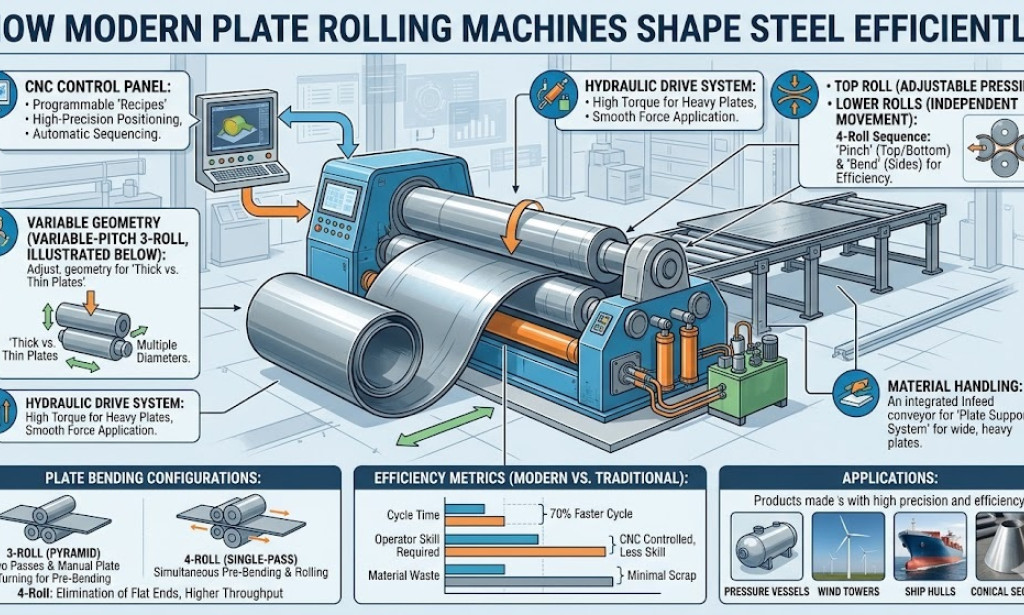
Older models use three rollers, sometimes enough depending on the job. Yet for many tasks involving sheet metal, experts usually point toward four-roller versions. With an extra roll built in, these units perform beyond basic curve shaping. Control improves noticeably during forming. They manage thicker materials without struggle. Wider sheets stay steady under pressure. Their build often lasts years longer than simpler types. Durability shows up clearly over time.
Two Types of 3-Roll Outfits: Initial Pinch and Pyramid
The pyramid 3-roll machine is the original concept. It is dependable, easier to maintain, and usually less expensive. However, it often results in a large flat end on the plate because the rollers can't grip the edge. This will require you to pre-bend the edges using a press brake or totally waste the material. The time and material losses easily negate the initial savings of purchasing such a machine.
The 4-Roll Difference
A four-roll machine is a different beast altogether. The two middle rolls pinch the plate and the side rolls do the bending.
- Quicker loading: The plate is squared against the back roll immediately.
- Rolling in one pass: Often the cylinder can be finished in a single pass.
- Safety: The plate remains clamped and there is no chance of slipping and "oops" moments.
It really seems to me that if you are looking to speed to market, a four-roll is a no-brainer. You leverage your lead without necessarily working harder, just smarter.
Seriously, anyone can publish a great brochure. My experience is that the real "aha" moments come when you take a look at what the folks don't put on the front page.
As a buyer, you should check whether or not the machine manufacturer designs the frames and hydraulic circuits.
Many smaller players in India, and also some globally-renowned "budget" brands, are just assembly houses at the end of the day. They buy the rolls from one supplier, the hydraulics from another, and the PLC from a third.
When something fails, which it will eventually, they will blame their suppliers. A genuine Plate Rolling Machine Manufacturer masters engineering. They'll be able to tell you the exact grade of forged steel used in the rolls and why the specific induction hardening depth was chosen.
Some "Hidden" Quality Markers:
- Roll Deflection Compensation: Steel is quite flexible. With the application of enormous pressure to the central portion of a roll, the roll will bow. Does the manufacturer favorite crowned rolls? Do they have a hydraulic support system for the bottom roll? If they don't have a plan for deflection, your "cylinders" will be "barrels" in the end.
- Bearing Housing: Check how the rolls are mounted. The gold standard is heavy-duty spherical roller bearings. If bushings are used on a high-capacity machine, then get away. Without looking back.
- Lubrication Systems: In a modern machine, lubrication is centralized and automatic. If your operator has to go inside with a grease gun every two hours, it's not a modern machine.
I guess we need to discuss the "India factor." If you are a manufacturer in Pune, Chennai, or Rajkot, buying a machine from a German or Italian company would be the most prestigious purchase. Besides, their technology is quite often of a world-class level. But, you know, I have seen it happen, what would you do if a proportional valve blows on a Tuesday morning?
The bottom line is that if that Plate Rolling Machine Manufacturer does not have a team dedicated to service in India, then you are looking at weeks of downtime while parts are being cleared through customs.
Insider Advice: It is a good idea to conduct a background check on the availability of spare parts as well as the local support. If the manufacturer has critical electronic components and seals earmarked in-country, it means that they are a serious contender.
Now showing up in India, homegrown brands start to shake things in Europe. These makers pull together parts from around the globe - think Rexroth hydraulics, Siemens PLCs - but build the big metal bodies locally. The result? Top-tier tech meets fast local backup, ready when needed.
I was recently talking to a company owner who is a direct-to-consumer brand who was in the process of ramping up their stainless steel tank production. They were thinking a lot about the price of a CNC system and how that was going to be prohibitively expensive. "Our operators are good, " was their explanation.
Well, here is the deal. Both AI and automation are not just about hype. They are about predictability. With a CNC plate rolling machine, you have the option of saving programs for specific materials and radii.
- Reduced Human Error: You no longer rely on the "gut feeling" of a tired operator who might have had a bad night's sleep.
- Efficient Operations: Automation will take you to the next level of efficiency, whereas strategic benefits like the capability to handle complex elliptical shapes will make you more scalable.
- Data Transfer: State-of-the-art equipment can even synchronize your ERP. You will be aware of the number of plates rolled and energy consumption.
Installing AI or CNC of the highest level is a long-term decision that will have an impact on all business functions. You can't build a "future-proof" shop without looking at the ROI but only the purchase price is not sufficient.
When you receive a quotation from a Plate Rolling Machine Manufacturer, remember to not base your decision solely on the price. Focus on the Total Cost of Ownership (TCO).
- Energy Efficiency: Ask if the machine comes with variable-speed pumps. A machine that utilizes 30% less power will recover the "premium" price within three years of heavy use.
- Resale Value: The resale market for a reputable machine holds its value. In case of an upgrade, a well-known brand in the used market can be sold for 60-70% of its value. A "no-name" machine is only sold for scrap.
- Foundations: Some machines that are poorly designed need very deep pits and specialized foundations. A well-engineered and compact machine may be installed right on your factory floor, thus saving you a lot of money in civil engineering.
Okay, enough of the philosophical side of things. You are about to sign the PO. Wait a bit and use this practical "no-nonsense" checklist. You will be found wanting if the machine manufacturer hesitates for any of these points. So, keep on looking.
- The "Live" Demo: Do not buy from a video only. Make a factory visit. See a machine roll a plate at the maximum rated capacity of the machine. Hear if the machine is stressed with sounds.
- The Metallurgy Report: Get material test certificates for the rolls. Rolls should be forged rather than cast and induction hardened to HRC 50-55.
- Parallelism Control: Inquire about how the machine maintains the parallelism of the rolls. Is the system based on the torsion bar (that is old, prone to wear) or is it electronic/hydraulic sync (modern and accurate)?
- Software Support: CNC machine-related queries also involve finding out who wrote the software. Is it the only proprietary system they can repair or is it built on an open platform?
- Reference Checks: Request for at least three references who have owned the machine for a period of at least five years. Give them a call and ask about the service response time. This step is, actually, the most important one.
Markets are changing and customers are not willing to wait anymore. Recently, we witnessed a massive shift to "Green Steel" and more energy efficient production.
In my view, good manufacturers today have their eyes set on:
- Material Waste Minimization: Rolling so accurately that the flat ends are minimal and you, as the final user, will therefore be buying less steel to make the same product.
- Hybrid Systems: Using full-electric positioning and hydraluic forces only for heavy work that cuts carbon footprint drastically.
- Remote Diagnostics: The manufacturer being able to not only see inside your machine and software but also service functions like sensor calibrations.
Making the decision to partner with the right Plate Rolling Machine Manufacturer involves more than the mere purchase of a heavy piece of equipment. It entails partnering with a manufacturer that realizes your success is intertwined with your ability to make the right moves at the right time.
Conclusive Remarks
True, it feels overwhelming. Hydraulics hit you first, then electronics, metals, even code - all together. Still, remember one thing: everything leans on the rolling machine. Get that right, and welds line up smoother, parts come together quicker, safety grows without extra effort.
Start strong. In India’s B2B arena, standing still means falling behind. Quality isn’t extra - it keeps you in the game. Trust gut feelings, yet look again at each detail. Every piece matters just as much as the whole. Success comes when care matches effort.

You must be logged in to post a comment.