
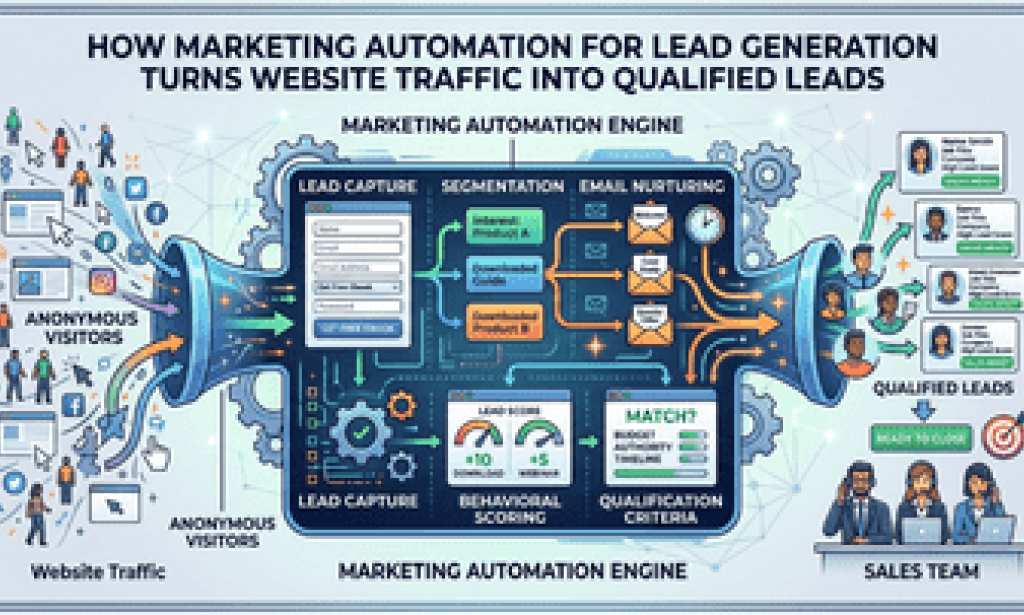
If you've ever watched website traffic roll in while your sales pipeline stays flat, you already know the problem isn't visibility. It's follow-up. Most visitors leave without a trace, and the ones who do raise their hand often get a slow, inconsistent response that costs you the deal.
This is where marketing automation for lead generation earns its keep. Done right, it catches interest the moment it happens, nurtures it automatically, and hands your sales team only the leads worth a phone call. In this guide, I'll walk through how it actually works, where most businesses go wrong, and how to set up sales funnel automation that fits a real team with real time constraints, not a fantasy tech stack.
What Marketing Automation for Lead Generation Actually Means
At its core, marketing automation is software that triggers marketing actions based on what a person does or doesn't do. Someone downloads a guide, gets a follow-up email three days later. Someone abandons a pricing page, gets a retargeting ad. Someone opens five emails in a row, gets flagged as sales-ready.
It's not about replacing human contact. It's about removing the manual, repetitive work so your team can spend time on conversations that need a person, not a checklist.
A common misconception is that automation means "set it and forget it." It doesn't. The best-performing systems I've seen still get reviewed and adjusted monthly based on what the data shows.
Why Lead Generation Breaks Down Without Automation
Without automation, lead follow-up usually depends on someone remembering to do it. That's a fragile system. Here's where it typically falls apart:
- Leads go cold within hours: Studies on response time consistently show that contacting a lead within the first five minutes dramatically increases conversion odds compared to waiting even an hour.
- Inconsistent nurturing: A sales rep might follow up with one lead three times and forget another entirely.
- No lead scoring: Sales ends up chasing browsers instead of buyers because there's no system separating the two.
If any of this sounds familiar, the issue usually isn't your team's effort. It's the lack of a structure that works even when nobody's watching it closely.
Building Sales Funnel Automation That Doesn't Feel Robotic
A funnel that converts well usually has three automated layers working together. Skipping any one of them is where most setups underperform.
Layer 1: Capture
This is your entry point: a lead magnet, a free consultation form, a webinar signup. The key here isn't the offer itself, it's friction. Every extra form field can cost you conversions. Stick to name, email, and one qualifying question if you need it.
Layer 2: Nurture
Once someone's in your system, automated email sequences keep the relationship warm without manual effort. A simple, effective sequence looks like this:
- Immediate welcome email confirming what they signed up for
- Value-driven email two days later (a tip, a case study, a common mistake to avoid)
- Soft offer email a few days after that, inviting a next step
The mistake I see most often is sequences that jump straight to a sales pitch in email two. People need a reason to trust you before they'll book a call.
Layer 3: Scoring and Handoff
This is the part that actually saves sales teams time. Lead scoring assigns points based on behavior: opening emails, visiting pricing pages, attending a demo. Once a lead crosses a set threshold, automation routes them straight to a sales rep, often with a notification and the lead's activity history attached.
This single layer is usually the difference between a sales team that trusts marketing leads and one that ignores them.
Choosing the Right Automation Tools Without Overbuying
There's no shortage of platforms promising to solve lead generation overnight. In practice, the tool matters far less than how clearly you've mapped your funnel before you start building in it.
A few honest considerations:
- Smaller teams generally do better starting with simpler platforms that combine email, forms, and basic scoring in one place, rather than stitching together five specialized tools.
- Growing teams with a dedicated sales process often benefit from a platform that integrates tightly with their CRM, so lead data doesn't get lost between systems.
- Avoid feature-chasing. A tool with advanced AI scoring won't help if your team isn't using basic email sequences consistently yet.
If you're unsure which category you fall into, it's worth working through a funnel audit before committing to software. This is something a marketing automation consultant or internal strategy session can map out in a single working session.
Common Mistakes That Quietly Kill Automated Funnels
I've audited enough funnels to notice the same handful of issues showing up repeatedly:
Sending too many emails too fast: Automation makes it easy to over-communicate. If every touchpoint feels like a push toward a sale, people unsubscribe before they're ready to buy.
No clear exit criteria: Leads who've already become customers sometimes stay stuck in nurture sequences meant for prospects. It looks unprofessional and damages trust fast.
Ignoring lead quality at the top of the funnel: Automation can't fix a lead magnet that attracts the wrong audience. If your "free guide" pulls in people who were never going to buy, no amount of email sequencing will convert them.
Treating automation as permanent: Buyer behavior shifts. A sequence that converted well last year might be underperforming now simply because expectations have changed.
How to Measure Whether Your Automation Is Actually Working
It's easy to track vanity numbers like open rates and miss what matters. Focus instead on:
- Lead-to-customer conversion rate by source and sequence
- Time from capture to first sales contact: this should be minutes, not days
- Drop-off points in your nurture sequence, so you know exactly where people lose interest
A short monthly review of these three numbers tells you more than a dashboard full of metrics that don't connect to revenue.
Bringing It All Together
Marketing automation for lead generation isn't about replacing your team. It's about making sure no interested lead falls through the cracks while your team focuses on actual conversations. The businesses that get the most out of it treat sales funnel automation as a living system: built with intention, reviewed regularly, and adjusted as real data comes in.
If you're starting from scratch, begin small. Map your current funnel, fix the biggest leak first, and build automation around that one layer before expanding. If you'd like a second set of eyes on your current setup, our team is happy to walk through your funnel and point out the quickest wins. No pressure, just a practical look at what's working and what isn't.

You must be logged in to post a comment.