
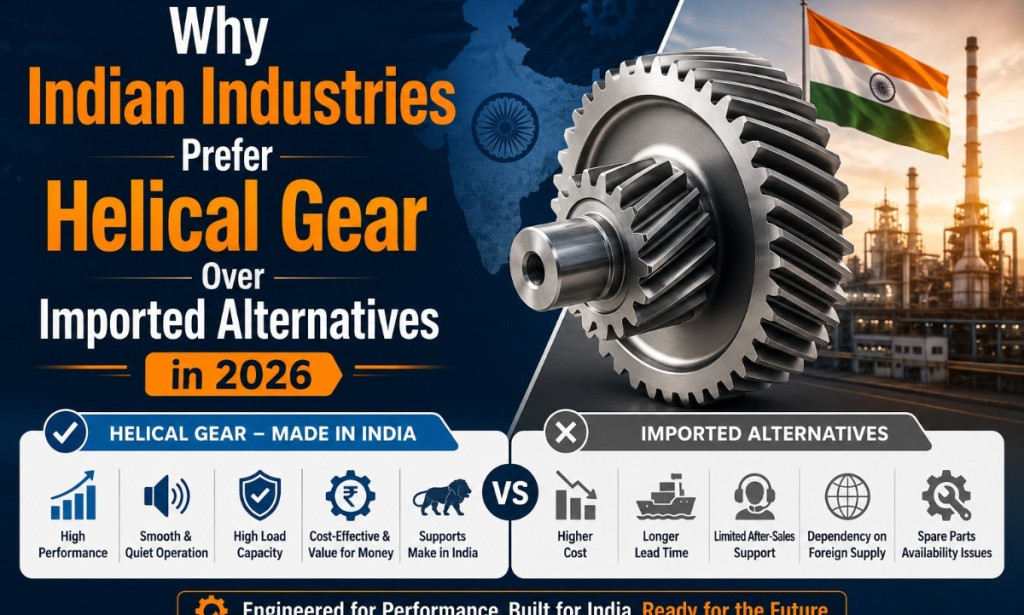
A delay on gearboxes can stop production lines completely. That's why many companies are choosing Indian Helical Gear manufacturers. Imported gearboxes typically come with longer lead times, longer customs delays, and unpredictable aftersales support that can create a lot of uncertainty and take considerable time.
And yet, many buyers still make the same mistake. They compare only unit pricing while ignoring downtime cost, replacement cycles, and machining tolerance consistency. A ₹40 cheaper imported gear means nothing if the machine sits idle for nine days waiting for replacement parts.
Manufacturing plants for vehicles, food, cement, and textiles prefer Indian suppliers because they are faster, more flexible, and customizable. This is in comparison to overseas suppliers, and will be especially true in 2026.
Why Do Procurement Teams Analyze Imported Gear Systems Again?
Things changed permanently in 2021 with freight instability. By the end of 2025, many Indian Original Equipment Manufacturers (OEMs) stated that industrial components arrived at the site after an 11 to 14 week wait, which were the shipping peak times. Buyers observed that imported catalogs of components looked great, but local technical support became nonexistent after clearing customs.
That’s where experienced Indian Helical Gear Manufacturers started winning repeat orders.
Most buyers don’t realize how expensive communication lag becomes during production issues. Waiting 48 hours for a reply across time zones sounds manageable until a packaging line loses output every hour.
One rejected batch can erase six months of “cost savings.”
Specifications Buyers Actually Need to Verify Before Ordering
Gear Material Grade Matters More Than Catalog Photos
A proper Helical Gear setup is not just about tooth profile accuracy. Material composition affects wear resistance, torque handling, and thermal stability under continuous load.
Common industrial materials include:
-
EN8 steel for moderate-duty applications
-
EN19 and EN24 for high-torque environments
-
Case-hardened alloy steel for heavy industrial use
-
Brass alloys in specialized low-noise assemblies
-
Stainless variants for food-grade machinery
Which means a supplier unwilling to disclose hardness range or heat treatment process is already a risk.
Some importers avoid sharing exact metallurgy details because the actual production is outsourced to third-party workshops. Buyers discover the truth only after premature tooth wear starts appearing around the 8–10 month mark.
Tooth Profile Accuracy Is Harder Than Buyers Expect
Helical gears operate quietly because their teeth engage gradually instead of striking abruptly like spur gears. But maintaining proper helix angle consistency during machining is difficult. Very difficult.
Even a slight deviation can increase vibration, heat buildup, and bearing stress.
That’s why experienced manufacturers inspect:
-
Lead accuracy
-
Pitch deviation
-
Tooth flank finish
-
Concentricity
-
Surface hardness after grinding
Nobody tells new buyers this, but post-heat-treatment distortion correction separates serious manufacturers from trading companies pretending to be factories.
Why Related Components Matter in Integrated Machinery
Industrial buyers rarely source only one component anymore. A gearbox assembly may require:
-
Timing Pulley
-
Spline shafts
-
Worm gears
-
Oil pump gears
-
Couplings
-
Precision-machined hubs
Reliable Timing Pulley Manufacturers and Sector Gear Manufacturers are increasingly preferred because integrated sourcing reduces tolerance mismatch between assembled parts.
The Spec Detail Most Buyers Skip During Supplier Evaluation
1. Ask About Rejection Policy, Not Just Inspection Reports
A supplier saying “we’ll handle issues mutually” is not offering protection. That’s a future argument waiting to happen.
Good suppliers define:
-
Replacement timelines
-
Batch traceability
-
Material certification process
-
Failure accountability
Bad suppliers avoid specifics.
2. Check Actual Production Capacity
Some exporters show CNC photos from rented facilities. Then your repeat order gets subcontracted elsewhere.
Ask:
-
Monthly production volume
-
In-house machining capability
-
Heat treatment availability
-
Grinding process ownership
If answers become vague, walk away.
3. Verify Lead Time Consistency
A 20-day quotation means nothing if dispatch slips to 37 days every quarter.
Most buyers evaluate quoted delivery time. Experienced procurement managers evaluate delivery reliability percentage.
There’s a difference.
4. Evaluate Technical Communication
Imported vendors sometimes rely entirely on distributors who cannot interpret machine drawings properly.
That creates tolerance mistakes.
Indian Sector Gear Suppliers and Helical Gear Supplier networks often work directly with factory engineers, which reduces drawing interpretation errors during development stages.
5. Ask for Failure Case Examples
A genuine manufacturer can explain where previous failures happened and what changed afterward.
A supplier claiming “zero defects ever” usually means either low production volume or dishonest reporting.
How Indian Manufacturing Helps Protect Margins in 2026
Faster Replacement Cycles Reduce Downtime
Replacement delivery inside India can happen within days instead of months.
That matters in:
-
Steel plants
-
Textile machinery
-
Packaging lines
-
Food processing systems
Especially for high-wear assemblies involving Sector Gear systems and heavy-duty Helical Gear applications.
Lower Freight Volatility
International shipping rates remain unstable in several trade lanes entering 2026. Domestic sourcing gives buyers more predictable landed cost calculations.
Finance teams care about that more than marketing departments do.
Easier Customization for OEMs
Imported catalogs are often rigid. Indian manufacturers are usually more flexible with:
-
Bore modifications
-
Keyway adjustments
-
Special coatings
-
Custom tooth profiles
-
Low-volume development orders
That flexibility helps OEMs launch faster without committing massive MOQs upfront.
Better Communication During Production
Which means engineering changes happen quicker.
A delayed clarification on module size or shaft tolerance can hold production for days. Local suppliers shorten that cycle dramatically.
Multi-Component Procurement Simplifies Supply Chains
Many Indian manufacturers now supply:
-
Timing Pulley
-
Industrial gears
-
Couplings
-
Sintered gears
-
Pump gears
That consolidation reduces vendor management complexity.
Experienced buyers increasingly prefer suppliers connected with:
-
Oil Pump Gears Suppliers in India
-
Stainless Steel Gear Manufacturers in India
-
sintered gear manufacturer india
Because synchronized sourcing lowers assembly compatibility issues later.
Why Location Is a Supply Chain Decision, Not Just an Address
India’s industrial manufacturing clusters matter more than overseas buyers sometimes realize.
Western India dominates export-oriented machining because of port connectivity. Northern manufacturing belts support faster inland logistics for automotive and agricultural machinery sectors. Southern industrial zones remain strong in precision engineering and electronics-linked assemblies.
That geographical spread gives Indian Timing Pulley suppliers, Sector Gear Suppliers, and gearbox manufacturers a logistics advantage across domestic and export markets.
And here’s the uncomfortable truth: many “European imports” sold in industrial markets are already being contract-manufactured in Asia anyway. Buyers often pay premium pricing mainly for branding layers and distributor margins.
About Us — Built Around Real Manufacturing Pressure
At Swadeshi Gears, we’ve worked with OEM buyers, wholesalers, and industrial procurement teams that care about repeat consistency more than presentation slides.
We manufacture industrial gear components for demanding operating conditions, including helical Gear, Timing Pulley, and precision-machined transmission products used across multiple industries. Our systems support export operations in 31 countries, but most of our long-term relationships came from buyers who needed reliable repeat batches — not flashy quotations.
We learned early that machining consistency matters more after the third shipment than during the first sample approval.
Back in 2021, we changed one heat-treatment vendor after repeated micro-hardness variation showed up in inspection reports from two export customers. The situation caused an issue with dispatches. We still proceeded with the change though. Long-term reliability was more important than short-term production convenience.
When Sourcing, Send Detail Drawings More than Just Product Naming
If you're involved in sourcing more industrial transmission components in 2026
Send
-
Gear Drawings
-
Modules
-
Material Grade Specifications
-
Annual Quantity
-
Type of Application
-
Surface Hardness Specifications
In general, you can expect a 1 day response from us.
For custom production, MOQ depends on component complexity and machining requirements, though most industrial orders begin from small-to-medium batch quantities for OEM evaluation. You can explore our manufacturing capabilities here: Industrial Gear Manufacturing Solutions
Conclusion
Industrial buyers choosing Helical Gear Manufacturers in India are not making a patriotic decision. They’re making a supply chain decision based on lead time control, technical communication, and operational reliability.
Imported components will still have a place in specialized applications. But for most industrial sectors entering 2026, faster response cycles and dependable local manufacturing support are becoming harder to ignore.
And the suppliers who survive the next five years will be the ones that solve production problems before buyers have to ask.
Here is another blog you might be interested in.
Sector Gear Applications in Heavy Industries Guide
FAQs
Do Indian Timing Pulley Manufacturers have what it takes to pass the export test?
Some do, and some don't. It's up to the buyer to assess inspection protocols, machining capacity, and batch traceability before any major buy. A fancy website doesn't equate to any practice in large-scale manufacturing.
What should I do to find trustworthy Sector Gear Manufacturers in India?
See if they do gear cutting, grinding, and heat treatment in-house or if they rely on others to do the processes for them. It's not bad to rely on others, but if they do it without telling anyone, there will probably be problems with consistency later on.
What are the reasons behind the market for Helical Gear Systems shifting to India?
There's lots of instability with lead times, unexpected charges for freight, and slow support for when problems occur. Now many OEM's are thinking that switching to local suppliers will make replacement cycles a lot more tolerable.
How flexible are Timing Pulley suppliers for modifying their dimensions for OEM?
A lot of suppliers are flexible for those changes. They are also pretty amenable to requests along the lines of custom bore sizes, different types of coatings, and different angles for tooth profiles. Consistency across batches, however, is much harder to ensure when the dimensions are altered for requests of this nature.
Do Indian Sector Gear Suppliers work on smaller projects?
Some will, but others seem to only be interested in continual large orders. Buyers should be clear on Minimum Order Quantity expectations to sidestep needless sampling.
Are the Suppliers in India that deal with Oil Pump Gears and the Sintered Gears Companies better for Integrated Sourcing?
Yes. Sourcing multiple components together helps reduce problems of incompatibility in assembled components and helps ease the overall management of purchasing for each project.
How do I identify a good Helical Gear Supplier without wasting my time?
Request they show you how they deal with issues that test their limits, see some inspection records, and show references for repeat orders. Suppliers who aren't prepared to walk you through production issues for large orders likely haven't done that much outside of a small scale either.

You must be logged in to post a comment.