
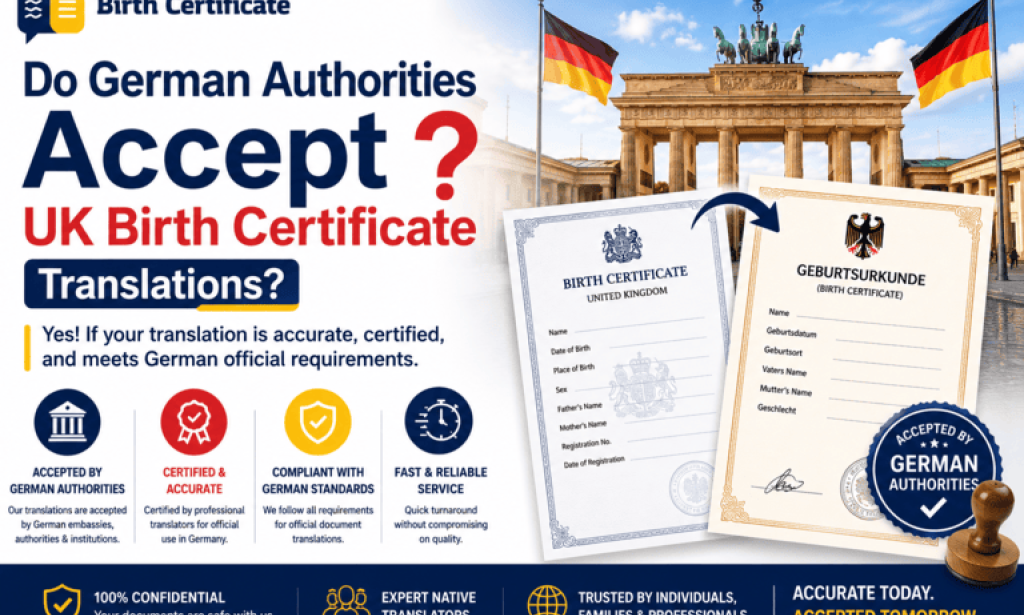
Moving to Germany? How to Get a UK Birth Certificate Translation That Actually Gets Accepted
Planning a move to Germany is incredibly exciting, but let’s be honest—the paperwork can give you a massive headache. Whether you are relocating for a new job in Frankfurt, enrolling at a university in Berlin, or getting married to your German partner, you quickly realize that the German authorities love their official documents. And if your original documents are in English, the very first thing they will ask for is a certified translation.
If you have ever tried navigating a foreign government website, you know how confusing the wording can be. You cannot just use a free online translator or ask a bilingual friend to write it out for you. To make sure your paperwork passes without any delays, you need a professionalbirth certificate translation service UK. Getting this sorted out early saves you from the nightmare of having your application rejected at the registration office after waiting weeks for an appointment.
The Reality of German Bureaucracy (The "Amt")
If you have spent any time researching your move, you have probably heard of the Bürgeramt (the local town hall or registration office) or the Standesamt (the registry office for marriage and births). In Germany, these offices hold the keys to your new life. When you arrive, you have to do something called Anmeldung—which is just a fancy word for registering your address.
The caseworkers at these offices review hundreds of international applications every week. They have zero tolerance for mistakes, missing stamps, or messy paperwork. If a single date is unclear or a name spelling does not match your passport exactly, they will simply hand the papers back to you and tell you to come back next month. Because appointments are notoriously hard to book in major German cities, a simple translation mistake can set your plans back by eight to twelve weeks.
What Exactly Do German Authorities Look For?
You might wonder why they cannot just look at a standard UK birth certificate and understand it. After all, basic words like "name," "date," and "location" are pretty universal. But legally, civil registrars in Germany can only accept documents written in German or accompanied by an official, sworn translation.
A proper translation needs to be an exact mirror image of your original UK document. This means the translator does not just translate the words; they also have to account for every single stamp, handwritten signature, official crest, and barcode on the page. If your original long-form certificate lists your parents' occupations or registration districts, all of that data must be meticulously carried over into the German version.
Furthermore, the translation must include a formal certification clause. This is a signed and dated statement where the professional translator confirms that the text is an accurate and complete representation of the original English record. Without this specific certification, the document holds no legal weight in Germany.
The Difference Between UK and German Translation Systems
Here is where many people get tripped up. The UK and Germany handle certified translations completely differently. In the UK, any professional translator or qualified agency can certify a document by attaching a signed letter of accuracy. In contrast, Germany relies on a system of vereidigte Übersetzer—which means "sworn translators" who have been officially registered and approved by a German court.
If you are already inside Germany, you usually have to track down a locally sworn translator. However, if you are still organizing your move from Britain, you can get anEnglish to German birth cert translation UK service that prepares your documents to meet international standards. Many high-quality services in the UK provide translations that are fully recognized across Europe, but it is always smart to double-check if your specific local Amt requires a sworn translator or a certified agency with specific credentials like ATC or ITI membership.
Do You Need an Apostille as Well?
This is a question that comes up constantly in expat forums. An Apostille is an official legal sticker attached to the back of your original UK document by the Foreign, Commonwealth & Development Office (FCDO). It proves to foreign governments that the signature and seal on your British birth certificate are genuine.
While a translation turns the words into German, the Apostille legalizes the document itself. Many German registry offices—especially if you are getting married or applying for citizenship—will demand both. A good rule of thumb is to get your original UK birth certificate apostilled first, and then hand the entire document (including the apostille page) over to your translator. That way, the entire package is translated into German in one go, leaving the German caseworkers with absolutely nothing to complain about.
Tips for a Stress-Free Translation Process
If you want to ensure your paperwork goes through on the very first try, here is a practical checklist based on what real expats go through:
-
Always use the long-form certificate: The short UK birth certificate only shows your name and date of birth. German authorities almost always require the full, long-form version that includes your parents' details.
-
Check the name spellings: Ensure the names on your birth certificate align with your current passport. If you have changed your name through marriage, you will need your marriage certificate translated too.
-
Scan your document clearly: Translators work from digital copies. If your scan is blurry or cuts off a stamp at the bottom of the page, it can delay the process or cause errors.
-
Don't leave it until the last minute: Give yourself at least a week or two before your flight or appointment. Rushing a translation increases stress and can cost extra in priority fees.
Conclusion: Peace of Mind for Your Journey
Moving to a new country is a massive life milestone. It is a mix of excitement, anticipation, and a fair amount of administrative stress. While you cannot avoid the long queues or the famous German bureaucracy, you can control how prepared you are when you walk into that office.
Investing in a proper, legally compliant translation of your birth certificate is about buying yourself peace of mind. When you hand over a perfectly formatted, professionally certified document, you show the caseworker that you respect their process. It keeps your application moving forward smoothly, leaving you free to focus on the fun parts of your move—like learning the language, exploring your new neighborhood, and settling into your new home.

You must be logged in to post a comment.