

Overview
After accumulating several Outlook PST files over a number of years, a mid-sized professional services company faced a significant email archive conversion project. About 612,000 emails, 74,000 attachments and 1,900 folders and subfolders were contained in the company's 37 PST files, which totaled 184 GB.
The archives belonged to departments, project teams, former workers, and outdated backup systems. To preserve email content, attachments and folder organization, the IT department needed to convert the necessary mailbox data into separate EML files.
This case study is based on actual email migration challenges that arise when businesses handle substantial amounts of legacy Outlook archives. It focuses on the issues encountered during the project, the manual techniques that were initially tested and the tool-based strategy that was ultimately chosen.
The Challenges
PST files at the company ranged in size from 1.8 GB to 16.7 GB. While some were kept on an internal file server, others were directly linked to Outlook.
The IT staff needed to:
· Create EML files from specific Outlook emails.
· Maintain message formatting and attachments.
· Keep folder structures organized logically.
· Effectively handle multiple PST archives.
· Avoid converting outdated messages needlessly.
· Validate the transformed email data.
Because they wanted to avoid purchasing extra conversion software, the team initially considered manual methods. However, manual processing quickly proved impractical due to the massive scale of the archives.
Manual Methods
The IT team tried manual methods first because they didn't want to spend money on software if they didn't have to and wanted to see if what was already in Outlook could handle their migration needs.
Manual Method 1: Individually Saving Emails
The first method was to open each communication in Outlook and save them one by one.
This approach worked well for small collections of e-mail but was totally infeasible for the total archive of the organization. It took more than four hours to process and review a test batch of 1,250 emails.
The group also ran into several operational issues:
· Repetitive manual operations were required for individual messages.
· Additional verification was required for attachments.
· Files were easily saved in incorrect directories.
· Maintaining naming consistency was challenging.
· Locating missing emails proved difficult.
At this rate, processing hundreds of thousands of communications would have consumed an excessive amount of staff hours.
Manual Method 2: Outlook Drag-and-Drop
Dragging specific emails from Outlook folders directly into Windows Explorer was the second method tested.
For smaller selections, this approach was faster. However, employees still had to manually choose messages and organize the resulting files.
Another major hurdle was technical constraints: dragging massive blocks of data triggered Windows path-length limitations, file-locking issues, and frequent Outlook application instability during bulk exports.
Consequently, drag-and-drop was deemed unsuitable for the entire archive, though it remained useful for sporadic, small-scale email exports.
Manual Method 3: Organizing Folders and Outlook Rules
The third technique involved arranging messages into temporary folders prior to export by using automated Outlook rules.
Although it required significant upfront planning, this method offered superior organization. The team spent about seven hours setting up and verifying the procedure for a single departmental archive, which generated 26 temporary folders.
Inaccurate classification was a major risk. If a message failed to meet the exact criteria of a rule, it could end up in the wrong place or be left outside the intended folder entirely.
Applying this procedure across all 37 PST archives would have drastically increased administrative labor.
Why Manual Conversion Was Impractical
The three manual methods demonstrated that exporting emails on a modest scale was feasible, but they completely failed when scaled up to a massive PST collection.
Instead of a few hundred files, the organization was dealing with nearly 600,000 messages. Manual processing also introduced inconsistencies in nomenclature, folder arrangement, selection and verification.
As a result, the IT department determined that native scripts or basic manual methods were insufficient due to lack of automated exception handling and a specialized conversion solution was required to handle multiple archives with selective email output.
A Tool-Based Solution
The company selected the GainTools PST to EML Converter for the conversion stage.
The IT team tested the procedures on 5,000 emails before processing the entire collection.
The conversion workflow consisted of four primary steps:
- Open PST Files
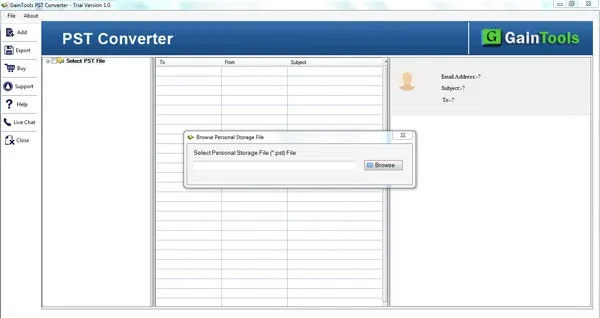
The experts imported the necessary Outlook PST files to the application. The existing mailbox design made it easy to spot individual folders and subfolders.
This was especially useful as the company did not want to convert every single message from every archive.
2. Preview and Select Required Emails
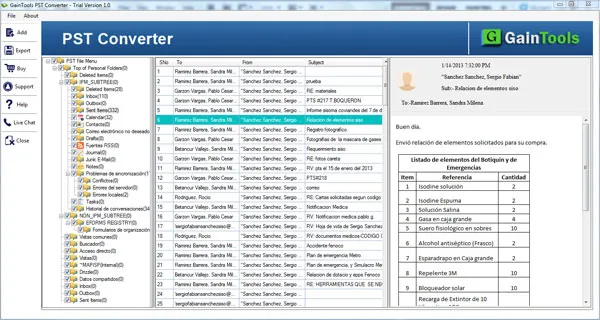
The team reviewed the available mailbox data and identified exactly which folders had to be converted.
During this phase we systematically removed unnecessary duplicate content and outdated project materials.
3. PST to EML Email Conversion
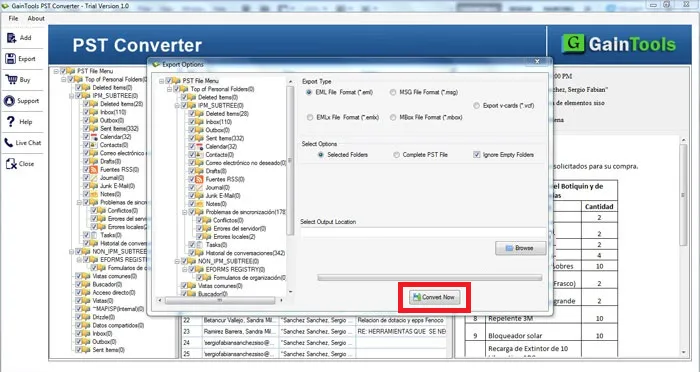
Selected Outlook emails were exported to individual EML files. The team verified the attachments were still correctly attached to their messages.
This resulted in a much cleaner and more manageable set of email files for the organization’s new storage environment.
4. Check Email Conversions
After each batch was done, technicians checked message counts, attachments, filenames, folder locations and message content.
Before approving a batch, a random sample of 2,500 converted emails were compared to the original messages.
Migration Outcomes
After the migration from PST to EML, the speed at which data was processed and organized improved significantly.
All told, 37 PST archives were processed in 31 hours of active conversion time. It took another nine hours to finally organize and verify.
Of the original 612,000 messages, around 585,000 were selected for migration. The other 27,000 messages were discarded as they came from old backup directories, duplicate collections or folders outside the scope of the migration.
The finished project metrics included:
· 184 GB of PST data processed.
· 37 Outlook archives managed.
· Approximately 585,000 relevant emails exported (excluding obsolete backup directories)
· Approximately 73,000 attachments retained.
· Over 1,700 necessary folders and subfolders organized.
· A total of 40 hours dedicated to quality control and conversion.
The IT staff also kept an active conversion log with the PST file names, folders selected, output locations, message counts and verification status.
Advantages Noted
Centralized Processing: Rather than working piecemeal with individual emails, technicians worked with entire Outlook archives and selected necessary mailbox data.
Batch Conversion: Established a more consistent workflow between departments and employee archives.
Selective Export: Enabled the organization to skip superfluous messages, thus greatly decreasing total output storage data.
Attachment Integrity: Safely retained attachments to important business documents such as contracts, bills, spreadsheets, project papers and customer communications.
Structured Workflow: The well-defined phases of the migration (conversion, selection and verification) made the management of the PST-to-EML migration much easier.
Lessons Learned
This initiative confirmed that large-scale Outlook email conversion should be a structured, planned migration, not a series of ad-hoc export tasks.
The IT staff said it was essential to plan up front. They created a complete PST inventory, found the necessary folders, deleted unnecessary data and tested a sample batch successfully before beginning full processing.
Also, the original PST files were left completely intact. Working copies were used during the entire conversion process and the original files were safely accessible until the final output was fully validated.
Conclusion
This case study demonstrates how a successful PST to EML migration can speed up a large Outlook archive project with hundreds of thousands of emails and dozens of PST files.
Manual methods are still useful for small-scale decisions, but they become less practical as you get more data. The organization could process multiple PST files, export specific emails, save attachments, arrange EML files and conduct a systematic verification via a proprietary conversion process.
For companies with large Outlook archives, careful planning, batch processing, selective conversion and post-conversion validation can mean the difference between a chaotic migration and a controlled, controllable operation.

You must be logged in to post a comment.