
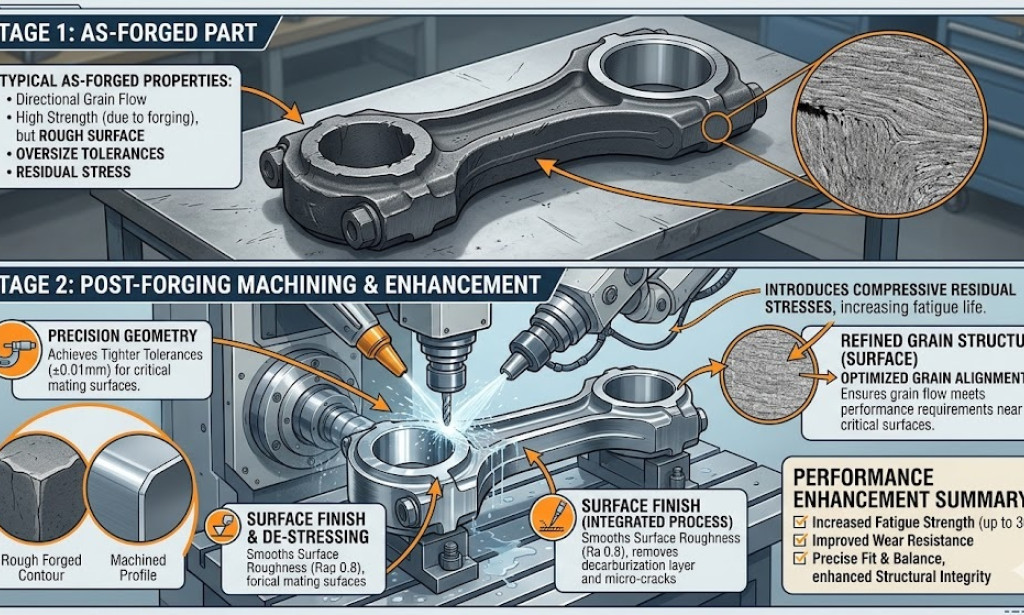
The forgings themselves were beautiful; the grain flow was perfect, the strength was there, but the dimensions? They were off by just a hair. A fraction of a millimeter. In the world of high-performance engines, that "hair" is the difference between a smooth-running machine and a catastrophic engine failure. It was a classic "aha" moment for me. I realized then that forging is only half the battle. To really unleash the power of a component, surgical precision is needed, a precision that only comes afterwards. It's the combination of brute strength with high accuracy.
The Power Couple: Why Forging and Machining Need Each Other
Let's face it, forging is a bit of a "brute force" method, isn't it? You're heating a piece of metal till it is red-hot, and then rapidly shaping it with high pressure. Besides allowing to create an internal strength, i.e. the well-known grain flow, forging is not really acclaimed for producing a mirror finish or tolerance of ±0.01 mm. This is the moment when precision forging machining comes into play.
Picture this: a rough forged piece sits like an awkward young bird. Still lumpy, still dull - yet something finer waits inside. Shaping it means steps, care, time. Across India’s production centers - from Pune to the foundry zones of Gujarat - change takes hold slowly. Buyers today do not stop at metal shapes pulled from molds. They expect pieces done completely, fit straight into place. The old way fades without noise.
1. Tightening the Reins: Dimensional Accuracy and Tolerances
The main reason forging machining is mentioned here is the achievement of precision. Dimensional accuracy is essential for forging components manufacturers and this is the reason why they make use of precision forging machining.
- Surface Levelling: Draft angle and bend angle plays important role in stripping the component from the die. Machining eliminates this taper and produces a totally flat or cylindrical surface.
- Hole Drilling and Threading: The on-the-fly forging of a threaded bolt hole is a challenge as well as an ugly result. Machining verifies the perfect fit of every bolt every time.
- Critical Interfaces: Consider the places where two parts touch one another. Their mating surfaces should be very flat to avoid leakages and vibrations.
Quite frankly, I feel that sometimes we just don't appreciate the marvelous tolerance a system normally has till it gets broken. Machining gets rid of those unwanted tolerances.
- SURFACE INTEGRITY
Here is something that people usually don't take into account: the surface of a forged product is subjected to a lot of stress. The cooling stage and the forging die contact can cause a "decarburized" layer or a thin surface scale. If this layer is not removed, the tiny flaws in this layer can develop into cracks.
Forging machining is a technique that raises your part "from the dead" by giving it a fresh skin.
Removing surface features such as micro-cracks, grain contaminants, and other surface imperfections is crucial to increase fatigue life.
Besides making the part look good, a fine surface finish is also effective at reducing crack initiation points or stress concentrators, resulting in much longer part life under severe loading conditions.
Based on my personal experience, a lot of failures occur in the field due to surface fatigue and not a lack of strength in the main body of the part. A simple CNC milling operation can increase the service life of a part by at least double. That's how easy it is.
-
Balancing Act Weights and Measures
Heavy things matter most when building planes or fast trains - India’s been busy with those lately. Yet lighter does not mean better by itself - it needs harmony too.
Spinning fast - five thousand turns every minute - a massive forged crankshaft demands precision. Off by just a few grams on one side, and imbalance begins to shake everything loose. A slight shift during forging can lead to that kind of uneven weight. Without correction, the whole system risks breaking down under stress. But here comes machining, shaping the rough metal into something stable. By carefully removing tiny bits from specific lumps or protrusions, engineers adjust the distribution. This fine-tuning allows perfect balance. Rotation becomes steady when mass aligns exactly where it should be.
4. Practical Sourcing Advice: What to Ask Your Supplier
If procurement head or project manager, you are probably looking at quotes right now. You will encounter some shops that only forge, and others that offer "value-added" services.
If you think it's a good idea to split the jobs that way. You think, "I will have the forging done at Shop A because they are cheap, and the machining at Shop B because they are fast." Stop. That is quite likely to lead to a headache later on.
5. Overcoming the "Indian Market" Hurdles
Our challenges are quite unique here. Power fluctuations, different steel grades, and sometimes... well, an ignorant attitude. If you want your parts to deliver world-class performance, you have to get over that.
- Ask about CNC Capabilities: Don't just rely on manual lathes.
- Check the Metrology Lab: If a supplier cannot measure a dimension accurately, how do you expect them to produce it accurately.
- Material Traceability: Ensure that the "as-machined" part can always be traced back to the original heat number of the steel.
6. The ROI of Precision (The "Speed to Market" Factor)
Did you really enjoy the blog post I wrote last time? If not, then maybe you can take this chance to check it out because what I am going to say here is basically a recap of that post: Speed is a big factor that distinguishes you from others. In the B2B world, if parts are delivered to you and they need "re-work" or they don't fit perfectly in your robotic welding cell, you are losing time. And losing time is losing profit.
By adopting quality forging machining, you are effectively making a time purchase. You are buying the ability to open a part off the shelf and fasten it straight on a machine. This minimizes your inventory "waiting time, " and keeps your production line going.
7. Balancing Cost and Quality
I can guess what has just crossed your mind. "Precision will be a big cost factor." You are right there; it is not free. As with AI, it is necessary to balance the cost and ROI.
Suppose you are making a simple manhole cover, you will not require micron-level precision. Nevertheless, if you are manufacturing a valve body for an oil rig or a gear for a wind turbine, "cheap" could be the most expensive mistake you make. I witnessed a company trying to save 5% on machining costs and ended up losing 200% on warranty claims and recall costs. It's not worth it at all.
Conclusion
Well, you see, really at the end of the day, all these machines and tolerances are operated by people. I've seen the best results produced by people who are focused on the "getting it right the first time" mentality. Supplying from the big industrial factory in Coimbatore or the specialized one in Jamshedpur, do focus on the ones who take pride in the finish.
How exactly a machinist handles a part, how they check the gauge, how they keep their station clean, reveals the quality of the final product better than any brochure.
Forging machining is not a simple procedure that is technical. It is a final turning point that changes a piece of steel into a highly efficient instrument. It is like the point when the "rough" is joined with the "ready."
Next time you make a sourcing decision, do not only consider the forge capacity. Consider the finishing floor as well. That is where the final performance occurs.
Important Points to Keep in Mind
- CNC controlled machines must have error free calibrations. Even a small error can cause huge loss and damage to company in long run.
- Where it works, one supplier handling both forging and machining cuts down on coordination mistakes. Not every setup allows it, yet combining these steps often streamlines flow. When available, shared responsibility simplifies tracking. Fewer handoffs mean fewer chances for missteps. It fits only certain cases, still - alignment improves when tasks stay together.
- Picture checks alone won’t cut it. Get CMM results instead - after machining finishes. Hardness testing should come through too, right alongside those measurements.
- Surprisingly few people realize that what you pay upfront isn’t the full story. Hidden behind the sticker tag lies effort - hours shaved off because parts snap together without extra work. That ease adds up, quietly lowering expenses over time. Most overlook how much value sits in ready-to-use design. It's not just about dollars spent but moments gained. Savings appear where attention rarely goes.

You must be logged in to post a comment.