
That moment stuck with me longer than most. A quiet promise formed inside, without words, about preventing repeats of what went wrong. Back then, my role involved checking standards for heavy equipment parts near Pune. One issue kept surfacing - broken crankshafts arriving at a client’s location. The root cause wasn’t hidden deep - it showed up in choices made earlier. Opting for a tiny unknown shop just because quotes were low turned everything sideways.
The crankshafts were of inferior quality due to improper thermal calibration and it was only a matter of time that they would fail. Six months later, they suffered complete structural breakdown. The internal grain flow of the crankshafts was severely compromised and resembled a splintered piece of wood. This was just one failure that cost our company millions due to the loss of operation, air freights by the emergency, and a lot of frustration.
In the industrial domain, the life of the project depends heavily on those products that are usually not visible. The concept holds true whether discussing utility networks of high voltage cables, automobiles, or defense hardware. What you purchase is not just the shape of the metal but the whole engineering of the structure, its safety, and the peace of mind for a longer period of operation.
India's industrial sector is right now expanding at a very rapid pace. Several big projects involving the construction of infrastructure, developing the automotive industry, and the shifting of global supply chains towards South Asia have led to a surge in demand for high-quality forged components. However, the thing is that the difference between a world-class production unit and a workshop where corners are cut is a very big one. Finding your way in this market will require a good sourcing strategy that has been tested in battles.
Together, let's explore how metal forging influences our industrial development and make prudent sourcing decisions.
The Bedrock of Industrial Might: Why Forging Matters
Flashy automated assembly lines, complicated IoT systems, and advanced software integrations can easily distract you when you think about heavy industries. However, the reality is that none of those things will be of any use if the physical components responsible for pulling the heavy loads, enduring the extreme pressures, or rotating at thousands of RPMs break due to stress. Basically, forging is the strength of the machine.
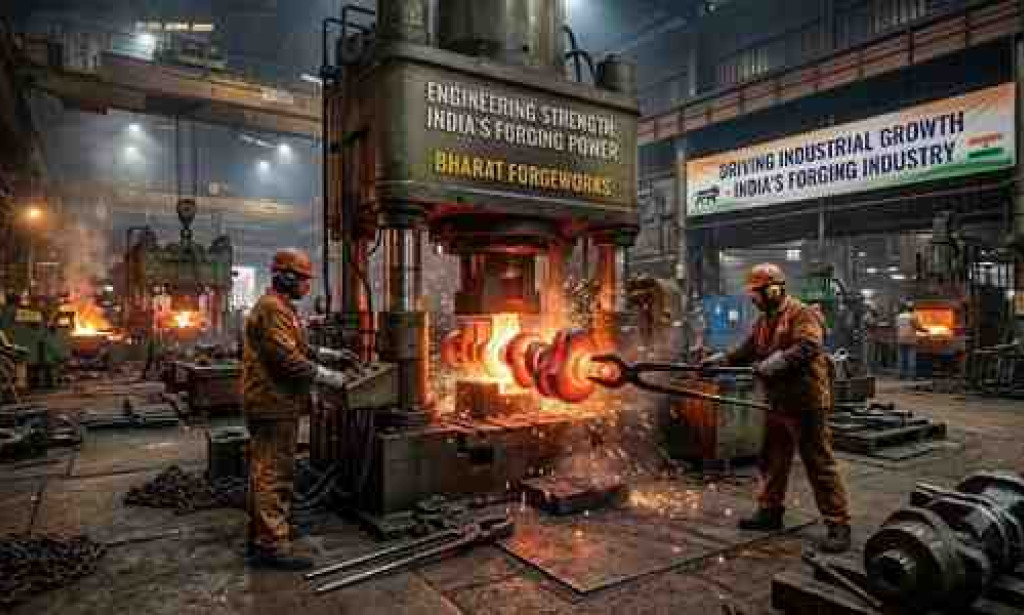
In casting, molten metal is poured into a mold, which often leads to the creation of air pockets or defects during cooling. Meanwhile, forging is a process where the metal is in solid form and subjected to extremely high localized pressure. This method of production causes the grain of the metal to change its orientation so that it matches the geometry of the component precisely.
The outcome? Superior strength against impact, extraordinary resistance to fatigue, and a part that will not break even if there is a sudden increase in pressure. For industries such as railways, defense, oil and gas, and aerospace, the utilization of forged parts is a safety requirement.
Navigating the Indian Forging Landscape: The Scale and the Chasm
It is a distinctive feature of the Indian forging industry that it is really a large market. Those looking from the outside might get dizzy by the sight. At one end of the spectrum, there are very large, advanced conglomerates able to supply aerospace products of precision to the Western markets. Quite the opposite, at the other end, are small workshop units that employ old hammers and lack digital quality control.
This large fragmentation releases two faces. One, you are spoilt for choice and you can find a supplier that matches conditions of your pocket and specifications. On the other hand, the risk is that you have to do the validation totally yourself. This is because you cannot simply be led by an attractively designed website or a fancy brochure and already expect that the supplier can deliver on a large scale.
If you want to find a dependable partnering Forging Company India, you should be able to separate the company from its marketing gimmicks and realize what they are technically, operationally, and culturally prepared for.
The Technical Checklist: What Separates the Masters from the Amateurs
Since, when you are looking for a process partner, great consequences come from those really minute details, let us briefly consider some technical points. In the future, huge problems in the supply chain will be the result of lack of readiness of the engineering team to ask relevant questions at the very beginning.
1. Grain Flow and Metallurgical Integrity
This is the most important criterion when assessing the quality of a forging. When metal is hammered or pressed into a die, the grains inside the metal get deformed and rearranged to be in keeping with the shape of the piece. The best manufacturers, through their design of the dies, will ensure that the grain flow remains consistent with the areas where the stresses are greatest.
- Ask for macro-etch testing records: The process uses an acid to etch the internal grain flow lines of a test piece. If the grain lines are cut or run perpendicular to the areas of stress, you should walk away.
- Check the raw material sourcing: The quality of a forging is directly related to the quality of the raw material used. Top manufacturers source only from reputed, Tier-1 steel plants that provide clean heat-treatment certificates and clear chemical compositions.
2. Die Design and Toolroom Capabilities
Attention to detail and a huge amount of skill goes into the making of a die. How the metal flows during forging, the quantity of material wasted as flash, and the uniformity in the final mechanical properties of the part are all determined by the engineering of the die.
Make sure to check if a supplier has a toolroom that is in-house and operates with the help of CAD/CAM. If the supplier has to depend on die-making by third-party workshops, your project timelines will, unfortunately, be compromised. By having the toolroom in-house, quicker iterations can be performed, control on die wear can be kept tighter, and when the dimensions start drifting, immediate troubleshooting can be carried out.
3. Thermal Calibration and Heat Treatment
You have only fabricated the metal physically when you forged it; through heat treatment, you accomplish the desired mechanical properties such as hardness, tensile strength, and ductility that the component has to possess.
Consider that a workshop may work with a state-of-the-art hydraulic press for forging but heat treatments are conducted in manually controlled ovens with visual inspection. This means that quality can be quite different in one batch from the other. What you want and what they should have is computerized, SCADA-controlled heat treatment furnaces with continuous temperature charting. Likewise, the performance of the thousandth piece is guaranteed to be the same as that of the first prototype.
Operational and Supply Chain Realities: Beyond the Sample Piece
The real problem is that manufacturing of one perfect sample piece is quite a bit different from production of 50, 000 identical pieces on a monthly basis, while also complying with delivery schedules and facing the changes in the costs of materials. This is where the real challenge of the situation lies.
Looking beyond the sales presentation is what choosing a top-grade Forging Company India is all about. Production capacity, materials handling systems, and logistics network are their key areas for assessment.
Scalability and Tonnage Capacity
Press or hammer lines need to match your project requirements. As an example, if you want heavy-duty commercial vehicle components, no supplier running with light 1-ton drop hammers will suffice. After all, they will end up stressing their machines, which will result in production delays and inconsistencies in structural densities. Look for a good blend of heavy hydraulic presses, networks of closed-die hammers, and ring rolling lines that meet your particular geometric and volumetric demands.
Stronger Supply Chains and Managing Material Costs
What trips up the worldwide metal trade? Hard to guess what comes next. Steel swings wild - jumping high when conflicts flare, dropping fast if fuel gets cheap. Surprises pop up from border fights, power bills, even cargo delays piling up at ports.
Here’s something useful. Picking a top forging company in India offers solid protection when prices swing wildly across the market. These strong suppliers often hold firm, long-standing deals with large steel producers - sometimes they even make their own steel. Because of this setup, brief spikes in material costs won’t shake them much. That stability travels down to you. Sudden jumps in pricing mid-project? Less likely to hit your budget hard.
Advanced non destructive testing
- Most of the time, a part looks fine after shaping and cutting. Yet underneath, something small might be wrong - hidden from sight. Eyes alone miss what lies beneath metal skin. Trust grows when checks go deeper than surface glances. Insist suppliers use smart scanning methods instead. Techniques exist that find flaws without damaging anything. These tests catch tiny splits invisible any other way. Proof comes not from hope but from careful technology
- Finding cracks just below or right at the surface? Magnetic Particle Inspection handles that. This method spots flaws using tiny magnetic bits drawn to irregular areas. It works where defects disrupt a material's magnetic field. Tiny particles gather where problems exist, making them visible. Inspectors rely on it when surface-level issues matter most.
- A beam of sound, beyond human hearing, moves through material to find hidden imperfections. Where echoes change, disturbances reveal gaps within. This method spots cracks others might miss. Waves bounce back when they meet resistance inside metal or plastic. What returns gets analyzed for irregularities. Speed and timing guide interpretation. Hidden breaks show up where signals shift unexpectedly.
- Flaw detection in non-magnetic materials? Liquid penetrant testing offers speed without sacrificing accuracy. With it, hidden cracks become visible through capillary action. This approach skips complex gear yet delivers consistent results. Instead of relying on magnetism, it uses dye seepage into openings. When surfaces stay clean, the process moves fast. Visibility improves once developers highlight problem spots. Even tiny fissures show up under proper lighting. Performance remains strong across varied shapes and sizes.
Total Cost of Ownership vs. The Cheap Quote Trap
Here we have to be brutally frank about price. The Indian market is fiercely competitive, and quotes looking very attractive on paper will be presented to you time and again. Sometimes, these prices may be 20% to 30% lower than the average market price. Very tempting indeed, especially when procurement KPIs for your team are strongly connected to immediate cost reduction.
You are probably forgetting to consider that the price is so low because there is generally one or more heavy compromises in quality or service.
Maybe they use a cheaper grade of scrap metal in place of proper clean steel billets. Or they might be leaving out critical normalization heat treatment cycles just to save on energy costs. Alternatively, it could be that the machining tolerances are scrimped on at the end and you are left with assembly misalignments.
Those factors must always be taken into account when determining the Total Cost of Ownership (TCO). Arelled in properly engineered parts from the beginning is not an expensive option. On the contrary, it is the most efficient use of money.
Future-Proofing Your Sourcing: Automation, Aerospace, and Clean Energy
The moment for the manufacturing industry to go through a significant step is quite near. Besides India's ambitious plan to achieve massive renewable energy targets, the development of expansive high-speed rail networks, and the earmarking of a larger share of global aerospace manufacturing will inevitably lead to the increase of forging requirements that are more stringent.
Recognizing the potential of the Industry 4.0 revolution, the inventiveness of the modern manufacturers is simply unmatched. Examples include robotic press lines that guarantee perfect cycle times, IoT sensors to keep real-time track of the wear of the dies in order to predict the dimensional drift, and AI-powered vision systems capable of instantly identifying surface defects.
Besides, as the world shifts to green hydrogen, solar infrastructure, and EVs, materials have to be lighter, yet stronger, and capable of surviving in highly specialized environmental conditions. Your long-term partner should be a company that is continuously investing in R&D. Collaborations with your design engineers to reduce component weight by employing smart geometries rather than the traditional methods of throwing more material at a problem this is what can be expected from such a company.
The Final Takeaway: Vet Relentlessly, Partner Strategically
You cannot simply find a vendor that will be able to mold the metal in the given shape when you are selecting a Forging Company India. The alignment of your project's long-term goals with a partner's quality standards, technical capabilities, and engineering philosophies is what you are really looking for.
One small change in a starting quote won’t make up for overlooking strong build quality, clean metal composition, or steady parts sourcing. Because proof matters, stick close to documented approvals. Full material check records aren’t optional - they’re required. See how things are made, by going there or logging in. What happens on the factory floor shapes what arrives later.
Tomorrow’s performance depends on how tough the parts are that you pick now. Because weak links fail fast, check every detail closely. When materials prove reliable, machines run longer without surprise stops. Strong builds start with careful picks, so look twice before locking anything down. Lasting gear comes from smart choices made early.

You must be logged in to post a comment.