
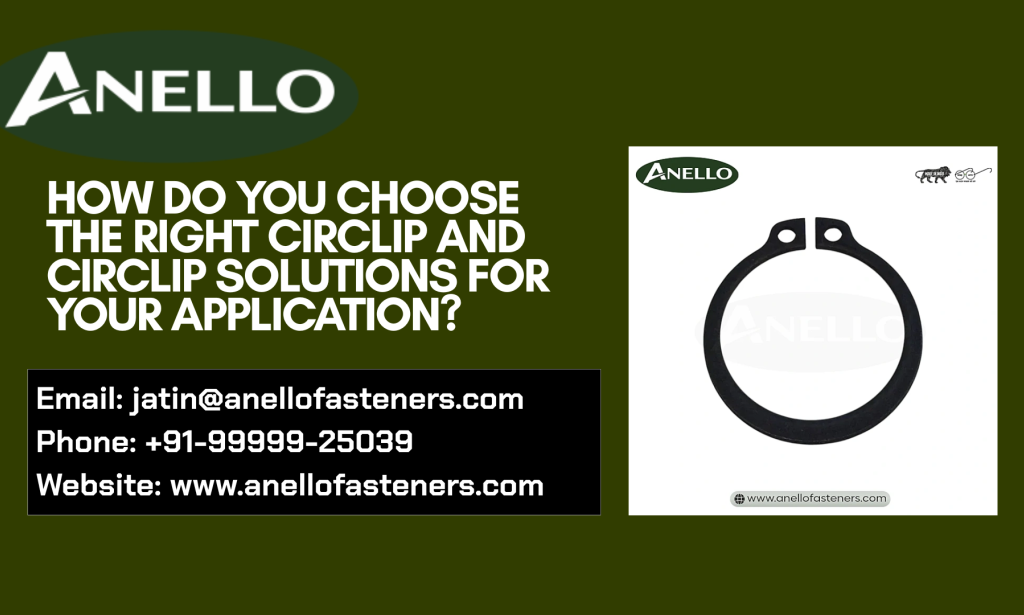
A tiny retaining ring can stop a big machine — and honestly, I’ve seen production lines lose hours because someone treated it like a “minor” component.
That’s the thing about a Circlip. It doesn’t look expensive. It doesn’t look complicated. But when it’s holding a bearing, shaft, piston pin, gear assembly, or housing in position, it’s doing serious work. Choose the wrong part and you don’t just get failure… you get vibration, shaft movement, warranty complaints, and sometimes full assembly rejection.
So yes, choosing the right circlip solutions matters.
And that’s where most businesses get it wrong.
Start With the Application, Not the Catalogue
Look, a catalogue size chart is useful. But it’s not the starting point.
First ask where the ring will sit. On a shaft? Inside a bore? Is it only positioning a part, or retaining a moving component under load?
For shaft applications, external rings are usually considered. For bore or housing applications, internal rings make more sense. Sounds basic, I know. But in real purchase discussions, this gets mixed up often — especially when buyers share only diameter and quantity, not the assembly drawing.
If you’re dealing with internal circlips and external circlips, check groove design first. Not after sampling. First.
The Right Circlip Depends on Groove Accuracy
Here’s the thing: even a good retaining ring will fail in a bad groove.
I’ve seen buyers blame material quality when the actual issue was groove width, groove depth, or rough machining. If the groove is too shallow, the part won’t seat properly. Too wide, and it’ll move. Too tight, and installation becomes a headache.
Use proper inspection tools — vernier caliper, micrometer, groove gauge, and where needed, profile projector checks. For critical assemblies, don’t rely only on “it fits by hand.”
That’s guesswork wearing safety shoes.
Don’t Ignore Load, Speed, and Vibration
A retaining ring used in a slow manual assembly isn’t facing the same stress as one sitting in a rotating automotive, pump, motor, or hydraulic application.
And honestly? Vibration changes everything.
If there’s shock load, repeated movement, high RPM, or sudden axial force, be careful with section thickness, free gap, groove engagement, and material hardness. Spring steel works well in many industrial applications, while stainless steel can be better where corrosion resistance matters. Surface finish also matters — phosphate, zinc plating, or black oxide may be selected depending on the environment.
Cheap selection becomes expensive here.
Matching Standards Makes Buying Easier
For regular industrial applications, standards like DIN 471 for external retaining rings and DIN 472 for internal retaining rings are commonly referenced. These help keep dimensions and groove compatibility under control.
But don’t assume every “standard size” from every supplier performs the same.
Ask your Circlip Suppliers for dimensional consistency, material grade, hardness range, finish details, and sample approval before bulk procurement. Good Circlip Suppliers in India won’t hesitate to discuss drawings, tolerances, and application conditions. If a supplier only talks price per piece, be careful.
Very careful.
Choosing circlip solutions for Material and Environment
Not every plant runs in clean, dry conditions. Some assemblies face oil, moisture, heat, dust, chemicals, or outdoor exposure.
So the material decision shouldn’t be casual.
For general mechanical use, carbon spring steel is common. For food-grade equipment, medical devices, marine exposure, or corrosion-sensitive machinery, stainless steel may be more suitable. In precision equipment, burr-free edges and clean finish matter more than people expect.
You don’t need the costliest part every time. You need the right one.
Work With Dealers Who Understand Fitment, Not Just Stock
There are plenty of Circlip Dealers in the market. Some are traders. Some understand applications. Big difference.
Experienced Circlip Dealers in India can help you avoid wrong substitutions, especially when dimensions are close but not identical. In B2B buying, one wrong batch can affect hundreds or thousands of finished products.
Before finalizing, share these details:
- Shaft or bore diameter
- Groove width and depth
- Load direction and movement
- Required material and finish
That’s enough to start a serious discussion.
FAQs
How do I know whether I need an internal or external retaining ring?
Use an external type when the ring fits around a shaft. Use an internal type when it fits inside a bore or housing. If there’s doubt, check the groove location.
Which material is best?
There’s no one-size answer. Spring steel is widely used for general industrial applications, while stainless steel is preferred where corrosion resistance matters.
Can I replace one size with a nearby size?
Honestly, avoid it. A nearby size may sit in the groove, but that doesn’t mean it’ll retain properly under load. Even a small mismatch can create movement, wear, or failure.
Final Thought
The right Circlip isn’t chosen by price alone, and it definitely isn’t chosen by eye. It’s chosen by application, groove accuracy, load, material, finish, and supplier understanding. Work with people who ask uncomfortable technical questions before quoting — because those are usually the people who’ll save you from expensive failures later. For serious buyers, Anello Fasteners can be the kind of partner that treats circlip solutions like engineering decisions, not just catalogue items.

You must be logged in to post a comment.