
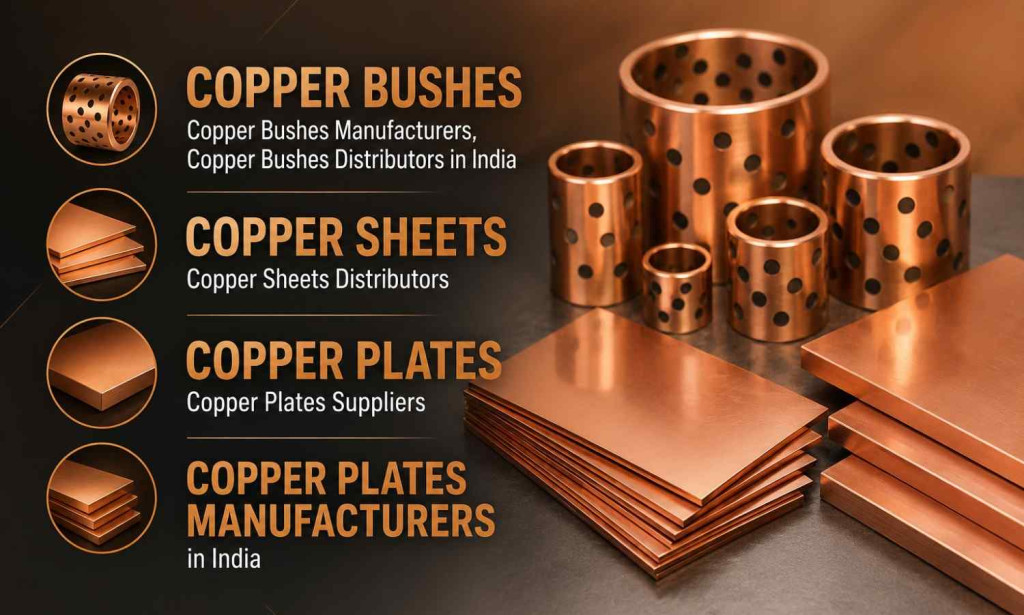
A delayed shipment of Copper Bushes can shut down an entire machining line faster than most procurement teams expect. One tolerance issue in a bearing assembly, one inconsistent copper sheet thickness in a fabrication batch, and suddenly production targets start slipping. That’s why serious manufacturers don’t treat sourcing as a back-office task anymore. They look closely at who handles their Copper Sheets, who stocks their Copper Plates, and whether their supplier actually understands industrial usage instead of simply forwarding catalog PDFs.
India’s manufacturing sector crossed USD 1 trillion in output-related activity across core industries and allied sectors in recent years, and metal component reliability now sits directly inside that growth story. Buyers who ignore supply consistency usually pay for it twice — first in downtime, then in replacement procurement at higher spot-market prices.
The Spec Detail Most Buyers Notice Too Late
Copper Bushes Used in Rotating Equipment
Copper Bushes are widely used in pumps, turbines, heavy machinery, gear assemblies, and electrical equipment because copper alloys reduce friction and handle heat better than many standard alternatives. Common grades include electrolytic tough pitch copper and phosphorus-bearing variants for higher wear resistance. Most buyers ask for dimensions first.
Few ask about hardness variation between batches. That mistake shows up later as uneven wear inside rotating assemblies. A difference of even 8–10 HB in hardness can affect operational life under continuous load.
Copper Sheets for Fabrication and Conductivity
Industrial-grade Copper Sheets are commonly supplied in thickness ranges from 0.3 mm to 25 mm for electrical panels, roofing systems, switchgear manufacturing, and precision fabrication work. Good Copper Sheets Distributors maintain flatness tolerance records because sheet warping becomes a serious issue during CNC cutting and bending.
And yet, some suppliers still store copper sheets in humid warehouses without protective layering. Oxidation marks may look cosmetic at dispatch. They become rejection points once the material reaches export-focused fabrication units.
Copper Plates in Heavy Industrial Applications
Copper Plates are heavily used in power distribution systems, transformer manufacturing, busbars, and industrial grounding systems because conductivity levels can exceed 97% IACS depending on grade and processing. A lot of procurement teams compare only per-kilogram pricing between Copper Plates Suppliers.
That comparison is incomplete. Machining loss, conductivity stability, and delivery reliability matter far more over a 12-month contract cycle than saving ₹11 per kilogram on the initial order.
What Procurement Teams Should Check Before Finalizing Any Supplier
1. Ask for Batch Traceability — Not Just a Test Certificate
A proper supplier should identify raw material origin, batch number, and inspection stage. A vague response like “material comes from approved mills” usually means documentation gaps exist somewhere in the chain.
2. Verify Stock Consistency, Not Sample Quality
One polished sample means nothing.
Most quality disputes happen on repeat orders where thickness tolerance or finish quality quietly changes. Buyers should ask how many tonnes of the same specification remain available continuously.
3. Check Packaging Standards for Transit Damage
Copper dents easily during transport. Especially sheets and precision-cut plates. Suppliers who still use loose wooden packing without moisture barriers are creating problems they expect buyers to absorb later.
4. Review Lead Time History
A supplier claiming “dispatch anytime” without inventory data is guessing. Reliable Copper Bushes Manufacturers usually maintain production planning schedules at least 2–3 weeks ahead for standard industrial dimensions.
5. Ask How Rejections Are Handled
Nobody tells you this during early negotiations.
A supplier who says “we’ll review after inspection” without a written rejection policy is leaving room to delay compensation later. That becomes expensive once the material is already integrated into production.
Why Reliable Copper Supply Protects Margins More Than Buyers Admit
Reduced Downtime in Industrial Machinery
Correctly manufactured Copper Bushes reduce friction-related failures and improve operational continuity in heavy-load systems. Even a 3-hour shutdown in automotive or process manufacturing can cost lakhs in lost output.
Better Electrical Performance
High-purity Copper Sheets and Copper Plates support stronger conductivity in switchgear systems, transformers, and electrical assemblies. Lower resistance means lower heat buildup over extended operating cycles.
Less Material Waste During Fabrication
Consistent thickness tolerance reduces rejection during laser cutting and forming operations. Which means fabricators waste fewer sheets and maintain predictable output ratios.
Easier Export Compliance
Export-focused manufacturers often need RoHS or mill-level certification. Experienced Copper Plates Suppliers usually maintain documentation ready before dispatch instead of scrambling after buyers request it.
Stable Procurement Planning
Reliable inventory availability matters more than buyers admit publicly. Production planners hate uncertainty because one delayed copper shipment affects machining schedules, packaging timelines, and dispatch commitments downstream.
Lower Long-Term Maintenance Costs
High-quality copper components last longer under thermal and mechanical stress. That directly reduces replacement frequency in industrial assemblies.
Why Location Still Shapes Metal Supply Chains in India
India’s western and northern industrial corridors continue dominating copper movement because access to ports, rolling mills, and transport infrastructure shortens lead times significantly. Which explains why many Copper Bushes Distributors in India operate near major manufacturing hubs like Mumbai, Ahmedabad, Delhi NCR, and Pune.
Northern India, especially around NCR logistics routes, supports faster movement toward automotive and electrical manufacturing clusters. A truck delayed by even 36 hours during monsoon congestion can disrupt assembly schedules for multiple factories.
That’s harder than most new buyers expect.
Meanwhile, established Copper Sheets Distributors with warehousing access near industrial freight corridors usually maintain better dispatch predictability during volatile demand periods.
About Us — What We Learned After Years of Industrial Supply
At Ganga R Ispat Metals, we’ve worked with procurement teams that care less about marketing language and more about whether material arrives exactly as promised. We supply Copper Bushes, Copper Sheets, and Copper Plates to manufacturers, fabricators, exporters, and industrial buyers across India.
We’ve seen projects stall because suppliers mixed old and fresh stock inside the same shipment just to clear inventory. We don’t do that.
Since handling industrial metal requirements for buyers across multiple sectors, we’ve learned something simple: consistency keeps customers longer than aggressive pricing ever will. A shipment that reaches the factory floor without rejection saves everyone time, arguments, and unnecessary cost escalation.
We also changed our internal packaging process in 2022 after repeated transit feedback from fabrication buyers dealing with edge damage on thinner copper sheets. Extra protection increased packing cost slightly. Rejections dropped noticeably afterward.
If you’re sourcing from Ganga R Ispat Metals, send exact thickness, dimensions, grade preference, quantity requirement, and delivery location first. Our team usually responds within one working day for standard industrial inquiries.
MOQ depends on product type and processing requirement, although regular stock dimensions often support lower-volume dispatches for repeat industrial buyers.
And please include application details.
A copper plate for electrical grounding and a copper plate for machining use may require very different specifications even if dimensions look similar on paper.
Conclusion
Reliable sourcing of Copper Bushes, Copper Sheets, and Copper Plates affects production stability far more than many buyers initially assume. The difference between a dependable supplier and an inconsistent one usually appears after the second or third shipment — not the first. Manufacturers across India are becoming stricter about traceability, stock reliability, and technical accuracy because downtime costs are rising every year. Buyers who build stronger supplier relationships now will handle future manufacturing pressure far more effectively.
Here is another blog you might be interested in
FAQs
Why do industrial buyers prefer experienced Copper Bushes Manufacturers?
Because machining accuracy and alloy consistency matter under continuous load conditions. Some newer suppliers outsource production quietly, which creates tolerance variation between batches. Experienced manufacturers usually maintain better inspection controls.
Are Copper Sheets Distributors responsible for storage quality too?
Absolutely. Poor storage causes oxidation, scratches, and edge damage before dispatch even happens. Reliable Copper Sheets Distributors use protective layering and dry storage conditions, especially during humid months.
How do Copper Plates Suppliers handle custom industrial sizes?
Most established Copper Plates Suppliers can arrange custom cutting and processing, although lead times increase for non-standard thicknesses or low-volume orders. Buyers should confirm tolerance limits before production begins.
Why are Copper Bushes Distributors in India important for local manufacturing?
Because regional inventory access reduces downtime risk. If a replacement component takes 9 days instead of 3, production schedules suffer quickly in high-output industries.
Do Copper Plates Manufacturers in India always maintain ready stock?
Not always. Standard grades are commonly available, but specialized dimensions or high-conductivity variants may require rolling schedules. Buyers planning large-volume orders should avoid last-minute procurement.
How should buyers compare Copper Sheets besides pricing?
Check flatness tolerance, surface finish, packaging standards, and documentation quality. A cheaper sheet with inconsistent thickness often increases fabrication waste later.
Are Copper Bushes suitable for all heavy industrial applications?
No. Application conditions matter. Load pressure, lubrication environment, rotational speed, and operating temperature all affect suitability. Good suppliers usually ask technical questions before recommending specifications.

You must be logged in to post a comment.