
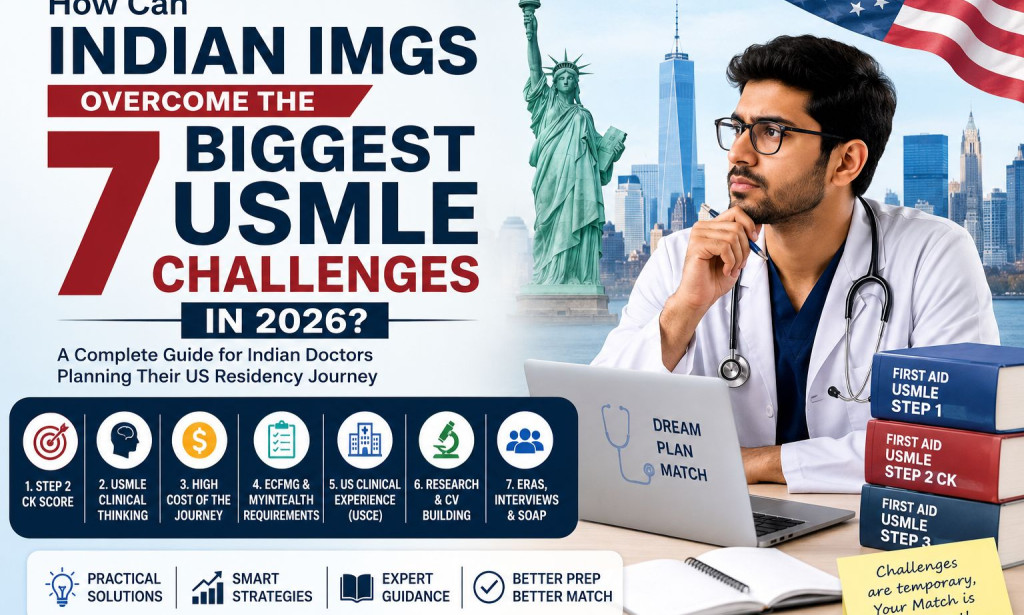
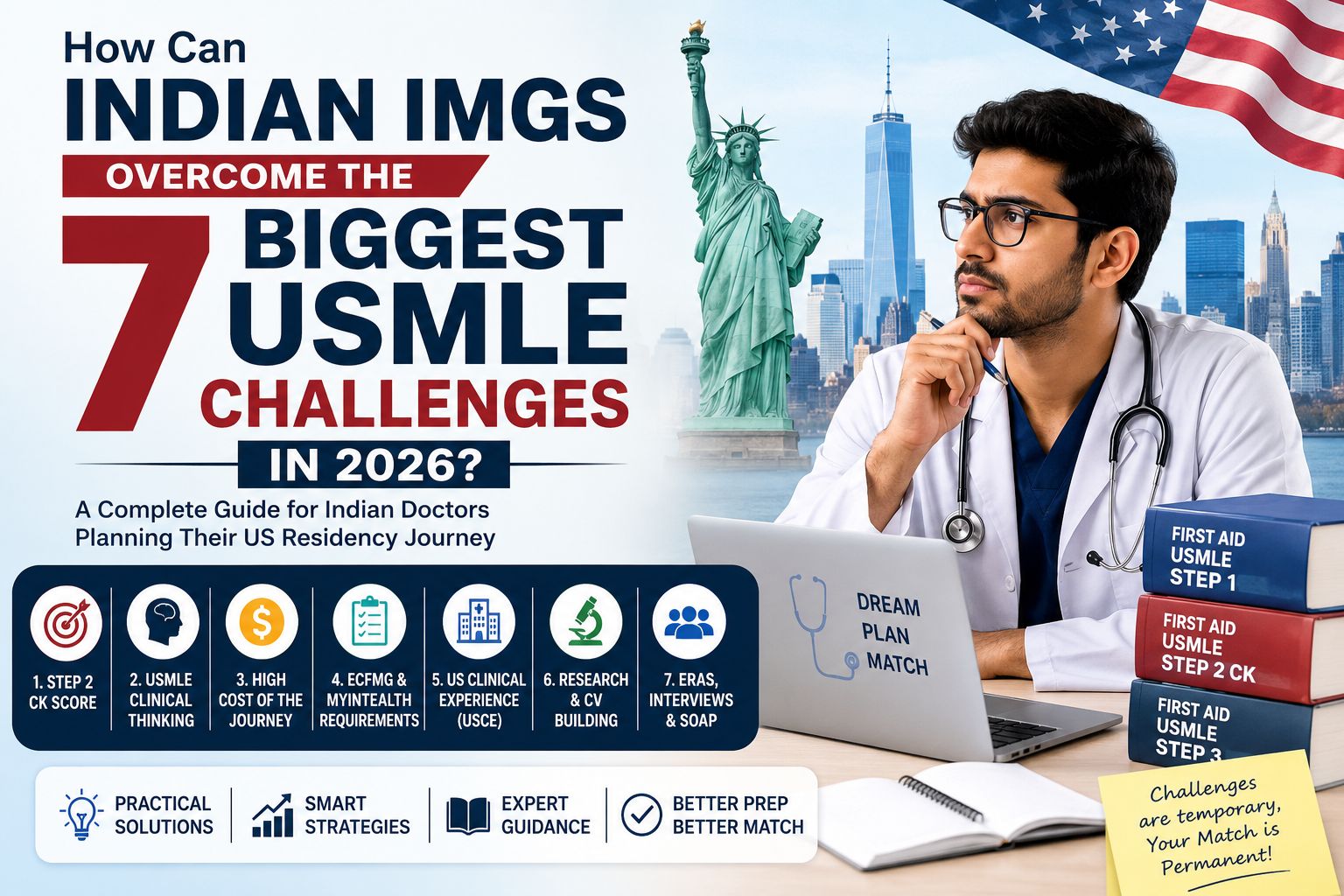
In January 2022, USMLE Step 1 changed to pass/fail, reshaping the journey for Indian doctors. Now, Step 2 CK scores carry greater importance. Match rates for non-US IMGs remain lower than US graduates, but early preparation and awareness can greatly improve residency opportunities.
Challenge 1 - Why Is Step 2 CK Now the Most Important Score for Indian IMGs?
Step 2 CK is now the key score residency programs use to screen IMG applicants. Simply passing is not enough. In 2024, matched non-US IMGs in Internal Medicine averaged 248. Scores under 240 may miss filters. Higher scores also improve clinical credibility and H-1B visa chances.
Recommended Step 2 CK Score Targets for Indian IMGs
|
Specialty |
Non-US IMG Matched Avg (2024) |
Safe Target for Indian IMGs |
|
Internal Medicine |
248 |
255+ |
|
Family Medicine |
241 |
250+ |
|
Pediatrics |
245 |
260+ |
|
Psychiatry |
242 |
260+ |
|
Neurology |
246 |
260+ |
|
General Surgery |
249 |
265+ |
How to overcome it: Target scores 10-15 points above your specialty’s matched average and attempt the exam only after achieving stable NBME practice scores.
Challenge 2 - How Can Indian MBBS Graduates Adjust to USMLE Clinical Thinking?
The USMLE mainly tests clinical judgment and decision-making, not just memorized facts. This differs greatly from most Indian medical education systems. Indian training often emphasizes recalling diagnoses and treatments, while Step 2 CK focuses on selecting the safest, most appropriate, and cost-effective next step for patient care.
For example, an Indian doctor may immediately choose a CT scan, while the USMLE may prefer observation, counseling, or a detailed physical examination first. The exam also includes subjects that are less emphasized in Indian medical colleges, such as HIPAA and patient privacy laws, preventive healthcare, ethics, communication, and the US insurance system.
Another common mistake is concentrating only on Internal Medicine while ignoring subjects like Pediatrics, Surgery, and OB-GYN, which can reduce overall Step 2 CK performance.
How to overcome it - the resource hierarchy
· UWorld Step 2 CK: Complete at least 1.5 full question bank rounds using tutor mode first, then timed random mode.
· NBME Self-Assessments: Use them regularly and schedule the exam only after consistent target scores.
· MOKSH Academy: Provides mentoring, analytics, adaptive learning, mock exams, study plans, and high-yield practice resources.
Challenge 3 - What Is the Total Cost of the USMLE to Residency Journey for Indian Students in 2026?
In 2026, the complete USMLE to residency pathway for Indian IMGs costs about $19,000 USD, nearly Rs. 16 lakh. This amount does not include Step 3, visa charges, or different USCE expenses. Additionally, India charges 18% GST on USMLE exams taken at Prometric centers, which further increases the total cost.
|
Expense |
Total (USD) |
Total (INR approx.) |
|
USMLE Step 1 (with GST + surcharge) |
$1,068 |
Rs.90,780 |
|
USMLE Step 2 CK (with GST + surcharge) |
$1,097 |
Rs.93,245 |
|
ECFMG + MyIntealth fees |
$690 |
Rs.58,650 |
|
OET Medicine |
$455 |
Rs.38,675 |
|
USCE - 3 months (variable) |
$6,000 |
Rs.5,10,000 |
|
ERAS (100 programs) + NRMP |
$2,800 |
Rs.2,38,000 |
|
Total Estimated |
$19,000 |
Rs.16,15,000 |
How to overcome it: Divide your expenses into phases instead of planning one large budget at once. USCE is often the highest variable expense. Using alumni networks from your medical college can help you find affordable or even free observerships through Indian doctors already working in the US.
Also read: USMLE Exam Fees
Challenge 4 - What Should Indian Applicants Know About MyIntealth and the Seven-Year Rule?
ECFMG now uses MyIntealth as the primary platform for all services, replacing older systems like IWA and OASIS. In 2026, Indian applicants must use it for exam registration, credential verification, and pathway applications.
The ECFMG certification process includes:
- Creating a MyIntealth account and paying the platform fee
- Submitting the ECFMG Certification Application
- Completing Form 186 notarization through NotaryCam
- Verifying MBBS degree and transcripts through the medical college
Indian students remain eligible because India received 10-year WFME Recognition Status in 2023.
Another important challenge is the Seven-Year Rule. Step 1, Step 2 CK, and pathway requirements must be completed within seven years after passing the first exam. Missing this deadline may require repeating exams.
For the 2027 Match, OET Medicine scores must reach ECFMG before January 31, 2027.
How to overcome it: Track your seven-year timeline carefully from your Step 1 result and complete OET Medicine during Step 2 CK preparation.
Challenge 5 - How Can Indian IMGs Gain U.S. Clinical Experience Without High Rotation Costs?
USCE helps Indian IMGs stand out after clearing the Step 2 CK score filter. It also provides US-based Letters of Recommendation from doctors who directly evaluate your clinical skills and work ethic.
Different Types of US Clinical Experience Carry Different Importance
|
Type |
Hands-on? |
LOR Value |
Cost |
|
Clerkship (pre-graduation) |
Yes |
Highest |
Low if via medical school |
|
Externship (post-graduation) |
Yes |
High |
Variable |
|
Observership |
No |
Moderate |
Low to free |
|
Tele-rotation |
No |
Lowest |
Low |
Hands-on rotations are more valuable because they show your ability to work within the US healthcare system. Observerships may carry less weight but are still helpful for gaining experience and recommendation letters.
How to Reduce USCE Costs:
- Use alumni connections from your medical college in the US
- Send a professional CV and personalized outreach emails
- Start networking during Step 2 CK preparation
How to overcome it: Try to secure at least one hands-on rotation. If that is not possible, observerships still add value. Early networking remains the most effective way to reduce USCE expenses.
Challenge 6 - Can Indian IMGs Build a Strong Research Profile Without a US Mentor or Lab?
Yes, systematic reviews are among the easiest ways for Indian IMGs to gain research experience. They do not require a lab, US institution, or travel because research data is available through PubMed, Scopus, and Google Scholar.
Research is becoming increasingly important for residency applications, especially at university-based programs. PubMed-indexed publications hold the highest value since program directors verify research using PMID numbers, while non-indexed work often receives limited attention.
Useful Publication Options Include:
- Cureus Journal
- Indian Journal of Medical Research
- Indian Journal of Surgery
How to overcome it: Begin a systematic review during internship and aim to publish at least one strong PubMed-indexed paper in your preferred specialty.
Challenge 7 - How Can Indian Doctors Manage ERAS, Virtual Interviews, and SOAP Across Time Zones?
The US-India time difference can be handled with careful planning. Since Match Week follows US Eastern Time, major updates often arrive late at night for Indian applicants.
|
SOAP Event |
US Eastern Time |
IST |
|
Match Status Notification |
Monday 10:00 AM |
Monday 7:30 PM |
|
SOAP Applications Open |
Monday 11:00 AM |
Monday 8:30 PM |
|
SOAP Round 1 Offers |
Thursday 9:00 AM |
Thursday 6:30 PM |
|
SOAP Round 4 Offers |
Thursday 6:00 PM |
Friday 3:30 AM |
ERAS Application Strategy for Indian Doctors:
Do not describe “Internship” in just one line. Clearly explain patient volume, procedures completed, and independent clinical responsibilities. Rural postings should be highlighted as leadership and public health experience.
Virtual Interview Checklist:
- Use wired internet instead of Wi-Fi
- Keep a mobile hotspot as backup
- Position the camera at eye level
- Maintain a simple and clean background
SOAP strategy: Use the short application window wisely. Focus on programs offering J-1 or H-1B visas and those already familiar with your profile during the main Match season.
Conclusion - Your Complete 7-Point Quick Guide
Every challenge explained above can be managed with the right strategy and preparation. The table below gives a quick overview of the complete process.
|
Challenge |
One-Line Fix |
|
Score pressure |
Target 10-15 points above the matched IMG average for your specialty |
|
Clinical reasoning gap |
UWorld 1.5 passes + AMBOSS ethics; gate the real exam behind NBME scores |
|
Financial burden |
Budget by phase; use alumni networks for free or low-cost USCE |
|
Admin complexity |
Map your Seven-Year Rule from Day 1; OET no later than December 2026 |
|
USCE access |
Start alumni outreach during Step 2 prep, not after you pass |
|
Research gap |
One systematic review in a PubMed-indexed journal, started during an internship |
|
Time zone + ERAS |
Use Monday night IST for SOAP research; frame Indian training as clinical autonomy |
These challenges are common for many Indian doctors. Success comes from understanding them early, planning ahead, and preparing properly before starting the residency journey.
FAQs
What Step 2 CK score do Indian IMGs need for Internal Medicine?
A score of 255+ is considered safe. In 2024, matched non-US IMGs averaged 248, so aiming higher improves your chances.
Is USCE mandatory for Indian IMGs applying for US residency?
No, but it strongly improves your profile. USCE and strong US-based LORs help applicants stand out.
How much does the full USMLE journey cost for Indian students in 2026?
The total cost is around Rs. 16 lakh ($19,000 USD), including exams, GST, ECFMG, OET, USCE, and ERAS fees.

You must be logged in to post a comment.