

The Light-Absorbing Butterfly Wing.
IN ORDER to reduce mankind’s dependence on fossil fuels, scientists are eager to improve the light-harvesting efficiency of solar collectors. “The solution to this problem,” said a scientist, “may have been . . . fluttering right in front of our eyes.”

Scales on the butterfly’s wing have honeycomblike holes
Consider: To keep themselves warm during cold weather, butterflies spread their wings in the sun. The wings of some species of swallowtail are remarkably efficient at trapping and absorbing sunlight. The insects’ secret lies not just in their dark pigment but also in the structure of microscopic, overlapping scales coating their wings. The scales, in turn, contain rows of honeycomblike holes separated by inverse V-shaped ridges that funnel light into the holes. This ingenious structure traps incoming sunlight, making the wings extremely black and warming the butterfly with amazing efficiency.
“Butterfly wings may rank among the most delicate structures in nature,” says Science Daily, “but they have given researchers powerful inspiration for new technology that doubles the production of hydrogen gas—a green fuel of the future—from water and sunlight.” Other promising applications include optical instruments and solar cells.
EUROPEAN observers have long admired colorful painted lady butterflies (Vanessa cardui) and have wondered what happened to them at the end of each summer. Do they simply perish with the onset of cold weather? Fresh research reveals an extraordinary story. The butterflies make an annual journey between northern Europe and Africa.
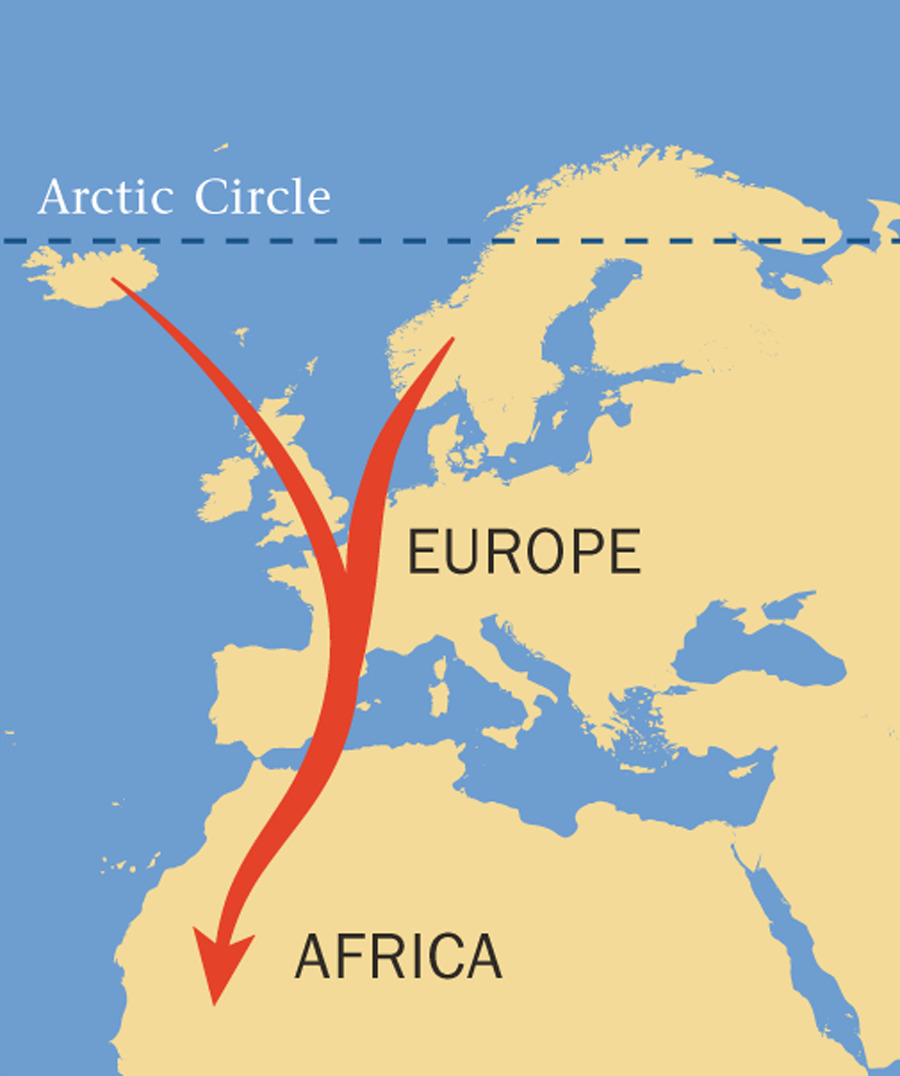
Researchers combined results from sophisticated radar with thousands of sightings reported by volunteers across Europe. The results revealed that as the summer ends, millions of painted lady butterflies migrate south, mostly flying at an altitude of more than 1,600 feet (500 m)—therefore hardly ever seen by humans. The butterflies wait for favorable winds, which they ride at an average speed of 28 miles per hour (45 km/h) on the long trip to Africa. Their annual migration is up to 9,300 miles (15,000 km) long, beginning from as far north as the fringes of the Arctic and terminating as far south as tropical West Africa. The trip is almost double that of the North American monarch butterfly. It takes six successive generations of painted ladies to complete the round-trip.
Professor Jane Hill of the University of York, in England, explains: “The Painted Lady just keeps going, breeding and moving.” Annually, those steps take the whole population from northern Europe to Africa and back again.
“This tiny creature weighing less than a gram [0.04 oz] with a brain the size of a pin head and no opportunity to learn from older, experienced individuals, undertakes an epic intercontinental migration,” states Richard Fox, surveys manager at Butterfly Conservation. This insect was “once thought to be blindly led, at the mercy of the wind, into an evolutionary dead end in the lethal British winter,” Fox adds. Yet this study “has shown Painted Ladies to be sophisticated travellers.”
To keep themselves warm during cold weather, butterflies spread their wings in the sun. The wings of some species of swallowtail are remarkably efficient at trapping and absorbing sunlight. The insects’ secret lies not just in their dark pigment but also in the structure of microscopic, overlapping scales coating their wings. The scales, in turn, contain rows of honeycomblike holes separated by inverse V-shaped ridges that funnel light into the holes. This ingenious structure traps incoming sunlight, making the wings extremely black and warming the butterfly with amazing efficiency.

NICE
You must be logged in to post a comment.